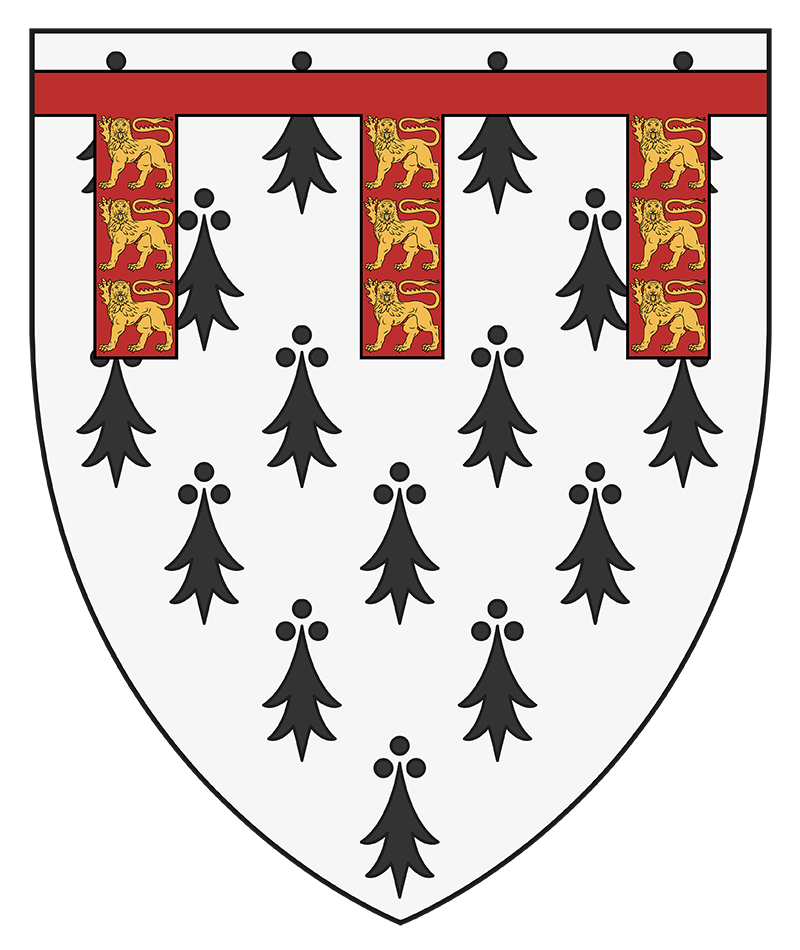
Arthur de Richemont - Duke of Brittany
Le Justicier (The Justiciar)
Arthur de Richemont was a Breton Nobleman and Constable of France who fought beside Joan of Arc and helped drive the English out of France during the Hundred Years' War.
Arthur was born on August 24th, 1393, at Château de Suscinio in Brittany. He was the younger son of John IV, Duke of Brittany, and Joan of Navarre, who later married King Henry IV of England and became Queen of England. That made Arthur the stepbrother of the future King Henry V.
Arthur fought for France at the Battle of Agincourt on October 25th, 1415, where he was wounded. The English found him still alive that evening under a pile of bodies and took him prisoner. He was held in England for about five years, first at Fotheringhay Castle and later at the Tower of London, until 1420. After his release, he persuaded his brother, John V, Duke of Brittany, to accept the Treaty of Troyes, and the English rewarded him with the title Duke of Touraine. He also inherited the English title Earl of Richmond, but the English crown never recognized it. In October 1423, he married Margaret of Burgundy, the widow of Louis, Duke of Guyenne, who was the Dauphin, and the sister of Philip the Good, Duke of Burgundy.
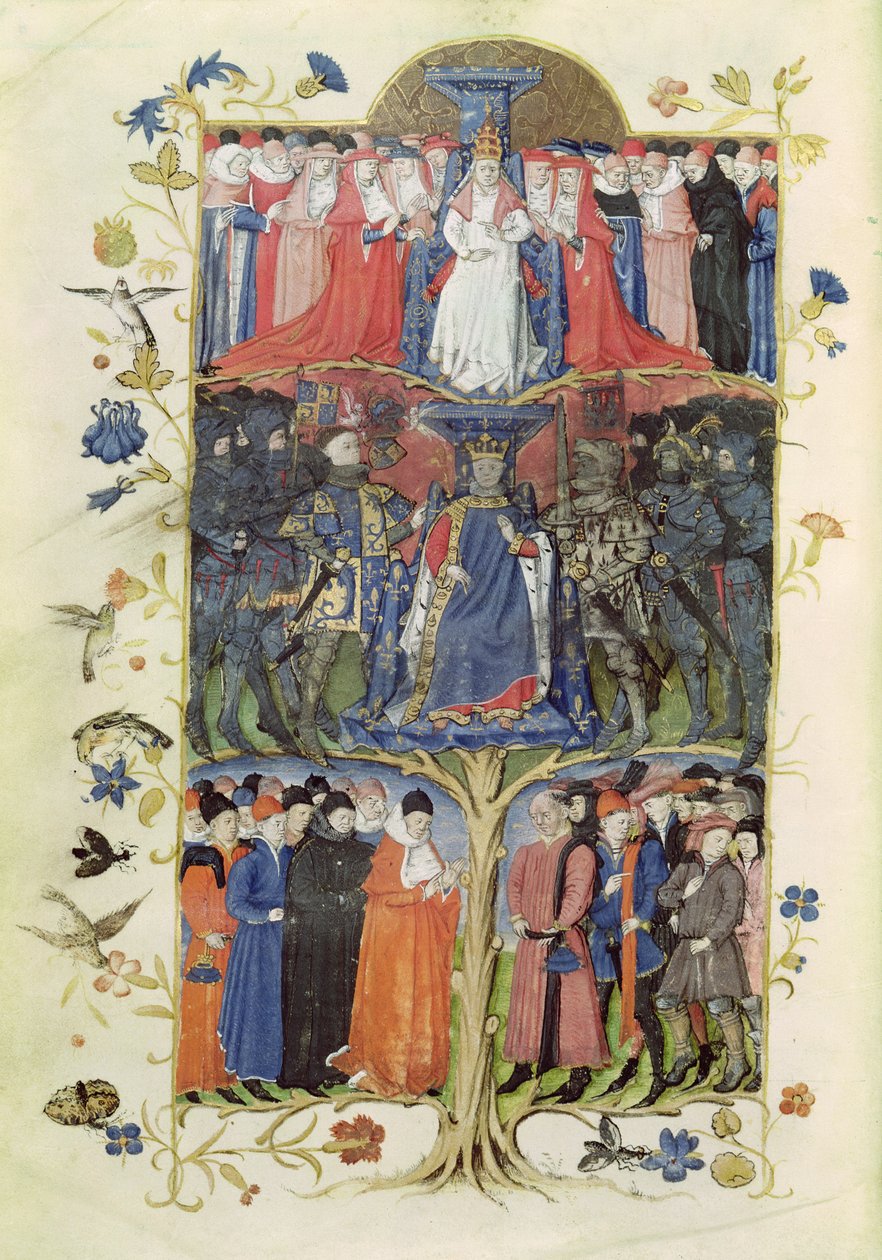
Charles VII with the Dauphin Louis and Arthur de Richemont, Constable of France, c. 1450.
L'arbre des batailles, Bibliothèque de l'Arsenal, Paris. Public domain, Wikimedia Commons, cropped.
In 1424, Arthur grew frustrated with the English, who refused to give him a high command, and he joined the Dauphin Charles, the future King Charles VII. With the support of Yolande of Aragon, Charles made him Constable of France in 1425, the commander of the royal army. That October, he also helped arrange the Treaty of Saumur, which brought Brittany to Charles's side. In 1427, Arthur, La Hire, and Jean de Dunois forced Richard Beauchamp, Earl of Warwick, to end his siege of Montargis.
Arthur's hard temper made him enemies at court. In 1427, Georges de La Trémoille, a favorite of Charles VII, drove him away from the royal court, and La Trémoille ruled French politics for six years. Arthur still fought for France. On June 18th, 1429, he fought beside Joan of Arc at the Battle of Patay, where the French destroyed an English army.
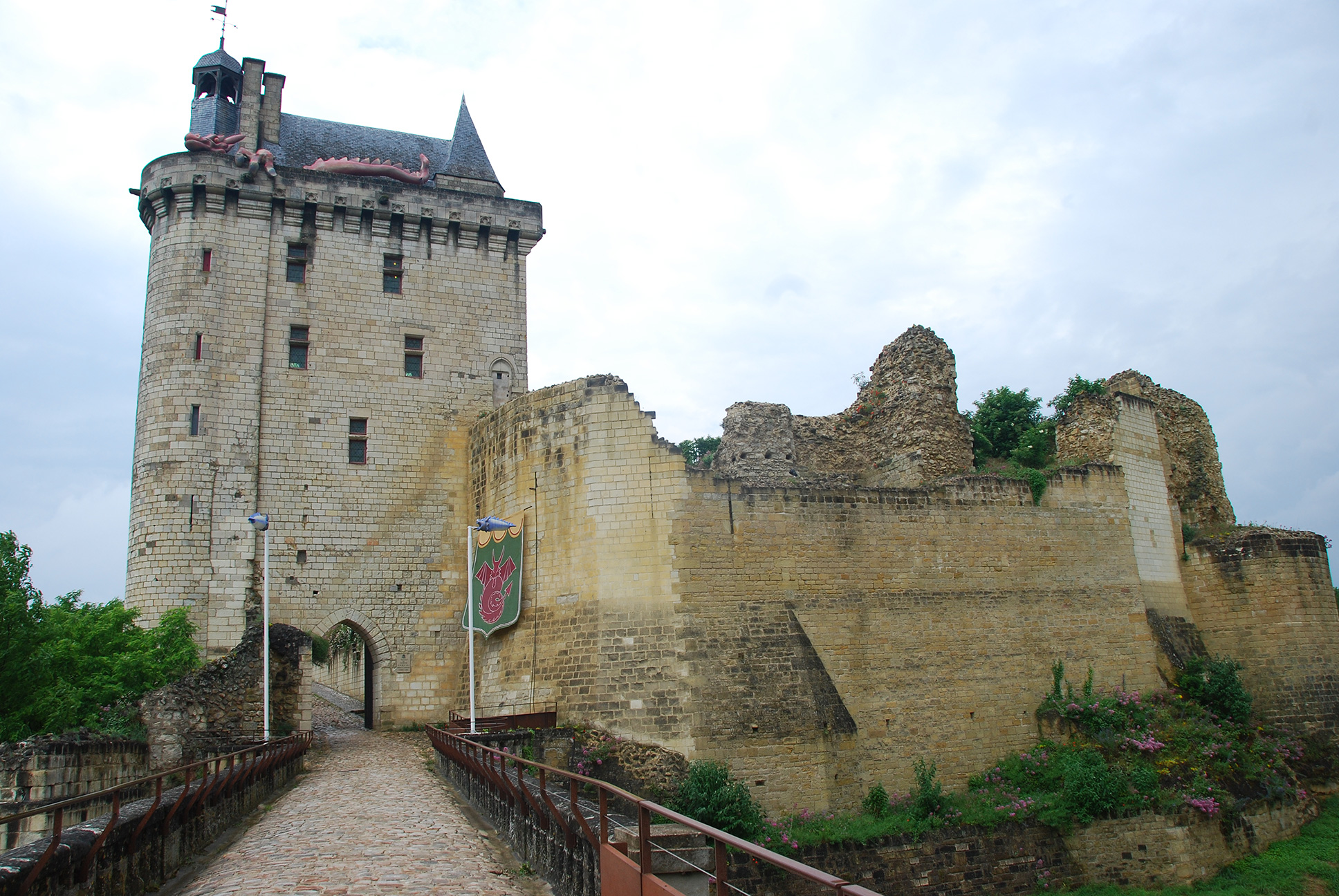
Arthur finally ended La Trémoille's power at Château de Chinon, the castle where Charles VII held his court. In June of 1433, Arthur's supporters seized La Trémoille, who was wounded and then released for a ransom after he agreed to leave the court. Charles VII then restored Arthur as Constable, and Arthur's influence at court rose again.
Arthur helped arrange the Treaty of Arras in 1435, which reconciled Charles VII with Philip the Good of Burgundy, and the French recaptured Paris the following year. Arthur's second marriage was to Jeanne d'Albret in August 1442. She died in 1444, and in 1445 he married Catherine of Luxembourg-Saint-Pol.
After the Treaty of Tours in 1444, Arthur reorganized the French army. He created the compagnies d'ordonnance, France's first permanent companies of professional soldiers, and organized a militia of archers known as the francs archers.
In 1449 and 1450, Arthur and his nephew, the Duke of Brittany, reconquered much of the Cotentin peninsula of Normandy. On April 15th, 1450, Arthur commanded the French forces at the Battle of Formigny, which sealed the reconquest of Normandy, and he then took part in the successful siege of Caen.
When his nephew, Peter II, died on September 22nd, 1457, Arthur became Duke of Brittany, though he kept his office of Constable. He died at Nantes on December 26th, 1458, after fifteen months as duke, and was buried in Nantes Cathedral. He had no legitimate children, so his nephew, Francis II, succeeded him.