Battle of Damme (1213)
Background
On May 30th, 1213, an English fleet led by William Longespée, the Earl of Salisbury, attacked a large French fleet at anchor at Damme, the port of Bruges in Flanders, and captured or destroyed hundreds of ships. It is often called the first great naval victory in English history, and it ended the threat of a French invasion of England that year.
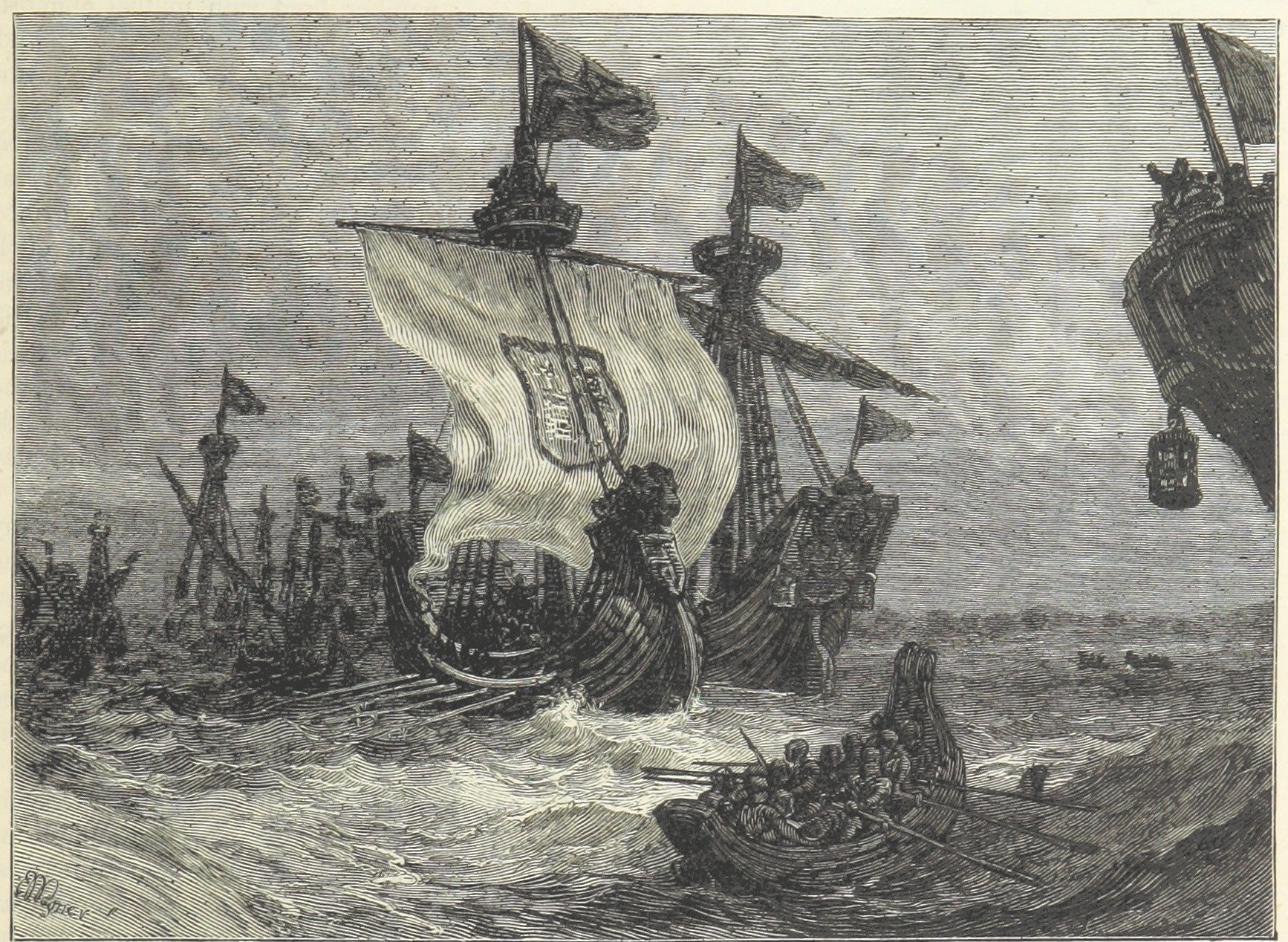
The advance of the English fleet upon Damme, an engraving by James Grant, 1873, from the British Library's Mechanical Curator collection. Wikimedia Commons, public domain, cropped.
King John had been at odds with the Church since 1208, when Pope Innocent III placed England under an interdict, and he was excommunicated in 1209. King Philip II of France saw his chance. He denounced John as an enemy of the Church and planned to invade England, and he gathered an army and a fleet for the crossing. One of Philip's vassals, Ferdinand, Count of Flanders, refused to take part, and John allied himself with him.
Then John changed course. In May 1213, he agreed to hold England and Ireland as fiefs of the pope, and the papal legate, Pandulf, told Philip that attacking England would now be a mortal sin. Philip turned his army against Ferdinand instead and began to besiege Ghent, while his fleet, loaded with supplies, pay chests and the goods of his barons, sailed from Boulogne to Gravelines and on to Damme. John held that a naval offensive was "the best and surest defense against a threat of invasion," so he sent his half-brother, William Longespée, to deal with it.
Battle
Longespée's fleet was sent out on May 28th and sailed into the Zwyn estuary on the 30th. The Zwyn was then a wide channel leading to Bruges, but it has since silted up. The French fleet was commanded by Savari de Mauléon, a noble who had once served John but was now on Philip's side. The English found the French ships crowded in the estuary, with many of the crews ashore plundering the countryside, and some accounts say the meeting was a chance one. At first they took the ships for their Flemish allies, but they soon saw that they were French and attacked.
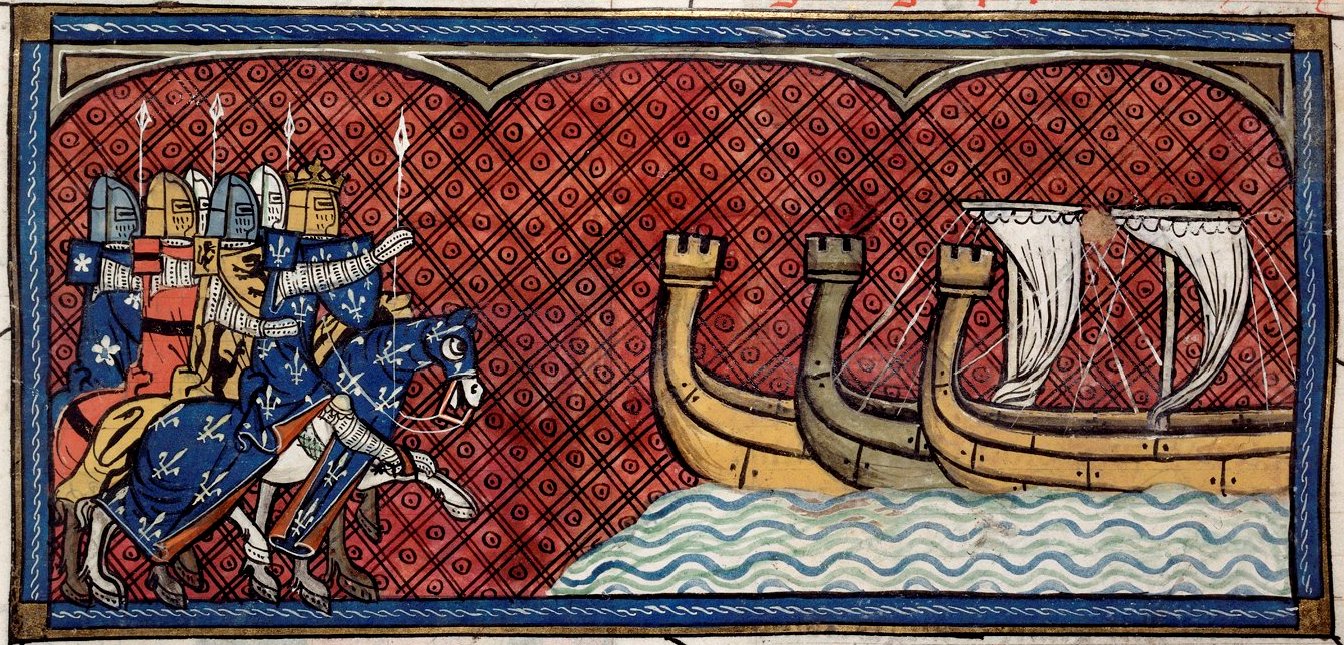
Philip Augustus awaiting his fleet. Miniature by the Master of the Cambrai Missal, Chroniques de France ou de St Denis, British Library, Royal MS 16 G VI, fol. 373. Wikimedia Commons, public domain.
The English captured about 300 of the ships riding at anchor and killed their crews. They looted and burned about a hundred more that had been drawn up on the beach. On May 31st, they attacked the rest of the French ships and tried to storm the town of Damme, but they were driven back. English and French chroniclers agree that the French lost about 400 ships in all.
The size of the fleets is disputed. William the Breton, a chaplain at Philip's court, claimed that the French had 1,700 ships, but a modern historian, F. W. Brooks, called that figure hopelessly exaggerated and estimated that there were fewer than 500, including transports. A 19th-century writer put the English fleet at about 500 ships, but Brooks believes it was much smaller than the French fleet. The English carried about 700 men-at-arms, both English and Flemish, along with mercenaries.
Aftermath
When Philip heard the news, he broke off the siege of Ghent and marched to Damme, arriving on June 2nd to relieve the garrison. He suspected that the crews, who came from lands that England had recently lost, might change sides, and he did not want the surviving ships to fall into English hands. He ordered them burned, and Damme itself was burned. He also took revenge on Flanders and extracted 30,000 marks in ransom from the captured Flemish cities.
The English sailed home with the captured ships and a huge amount of booty. A contemporary writer claimed that never had so much treasure come into England since the days of King Arthur. The victory removed the immediate danger of invasion, but it did little to weaken Philip's army, which was still strong.
John landed in France in February 1214 and, together with Ferdinand of Flanders and his ally the German emperor Otto IV, planned a two-pronged attack on Philip. The plan failed, because John was defeated at Roche-au-Moine on July 2nd, and Philip defeated Otto and Ferdinand at Bouvines on July 27th. That ended John's hopes of recovering his lands in France, and it helped lead to the rebellion of his barons and Magna Carta.