Hermitage Castle
History
Hermitage Castle stands in the wild and lonely valley of Liddesdale, in the Scottish Borders, near the English border. For about 400 years, it helped to control the Scottish Middle March, and its history is one of murder, torture, and treason. Sir Walter Scott called it a place so burdened with iniquity that it was said to have partly sunk into the ground.

The de Soulis family, also spelled de Soules, may have moved their seat to Hermitage as early as 1240, and the earliest records mention a residence here, possibly to the west near the ruins of a chapel. In 1300, Edward I wrote of two castles in Liddesdale, "Lydel" and "Eremitage-Soules," both belonging to the de Soulis family. The Soulis family held Hermitage until 1320, when William de Soulis was forfeited for plotting against King Robert the Bruce. Legend turned his fall into a far darker story, in which the wicked Lord Soulis, a practitioner of the black arts, was boiled in lead by his own tenants, though William actually seems to have died a prisoner at Dumbarton Castle. His younger brother was John de Soules. The tale is told on the ghost page.

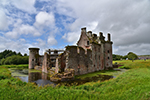
The walls of Hermitage Castle seen from the earthwork.
The castle then passed through the hands of English and Scottish lords as the border wars rolled back and forth. Around 1360, the English lord Sir Hugh de Dacre began the present castle. Sir William Douglas, the Knight of Liddesdale, held Hermitage by 1338, and in 1342 he seized Sir Alexander Ramsay and left him to starve to death in the castle dungeon, a crime remembered in its ghost stories. In 1353, the Knight of Liddesdale was himself murdered by his godson. In the later 14th century, William, 1st Earl of Douglas, transformed Hermitage almost beyond recognition into the grim fortress seen today.
The Black Douglases held Hermitage until 1455, and it then passed to the Red Douglas Earls of Angus. In 1492, the Earl of Angus exchanged it with Patrick Hepburn, 1st Earl of Bothwell, for Bothwell Castle. The Hepburns became Keepers of Liddesdale, officials charged with controlling the Border reivers, the raiding families who lived by theft and feud on both sides of the border. In the 16th century, gun holes were punched through the castle's thick walls, and a large gun defense was built outside the western approach to meet the threat of gunpowder artillery.

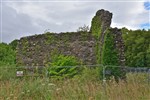
The well inside the castle.
The best-known visit to Hermitage came in October 1566. James Hepburn, 4th Earl of Bothwell, was wounded in a clash with the reiver "Little Jock" Elliot, and Mary, Queen of Scots, rode about 25 miles from Jedburgh to see him. On the way back, her horse threw her into a bog, and she later fell ill with a fever that lasted about ten days. Bothwell became her third husband the following year, after the murder of Lord Darnley.
After Bothwell's forfeiture, the Crown granted the castle in 1594 to Sir Walter Scott of Buccleuch, and the Scotts of Buccleuch owned it for centuries. It lost its strategic importance in 1603, when James VI of Scotland also became James I of England, and its noble owners abandoned it. It decayed into a ruin, and in the 19th century, the Duke of Buccleuch and Queensberry had it preserved, inspired partly by Sir Walter Scott's writings, with repairs made in 1820. The castle passed to the nation in 1930, and Historic Environment Scotland now cares for it.
Castle Highlights
Hermitage Castle is a large, grim, and remarkably complete ruin, set on an earthen platform that may belong to an earlier complex. It has a 13th-century courtyard, a 14th-century four-story tower, and a 15th-century wing, and its thick walls and corner towers give it the look of a fortress built to be defended to the last. The ruins include a Central Tower, the Douglas Tower, a Well Tower, and a Prison Tower, and the site of the old entrance can still be traced.

The lonely moorland of Liddesdale around the castle.
The castle stands in bare, windswept country about 5 miles north of Newcastleton, on the B6399. It is open from April to September, and last entry is 30 minutes before closing. Parking is limited, and the castle is about 200 meters from the car park along a mainly grass path with several steep sections. Inside, the courtyard is cobbled and the rest of the ground floor is gravel, and the walkways and stairs are steep and narrow, with a spiral staircase of 18 steps. Dogs are welcome in outdoor areas, and there is a picnic area.
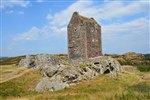
Smailholm Tower makes a good pairing on the same day, and Lochmaben and Caerlaverock castles lie to the west if you have more time.