Llywelyn ab Iorwerth - Prince of Gwynedd
Llywelyn the Great
Llywelyn ab Iorwerth, known as Llywelyn the Great, was the most powerful Welsh ruler of the Middle Ages. Starting as a young claimant in a family quarrel over Gwynedd, he became its master, did homage to King John, nearly lost everything to him, and became the overlord of most of the other Welsh princes. He also married John's daughter, built some of the finest native Welsh castles, and by his death in 1240, he had made Wales a power that the English crown had to negotiate with.

Llywelyn was born in 1173, possibly at Dolwyddelan in the Lledr valley, although not in the stone tower seen above, which came later. His father was Iorwerth Drwyndwn, who died while Llywelyn was an infant, and his mother was Marared (Margaret), a daughter of Madog ap Maredudd of Powys. Gwynedd was then ruled by his uncles, Dafydd and Rhodri ab Owain, and by 1188 Llywelyn was already fighting them. In 1194, Llywelyn joined his uncle Rhodri and his cousins Gruffudd and Maredudd ap Cynan against Dafydd, and they defeated him. Rhodri died the next year, and in 1197 Llywelyn captured Dafydd, who was released in 1198 and went into exile in England. In 1199, he took Mold Castle from the Earl of Chester's men, the first Welsh capture of Mold since his grandfather Owain Gwynedd, and the Welsh were jubilant. By about 1200, he was the main power in Gwynedd.
Llywelyn then dealt with the English king. In 1201, he made a peace with King John's representatives in which he agreed to do homage to John for his lands in Gwynedd. Around 1205, he tied himself closer to the crown by marrying John's illegitimate daughter Joan, who became known as the Lady of Wales. In 1208, John imprisoned Gwenwynwyn of Powys after summoning him to Shrewsbury, and Llywelyn took the chance to attack Powys and then Ceredigion, seizing Gwenwynwyn's lands.
The peace did not last. In 1210, Llywelyn destroyed the hilltop fortress of Deganwy because he feared the king, and in 1211 John invaded Gwynedd. Llywelyn and the people of Gwynedd withdrew into the mountains of Snowdonia, and the Welsh cut off John's supplies, so that famine forced his army back to Chester. John returned on August 1st, built castles as he advanced, imprisoned Bishop Robert of Bangor, and burned the town. With the support of his councillors, Llywelyn sent Joan to make peace with her father, and on August 12th, 1211, he gave up the Perfeddwlad, the lands east of the Conwy, with the castles of Deganwy, Denbigh, and Ruthin. He also handed over hostages, including his illegitimate son and heir Gruffudd, and had to agree that if he had no heir by Joan, his lands would pass to the king.
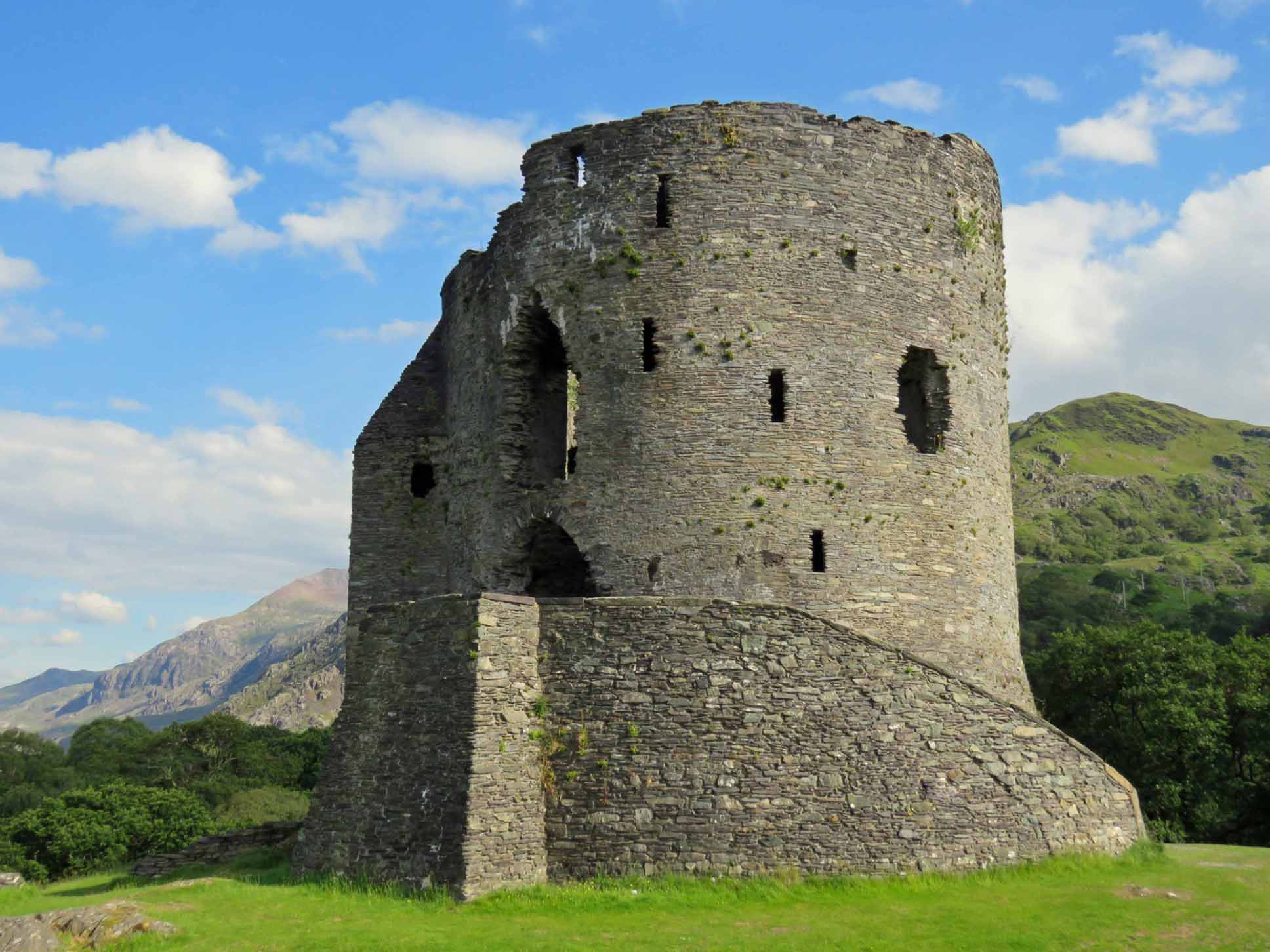
The round tower at Dolbadarn Castle, guarding the pass above Llyn Padarn.
Llywelyn's recovery was fast. Many Welsh princes now turned against John, and Pope Innocent III released them from their oaths to him. In 1212, the Welsh rose up, and Llywelyn won back all his castles except Deganwy and Rhuddlan, which the Welsh recaptured soon afterward. He also wrote to Philip II of France and received a gold-sealed letter confirming a treaty between France and Gwynedd. In 1215, as the English barons rose against John, Llywelyn supported them and took Shrewsbury without a fight, and his allies took Abergavenny, Pencelli, Skenfrith, and White Castle. When John sealed Magna Carta, it included a provision to return lands, liberties, and hostages to the Welsh, including Llywelyn's son Gruffudd. In 1216, Llywelyn held a council at Aberdyfi, where the Welsh princes reallocated the lands of Dinefwr, and John died later that year.
The new king was the nine-year-old Henry III, and in 1217 Llywelyn went to war against his own son-in-law Reginald de Braose, who had made peace with the new regime. In March 1218, in the Treaty of Worcester, Llywelyn became guardian of Carmarthen and Cardigan castles under the papal legate, and he also received the lands of his old rival Gwenwynwyn until Gwenwynwyn's heirs came of age. He had used marriages to bind the Marcher families to him. His daughter Gwladus Ddu married Reginald de Braose in 1215, another daughter, Marared, married Reginald's nephew John de Braose in 1219, and around 1222, his daughter Elen married John the Scot, the nephew and heir of Ranulf, Earl of Chester. Llywelyn also built stone castles to hold his gains, including Dolwyddelan, Dolbadarn, Criccieth, Deganwy, and Castell y Bere, and he was a generous patron of Aberconwy Abbey, where he later took monastic vows.

Criccieth Castle, on its headland above Cardigan Bay.
Not every Marcher family stayed friendly. In 1220, Llywelyn and his allies attacked the Flemings of Rhos, burning Narberth and Wiston castles and Haverfordwest, before he agreed to a truce on May 1st. In April 1223, William Marshal, Earl of Pembroke, returned from Ireland with an army, and he retook Cardigan and Carmarthen. In October of that year, Llywelyn made peace with the king, having captured Kinnerley Castle in Shropshire, and he promised to pay compensation for the damage. In 1228, Henry III gave the lordship of Montgomery to Hubert de Burgh, who began a new castle at Ceri, threatening Llywelyn's hold on Arwystli. The war was a failure for the English, and the unfinished castle, which the Welsh called Hubert's Folly, was razed.
Llywelyn's most notorious act came in 1230. In the war of 1228, Llywelyn had captured William de Braose the younger and held him for ransom, and the price was money, the castle of Builth, and a promise that William's daughter Isabella would marry Llywelyn's son Dafydd. At Easter, on April 7th, 1230, Llywelyn found Joan in his bedchamber with William, who was then a guest at his court. Both were imprisoned, and on May 2nd, William was hanged from a tree at the manor of Crogen in front of more than 800 people, and Joan was kept under house arrest for a year. It did not hurt Llywelyn's grip on power, and from 1230, he called himself "Prince of Aberffraw and Lord of Snowdon." He never claimed the title Prince of Wales, though his authority reached across most of the country.
In 1231, relations with Henry III broke down again over his rebuilding of Painscastle, and Henry had Llywelyn excommunicated on July 13th. That summer, the Welsh burned the castles of Montgomery, Radnor, Hay, Brecon, Caerleon, Neath, and Kidwelly and recaptured Cardigan, while Henry managed only to refortify Painscastle in stone. In 1233, Llywelyn allied with Richard Marshal, Earl of Pembroke, who had rebelled against Henry, and the Welsh captured several castles, including Cardiff and Abergavenny. After Richard's death in Ireland, Llywelyn agreed to a truce known as the Peace of the Middle on June 21st, 1234, in which each side kept what it held.

The painted statue of Llywelyn on a fountain in Lancaster Square, Conwy, unveiled in 1898. Photo by Rhion Pritchard, public domain.
Joan died in February 1237 and was buried at Llanfaes on Anglesey, where Llywelyn founded a Franciscan friary for her. A stone coffin traditionally identified as hers was later moved to St Mary and St Nicholas's Church in Beaumaris, where an early 19th-century slate panel above it records the link. That year he suffered a paralytic stroke. His son Dafydd took over more of the government, and on October 19th, 1238, at Strata Florida Abbey, the Welsh princes swore loyalty to him, although Henry III protested. Two years after that, Llywelyn took the Cistercian habit at Aberconwy Abbey, and he died there on April 11th, 1240, and was buried in the abbey. Edward I later moved the abbey to Maenan to make room for Conwy Castle, and Llywelyn's stone coffin is now in St Grwst's Church in Llanrwst.
Dafydd succeeded him, but Henry III limited his power. Dafydd died in 1246, and Llywelyn's illegitimate son Gruffudd had died in 1244, falling to his death while trying to escape from the Tower of London. The inheritance passed to Gruffudd's son, Llywelyn ap Gruffudd, known as Llywelyn the Last, who rebuilt his grandfather's power until Edward I destroyed it.
