Siege of Berkhamsted Castle (1216)
Background
In December of 1216, Prince Louis of France besieged Berkhamsted Castle during the First Barons' War. Waleran Teutonicus held the castle for the young King Henry III.
King John died on October 18th, 1216, and his nine-year-old son, Henry III, became king. William Marshal soon led the regency council that governed for the boy king. After Louis failed to take Dover Castle in the Siege of Dover, he turned to the castles north of London and took Hertford Castle after a siege of about three and a half weeks.
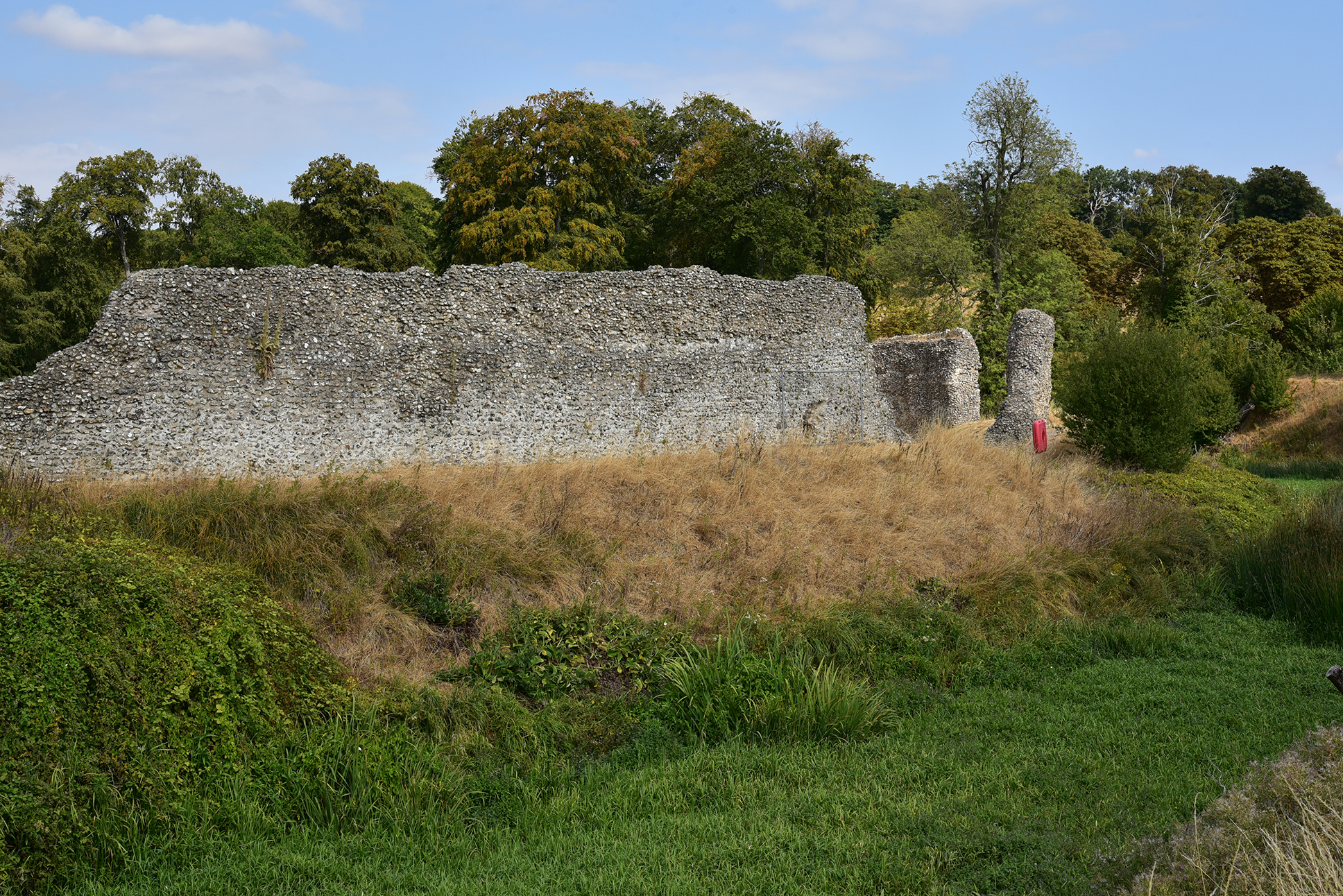
Berkhamsted Castle in Hertfordshire began as a Norman motte-and-bailey castle, with a tall earth mound and a moat dug around it. The castle stood on the road between London and the Midlands, which made it important to anyone who wanted to control the country north of the capital. By 1216, a flint curtain wall ran around the bailey and a shell keep stood on top of the motte.
The castle's defenses were unusually strong. A moat ran around the curtain wall, and outside it rose a high earth bank that surrounded the moat. Beyond the bank lay a second moat, which gave the castle a rare double moat. On the north and east sides, more earth mounds stood behind the bank. They are thought to be defensive works that King John's men added in 1215 and 1216, not platforms for the attackers. Wells in the bailey and on the motte gave the garrison fresh water.
Waleran Teutonicus, a German mercenary soldier, served King John and was the constable of the castle. His name means Waleran the German, and he was one of the foreign soldiers whom John relied on and whom the English barons resented.
Battle
Louis arrived at Berkhamsted on December 6th, 1216, the feast of Saint Nicholas, leading French and rebel English forces. On the first day, while the attackers were still pitching their tents and organizing their camp, the garrison made a bold sortie. They seized baggage and transport wagons and captured the standard of William de Mandeville, 3rd Earl of Essex, a rebel baron, and carried it back into the castle. Later that day, while the barons were sitting at table, they tried a second sortie and carried the captured standard in front of them to confuse the enemy, but the barons were ready and drove them back.
The next day, Louis had his petrariae, or stone-throwing engines, and other siege machines set up. According to the chronicler Roger of Wendover, Louis surrounded the castle with his engines of war to batter it. Some historians believe this may have been the first time a counterweight trebuchet was used in England.
Waleran and his garrison fought back, and Wendover called him "a German, well tried in warfare" who made a brave defense. For about two weeks, Louis's engines threw stones at the walls and the defenders.
On December 20th, 1216, Waleran surrendered the castle. The order to surrender came in the name of Henry III, but at nine years old, he acted through his guardian, William Marshal, who most likely made the decision for him. Louis allowed the garrison to leave with their weapons and armor.
Aftermath
Louis now controlled Hertford, Berkhamsted, and much of the country around London, but he never took the whole kingdom. The surrender may have been part of a truce arranged by William Marshal over Christmas. In 1217, the royalists defeated the rebels and the French at Lincoln and at sea off Sandwich, and Louis agreed to leave England in the Treaty of Lambeth, signed on September 11th, 1217.
The castle's ruined state today did not come from the siege. In 1580, Sir Edward Carey took much of the castle's stone for his own use.
Berkhamsted returned to royal control after the war. In 1225, Henry III gave the castle to his brother, Richard, Earl of Cornwall, who made it the administrative center of the earldom of Cornwall. This began a long association between Berkhamsted Castle and the Earldom of Cornwall, and later the Duchy of Cornwall.
Waleran went on to a long career in the service of Henry III. He guarded Christchurch Castle and the Isle of Wight in 1224, briefly served as constable of Windsor Castle in 1231, and from 1234 to 1254 held the Three Castles of White Castle, Skenfrith Castle, and Grosmont Castle, which guarded the Welsh Marches. He died by June of 1257.
 Waleran Teutonicus