Weeting Castle
History
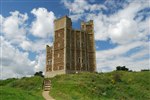
Weeting Castle was built in approximately 1180 by Hugh de Plais, a tenant of Hamelin de Warenne, Earl of Surrey. The earl lived at nearby Castle Acre, where he was redeveloping his own great house, and Hugh probably took his inspiration from it.

Despite its name, Weeting was never fortified. Castle Acre was a true castle, but Weeting is a rare surviving example of a grand 12th-century manor house, an East Anglian great house that borrowed some of the look of a castle to show the status of its owners.

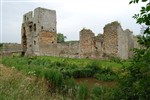
Flint rubble walls, where much of the smooth outer stone has been stripped away.
The house stood in three parts. In the middle was the great hall, open to its timber roof, with benches along the sides and a dais at the far end for the high table. At one end stood a three-storey chamber block, with a vaulted storeroom on the ground floor and the family's private chambers above, warmed by a fireplace built into the wall. A latrine block attached to it drained into a room on the ground floor, which was cleaned out through a small door near the moat. At the other end of the hall was the service block, with a pantry and buttery, and a passage leading out to a courtyard. The kitchen stood on its own beyond the courtyard, away from the main house to reduce the risk of fire, and a boundary wall screened the courtyard so that guests crossing the moat did not see the kitchens at work.
In the middle of the 13th century, a wide rectangular moat, up to about 10 meters across, was dug around the house, creating an island roughly 85 meters by 60 meters, with a bridge on the west side. It was decorative, not defensive, a display of the family's wealth and power, and it framed the house as a showpiece. The Plais family were also later connected by marriage to the Montfichet family of Mountfitchet Castle.

A surviving wall with a large recess, rising above the open ground inside the ruins.
The de Plais family lived at Weeting until the late 14th century. When the male line died out, the property passed by marriage, through Margaret Plais, to the Howard family, who rose to become Dukes of Norfolk. The Howards had other major residences, and they abandoned the house, which fell into ruin. From about 1770 the remains were incorporated as an ornamental landscape feature in the grounds of the nearby Weeting Hall, rebuilt by Charles Henry Coote, Earl of Mountrath. An 18th-century ice house, still visible, was built on the island to store ice harvested from the frozen moat in winter.
In 1926 the government acquired the surrounding estate, including the castle, when the Ministry of Labour bought Weeting Hall for use as a residential work camp, and the trainees helped clear the undergrowth from the ruins. The Hall was demolished in 1954, and archaeologists dug at the castle between 1964 and 1966 and consolidated the stonework. Today it is cared for by English Heritage.
Castle Highlights
Today only stone ruins and a dry moat remain, but ample flint stonework survives to show the shape of the original arched doorways and windows. English Heritage conserved the ruins in 2023-24 so that visitors can enter them safely, using new flint and cut-stone supports that, where possible, show the original form of the arches and piers.

The ruins glimpsed through yew trees across the grass.
The castle has a coarse appearance, probably because the smooth ashlar dressing stone was stripped from the outer walls, most likely to be reused in other buildings in the village. The moat fills with water in winter and dries out in summer.
Entry is free, and the castle can be visited at any reasonable time during daylight hours. There is a small lay-by beside the entrance, in front of the village church of St Mary's. Four steps lead up to the path, and two kissing gates lead to the ruins. There are no facilities, but Weeting village has shops and places to eat nearby, and dogs on leads are welcome.
Finding the castle can be a challenge because of the poor signage on the B1106, but it stands in a field beside the church of St Mary's in Weeting. It is a quiet place to relax, and a short visit is worthwhile if you are touring other sites in Norfolk. Castle Acre Castle and Castle Rising Castle are close by, so it is possible to visit all three in one day.
Weeting Castle is also haunted.