Arundel Castle
History
Roger de Montgomery, a close ally of William the Conqueror, founded Arundel Castle on Christmas Day of 1067. Since then, the castle has served as the seat of the Earls of Arundel and the Dukes of Norfolk, and their ancestors, for over 900 years.
Shortly after the Norman Conquest of England and the Battle of Hastings in 1066, William granted land in Sussex to Roger de Montgomery. By around 1071, Roger became the first Earl of Arundel.
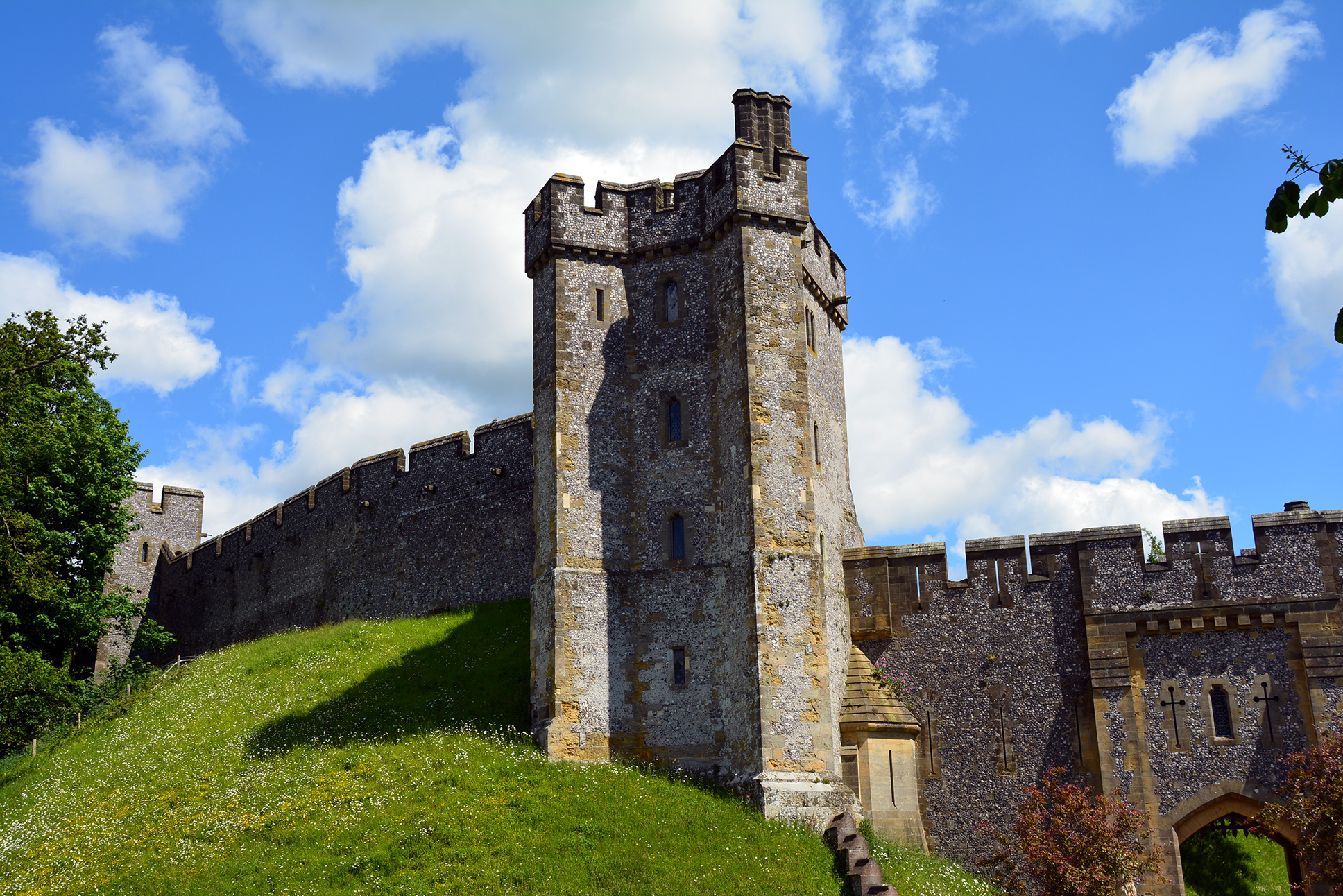
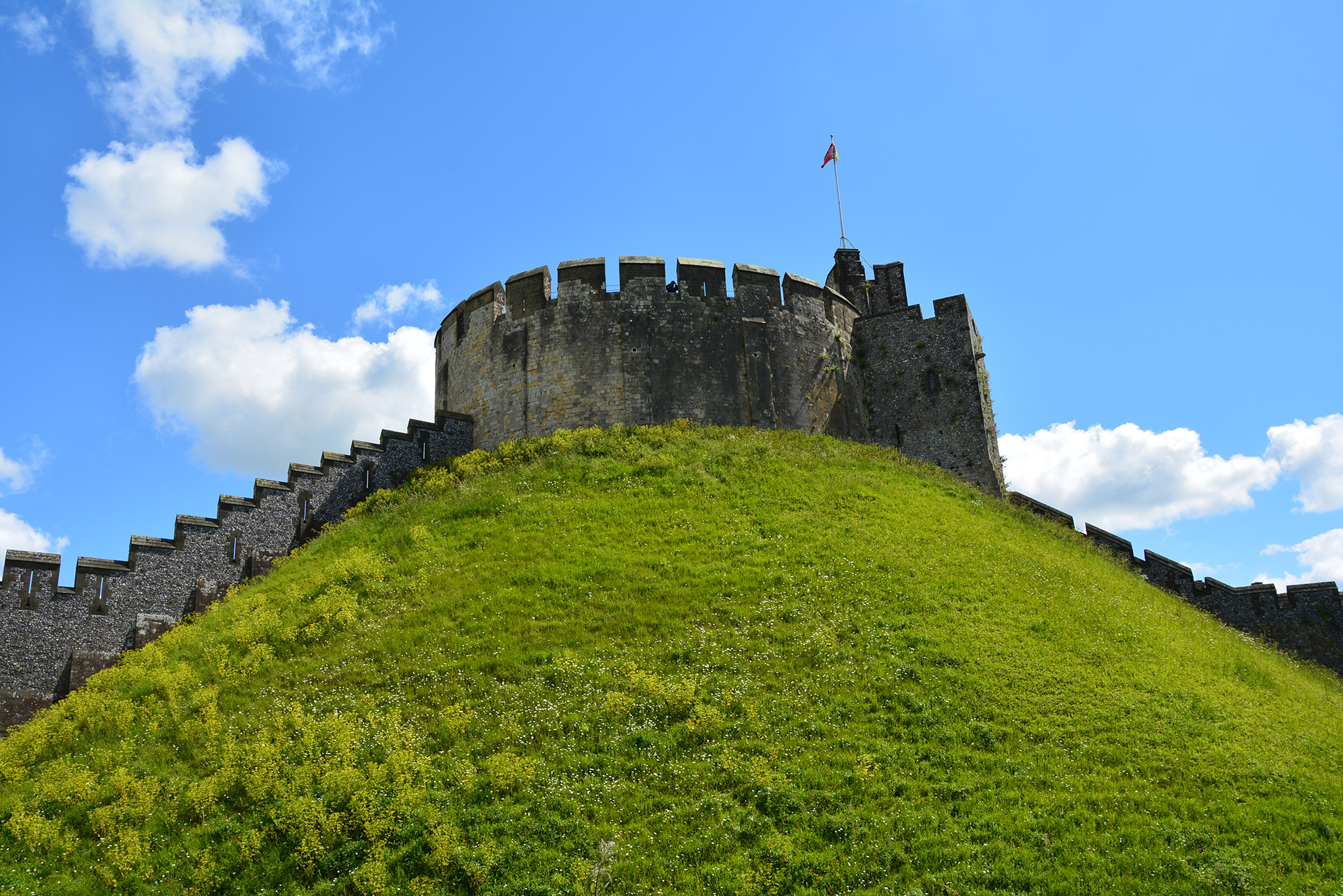
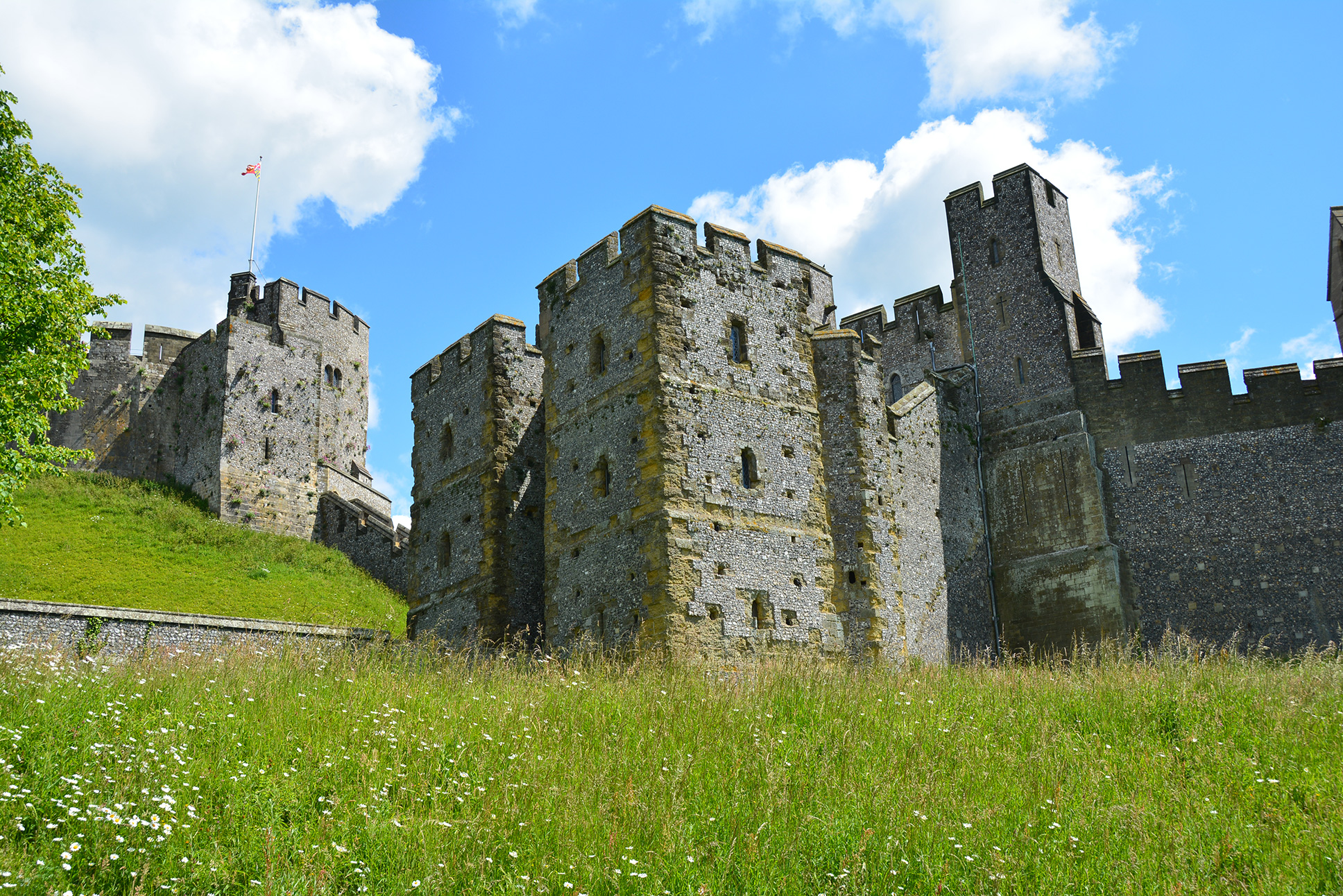
Roger began building a motte-and-bailey castle, initially in wood. The motte, standing over 100 feet high, was built quickly for coastal defense, overlooking the River Arun. In addition, the stone gatehouse dates from around 1070 and is one of England's earliest stone castle defenses. Unusually, Arundel Castle has two baileys, like Windsor Castle.
After Roger de Montgomery died, his eldest son, Robert de Bellême, inherited his Norman Estates, while his second son, Hugh of Montgomery, received his English Estates, including Arundel Castle. When Hugh died in 1098, those English Estates and Arundel Castle then passed to Robert, uniting both inheritances under him.
In 1102, Robert de Bellême held the castle. Later that year, during a rebellion, King Henry I besieged and captured it, turning it into a royal stronghold. Robert likely began construction of the stone circular Keep, which Henry I completed.
When Henry I died in 1135, Arundel Castle passed to his widow, Adeliza of Louvain, Queen of England. After she remarried, her new husband, William d'Aubigny, hosted Adeliza's stepdaughter, Empress Matilda, at the castle in 1139, during the early stages of the Anarchy. In response to Matilda's presence, King Stephen besieged the castle, but the siege was unsuccessful, and Matilda managed to escape.
Adeliza died in 1151, followed by William d'Aubigny in 1176. After their deaths, the castle remained in the d'Aubigny family until it passed to Hugh d'Aubigny, 5th Earl of Arundel. Upon Hugh's death in 1243, John FitzAlan inherited the castle through his mother and also received the honour of Arundel, which made him Earl of Arundel.
In the late 13th century, Richard FitzAlan carried out major building work at the castle. Notably, he added the barbican in 1295, which still protects the earlier gatehouse.
When Henry FitzAlan, 12th Earl of Arundel, died, his daughter and heir, Mary FitzAlan, married Thomas Howard, 4th Duke of Norfolk, in 1555. As a result, their descendants subsequently inherited the castle and the Earldom. Previously, the Howard lineage featured notable figures such as the 2nd Duke of Norfolk, who won the Battle of Flodden Field (1513), and the 3rd Duke, who was the uncle to two of Henry VIII's wives, Anne Boleyn and Catherine Howard.
In December 1643, parliamentarians under Sir William Waller besieged Arundel Castle during the English Civil War. After 18 days, the 800 royalists garrisoning the castle surrendered. A few years later, in 1649, Parliament ordered workers to slight (partially demolish) the castle, rendering it undefendable; as a result, most of the Great Hall and the south-west curtain wall were destroyed.
Although the FitzAlan-Howards retained ownership, the family spent most of the following 150 years at other estates, during which the castle remained in ruins.
In 1787, Charles Howard, 11th Duke of Norfolk, began restoring Arundel Castle. Others continued the restoration during the 19th century. As restoration progressed, Queen Victoria and her husband, Prince Albert, visited the castle for three days in 1846.
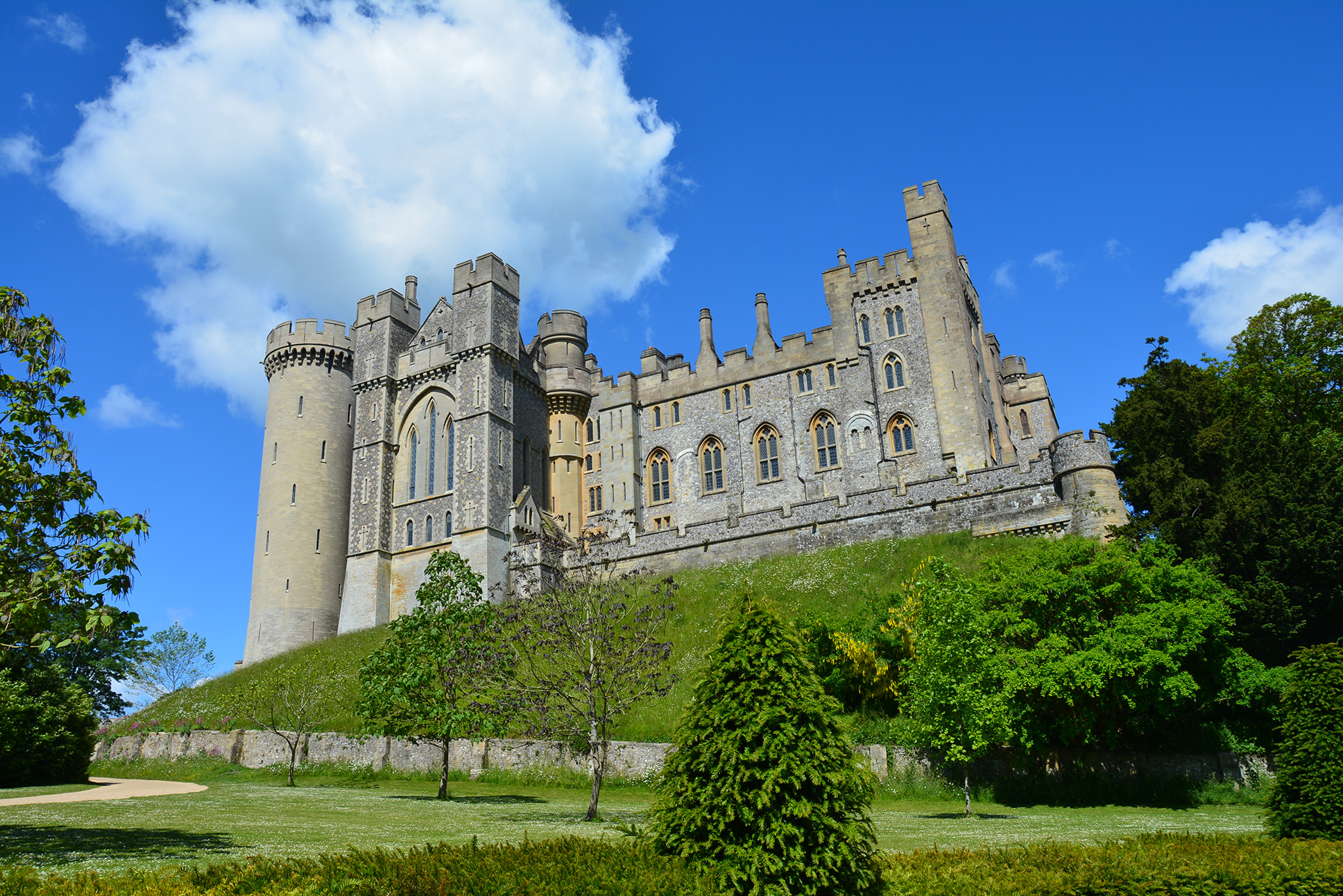
From 1870 to 1900, Henry FitzAlan-Howard, 15th Duke of Norfolk, oversaw the castle's most transformative rebuilding. During this period, he rebuilt it in a grand Gothic Revival style and created interiors, including the library, drawing rooms, and the Baron's Hall. Later in this same period, he installed electric lighting and central heating, making it one of the first English great houses to feature these innovations.
The Dukes of Norfolk continue to use Arundel Castle as their seat and to fulfill their hereditary roles, such as serving as Earl Marshal.
Castle Highlights
Arundel Castle today is mostly the Gothic Revival version built by 1900. However, a few parts still date back to the original medieval castle from the 11th and 12th centuries; these include the Norman motte and the stone keep atop it, as well as the medieval gatehouse. In addition, the barbican, dating from 1295, is also well-preserved.
Beyond the main structure, the FitzAlan Chapel, outside the medieval castle, is worth a visit. It was founded in 1390 and is still used for family burials.
The State Rooms inside the castle contain fine furniture and tapestries, while the art collection features works by Van Dyck, Gainsborough, and Canaletto.
The castle is open to visitors from April to October, but closed on Mondays. Events such as jousting and historical days are regularly held. Some interior areas may be closed for private functions, so check ahead to confirm access to the rooms you want to see.
Plan to spend at least half a day at the castle. Lewes Castle is nearby if you would like to visit another castle the same day.
Arundel Castle is also haunted.