Battle of Brémule
Henry I and Louis VI
Background
On August 20th, 1119, near Brémule in Normandy, King Henry I of England defeated King Louis VI of France and William Clito, the son of Henry's captive brother, Robert Curthose. It was a small battle, with perhaps nine hundred knights taking part, but the Norman chronicler Orderic Vitalis says that only three of them were killed.
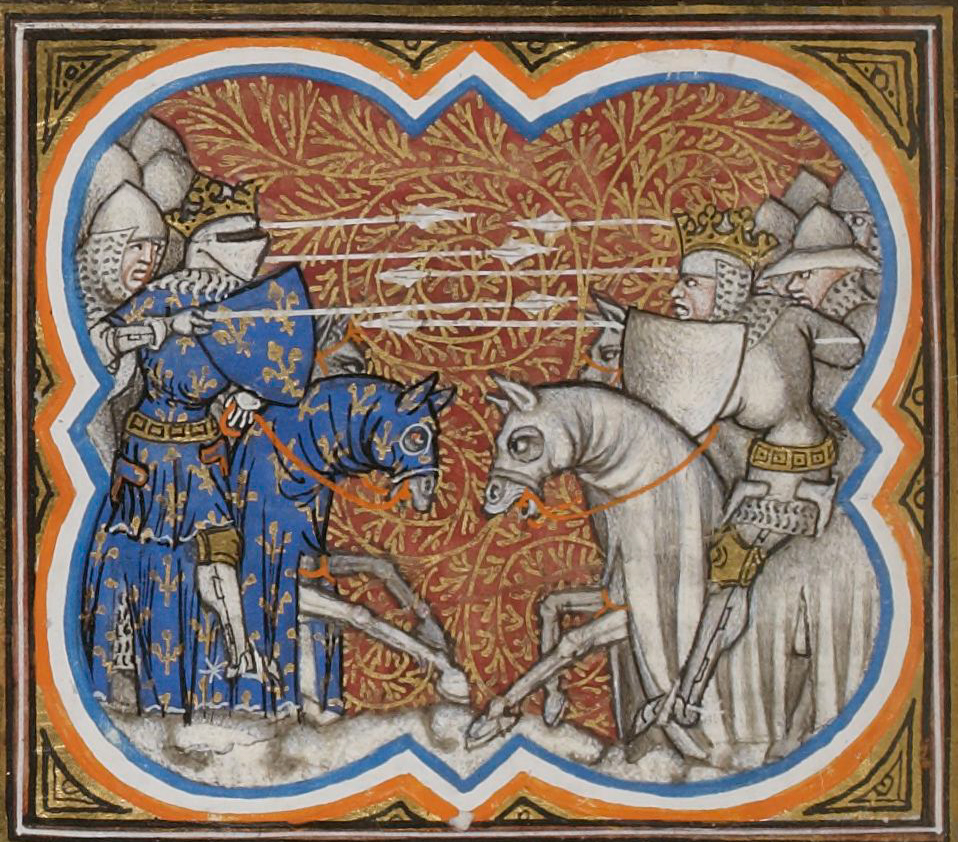
Louis VI and Henry I at the Battle of Brémule, from the Grandes Chroniques de France, about 1375-1380. Public domain, Wikimedia Commons.
Henry I had won Normandy by defeating his elder brother, Robert Curthose, at the Battle of Tinchebray in 1106, and he kept Robert a prisoner for the rest of his life. Robert's young son, William Clito, grew up as a rival claimant to the duchy. King Louis VI of France, Count Fulk V of Anjou, Count Baldwin VII of Flanders, and a party of rebellious Norman barons all backed William, and a war flared along the unsettled borders of the Vexin and the Seine valley. Baldwin died of a wound in 1118, and in 1119, Henry made peace with Fulk by marrying his own son, William Adelin, to Fulk's daughter, Matilda. That left Louis and his Norman allies to fight on alone.
Battle

Louis VI in the fighting at Brémule. Engraving by Philippoteaux, 1862. Public domain, Wikimedia Commons.
In the summer of 1119, Louis led an army into Normandy, and on August 20th, the two kings met near Brémule, in an encounter that began almost by accident. Henry had about five hundred knights with him, among them his illegitimate sons Robert, later Earl of Gloucester, and Richard, his only legitimate son, William Adelin, and three earls, and Louis brought about four hundred, along with William Clito and several rebel barons. Henry arranged his mailed knights in close ranks, and Edward of Salisbury carried the royal standard.
The French struck first. William Crispin and eighty knights charged the English line, but the Norman knights held, the French lost their horses, and Crispin's men were surrounded. Crispin forced his way toward the English king and struck him on the head with his sword. According to Orderic, “the collar of the noble prince's hauberk protected his head from injury.” Roger FitzRichard of Bienfaite and Orbec, a son of Richard FitzGilbert of the Clare family, then knocked Crispin down and took him prisoner, and he protected him from the men who wanted to kill him. With that, the French lines broke, and Louis fled toward Les Andelys.
The slaughter that usually followed such a defeat did not happen. Orderic wrote that the knights “were all clad in mail and spared each other on both sides,” and that only three of the roughly nine hundred who fought were killed. Modern historians add that ransom was a stronger motive than mercy, since a captured knight was worth money alive.
Aftermath

Rochester Castle, whose great keep was begun in the reign of Henry I.
About 140 French knights were captured, and Henry treated Louis with courtesy by sending back the French king's captured horse. According to Orderic, Prince William returned a lost palfrey to William Clito, as his father suggested, and sent him gifts. The victory did not end the struggle, since Louis kept supporting Clito's claim, but in 1120, the French king had to accept William Adelin as the Duke of Normandy, and William was formally invested.
That same year, on November 25th, 1120, William Adelin drowned in the wreck of the White Ship, together with his half-brother Richard, and Henry I was left with no legitimate son to inherit his realm. Robert, who had not been on the ship, later became the great supporter of his half-sister Matilda. That crisis led to his daughter Matilda's claim and to the civil war of the Anarchy. William Clito became Count of Flanders in 1127 and died in 1128.
A French story, perhaps from later chroniclers, says that during the fighting at Brémule a Norman knight seized the bridle of Louis's horse and shouted that the king was taken. Louis is said to have struck him down with the reply, “The king is not taken, neither at war nor at chess!” Historians now think the saying was attached to Louis later.
Orderic quotations are from the translation by Marjorie Chibnall, The Ecclesiastical History of Orderic Vitalis, Volume VI (Oxford, 1978).