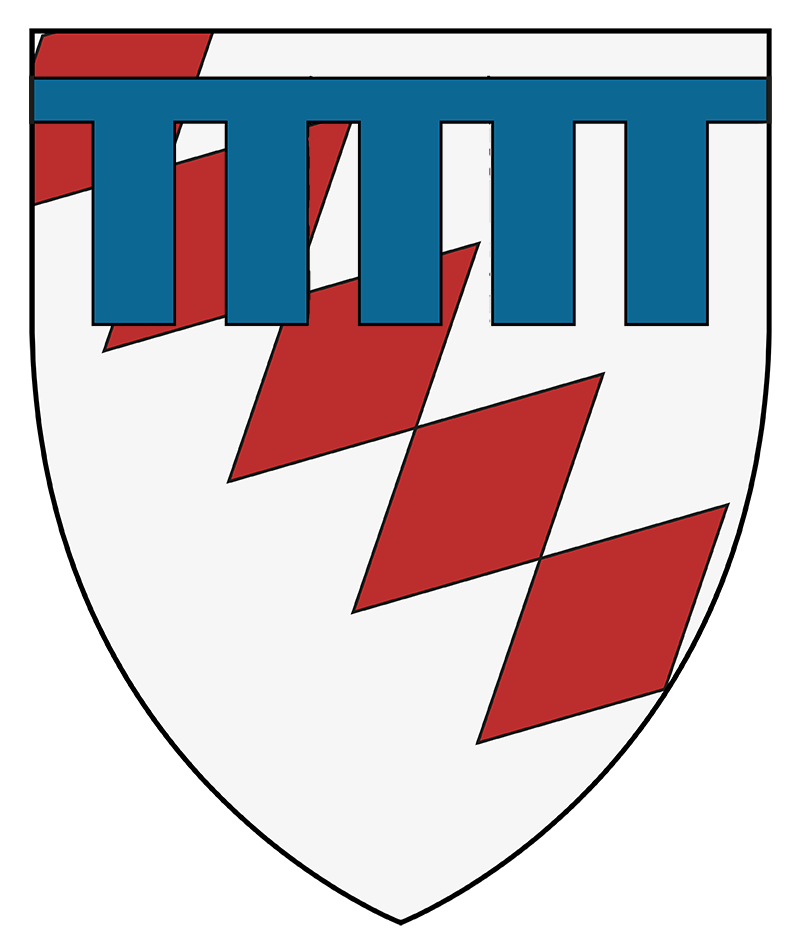
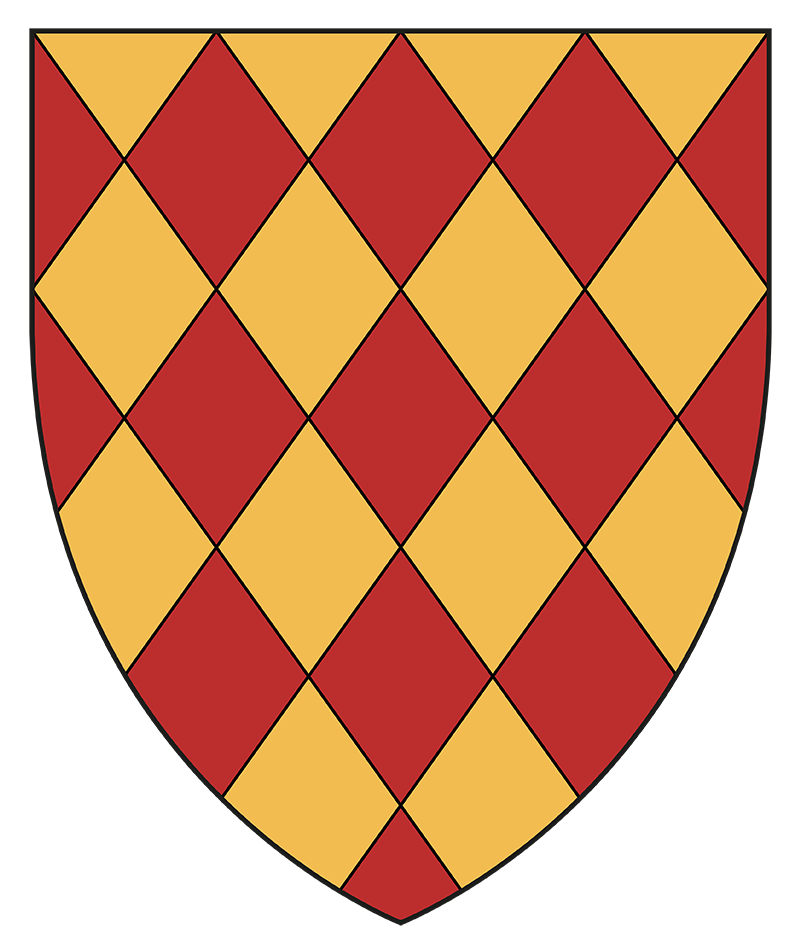
Battle of Roche-au-Moine (1214)
Background
In the summer of 1214, King John of England made his last attempt to win back the lands in France that he had lost ten years earlier. The plan was a two-pronged attack on Philip II of France. John's allies in the north, the German emperor Otto IV, Ferdinand of Flanders and Renaud of Boulogne, together with William Longespée, would march south-west from Flanders, while John advanced north-east from Poitou toward Paris. The plan depended on accurate timing, and it failed on both fronts. John was forced to retreat from the castle of Roche-au-Moine (also written La Roche-aux-Moines) on July 2nd, and Philip crushed Otto and his allies at Bouvines on the 27th.
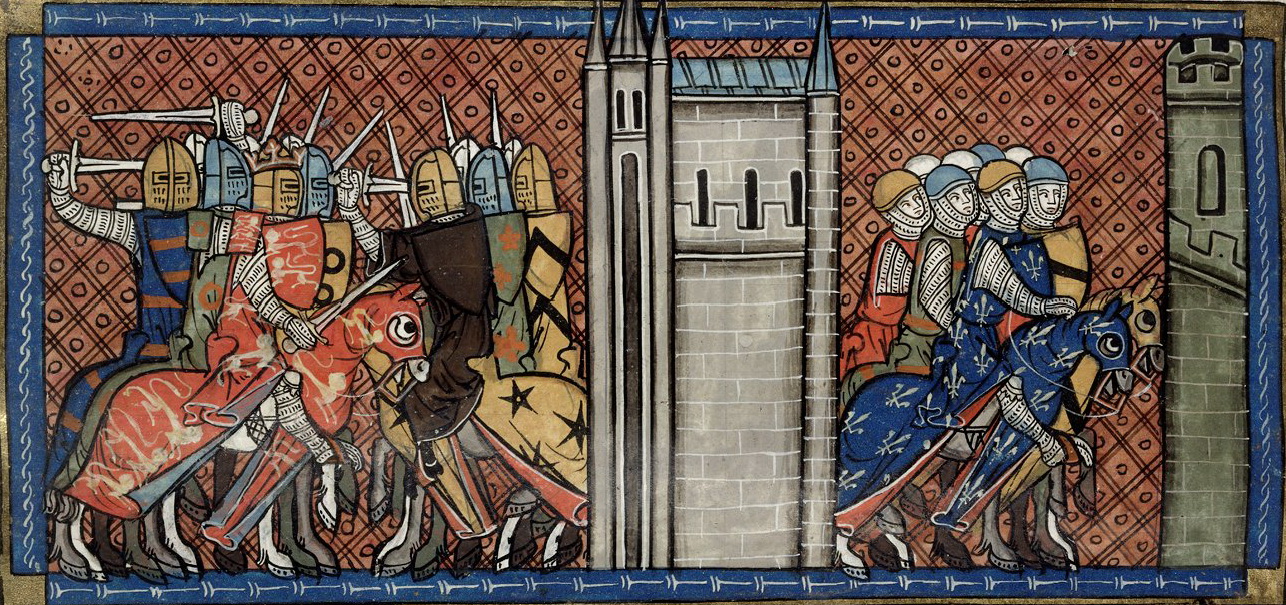
King John of England in battle with the French (left) and Prince Louis of France on the march (right). Miniature from the Chroniques de Saint-Denis, British Library, Royal MS 16 G VI, fol. 385. Wikimedia Commons, public domain.
John had left England in February 1214, even though many of his barons refused to provide military service, and mercenary knights filled the gaps. He sailed from Portsmouth and landed at La Rochelle on February 15th, and he called out the feudal levies of Guyenne. In Poitou he was joined by Hugh IX of Lusignan and by Hervé IV of Donzy, the Count of Nevers. In March he overran Poitou, crossed the Loire and invaded Anjou.
Philip marched to stop him, taking his son Louis and the best of the feudal levies, and went by Saumur and Chinon to cut John off from Aquitaine. John pulled back quickly to the south and had reached Limoges by April 3rd. Philip refused to chase him any further. He ravaged the rebellious parts of Poitou and then marched north to deal with the threat from Flanders, leaving Louis at Châteauroux with a few thousand troops to hold John in check.
The Siege
John returned to Poitou in May, where the Lusignans did homage to him, which at last smoothed over the offence of his marriage to Isabella of Angoulême. He crossed the Loire again, and early in June he tried to take Nantes, but the defenders, led by Robert of Dreux, attacked him at the bridge at Pirmil, and Robert was captured with several of his knights. Finding Nantes closed to him, John went up the river and took many towns in Anjou. On June 17th he entered Angers, the ancestral home of his family. It had no proper fortifications and fell without difficulty. He stayed there less than two days and then moved a few kilometres south to Roche-au-Moine.
The castle stood on a rock above the Loire at Savennières. It had belonged to the Benedictine monks of Saint-Nicolas at Angers, and Philip Augustus had fortified it to protect the French hold on the north bank of the river. John arrived there on June 19th and camped before it. He wrote to his officials that day, proposing that Queen Isabella and the royal treasure be sent north to the Loire, which suggests that he expected to be moving toward Paris.
John's army was joined by the garrison of Rochefort-sur-Loire, under Paies de Rochefort, a brigand knight in the best tradition of the robber baron. The French defenders fought hard. Like many hard-pressed garrisons, they stripped their surroundings of anything they could throw, including beams and wooden supports from houses, and hurled it down on the attackers.
William the Breton, a chaplain at Philip's court, tells a story from the siege. A crossbowman named Enguerrand, a huge man known as "the Monastery-breaker" (perhaps a sign that he was one of Rochefort's men), advanced to the castle ditch each day under cover of a large mantlet, a movable wooden shield, carried by a boy. From behind it he shot at the garrison with impunity. A French crossbowman named Pons found an answer. He tied one end of a long, thin rope to a bolt and the other to a fixed point beside him, then shot the bolt into the mantlet, where it stuck fast. He hauled on the rope and dragged the shield and the boy into the moat, and Enguerrand, left exposed, was struck down by a hail of arrows as he tried to get away. John was furious, and more so when Pons called out, "Get away from here, King, and leave us in peace, for fear that you will meet a similar death." John did pull back a little to direct the assault from a safer distance. He would have remembered how his brother Richard had been killed by a crossbow bolt at Châlus-Chabrol in 1199.
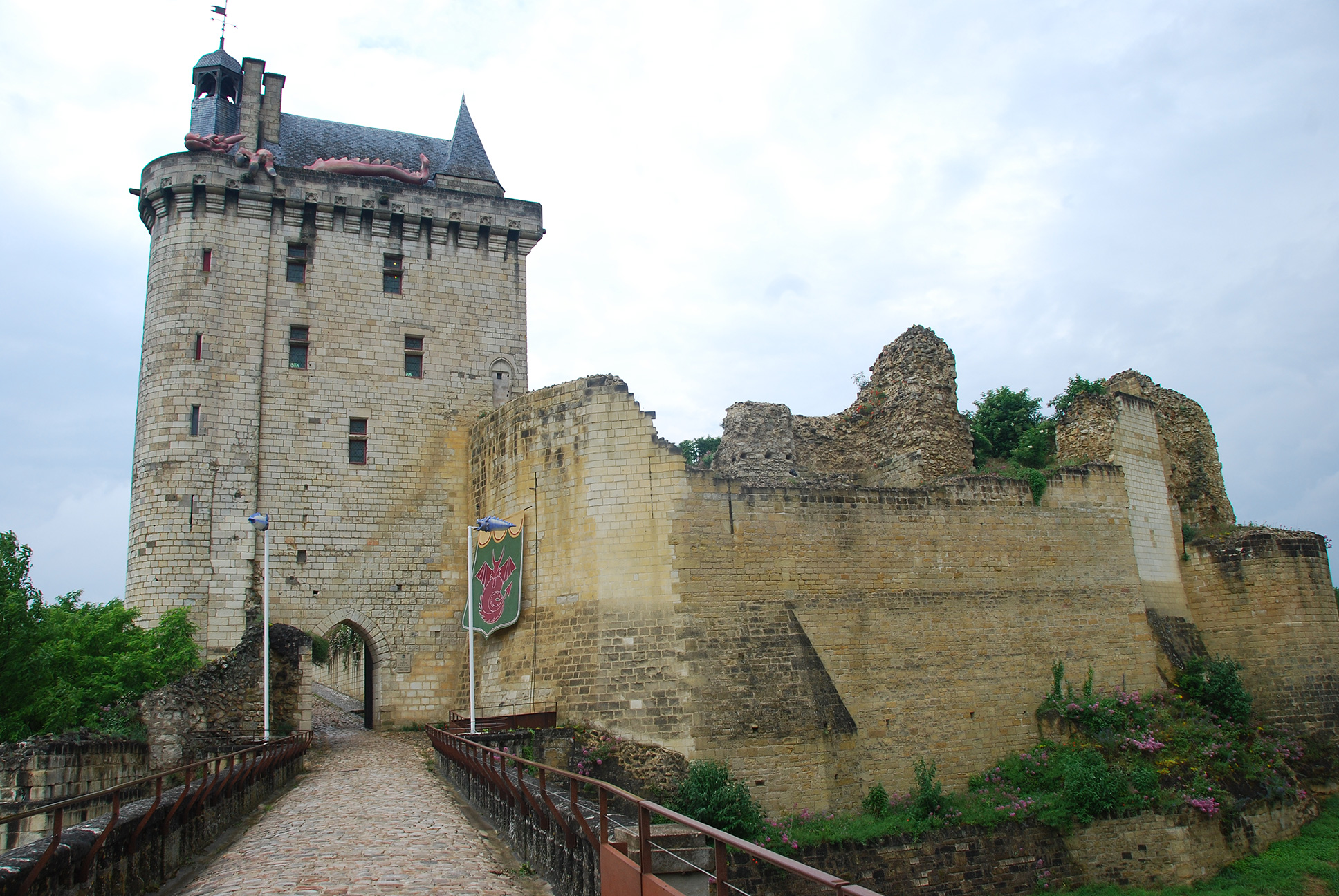
Chinon Castle, where Louis waited for his father's orders before marching on Roche-au-Moine.
Louis was at Chinon, where he had waited about two weeks for instructions from his father. When he finally moved south, his army was joined by Angevin levies led by William des Roches and Amaury de Craon, and he sent a herald to defy John publicly. The siege had lasted about two weeks when Louis came up to relieve the castle.
Battle
John's army was larger than Louis's, and at first he was inclined to accept battle against a force he believed to be much smaller. Then he began to doubt his Poitevin allies. The Lusignans and the other Poitevins were willing to ride with John and take his money, but many of them refused to follow him into a fight against the French prince, and he was afraid that he would not be supported if the two armies met. He was persuaded to retire, perhaps by Aimery, the Viscount of Thouars, or perhaps by Savari de Mauléon, the same Savari who had commanded the French fleet at Damme the year before.
John gave up the siege on July 2nd. He destroyed his siege equipment and withdrew in a hurry, without a fight. French chroniclers say that the panic was so great that he left behind his tents and supplies, and that a large number of his men drowned while crossing the river. His rearguard suffered badly at the hands of Louis's army as it fell back. By July 5th the king was about 80 kilometres south of the Loire, probably at Pouzauges, on the road to Niort, and by July 9th he was back at La Rochelle.
Aftermath
Louis chased John as far as Thouars and then turned back to Anjou. Letters later sent by Aimery of Thouars say that his viscounty was left open to plunder and occupation by Louis's army for two weeks. Louis also began tearing down the walls that John had started to build around Angers.
The defeat decided the campaign. With Louis blocking the way to Paris, John could no longer take part in the plan, and less than four weeks later Philip defeated Otto IV and his allies at Bouvines, where Ferdinand of Flanders and William Longespée were captured. John's hopes of recovering Normandy and Anjou were over. On September 18th, 1214, Philip agreed to a five-year truce at Chinon, which John confirmed on the same day at Parthenay, and John landed back in England on October 13th. Within a year his barons were in open revolt, and he was forced to seal Magna Carta.
The failure of the Poitevins to stand by John at Roche-au-Moine has long been blamed on treachery, but some modern historians question this, and it may be that John simply lost his nerve.