Dunnottar Castle
History
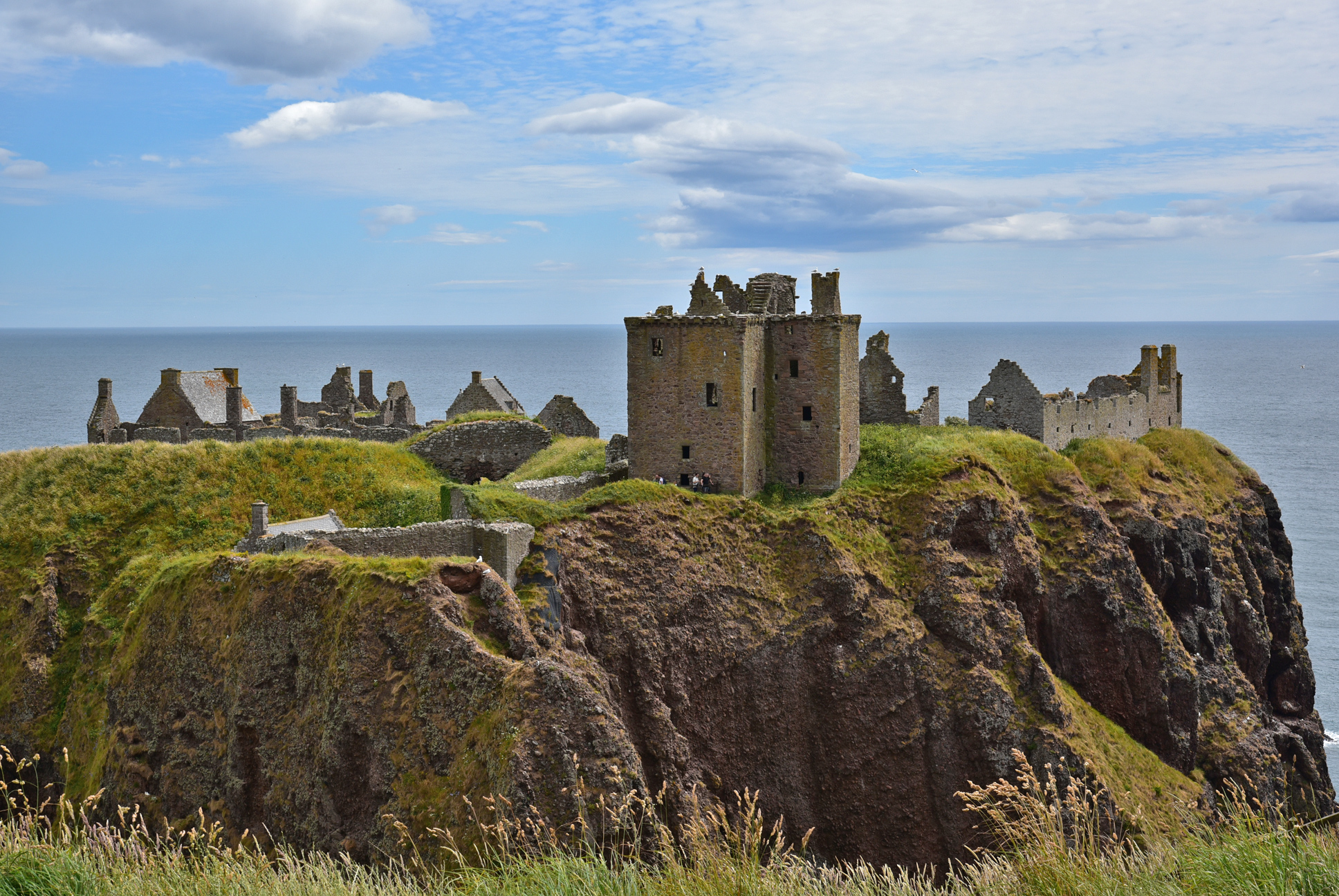
Dunnottar Castle, on a rocky North Sea headland near Stonehaven, played a key role in Scottish history and once secretly safeguarded the Honours of Scotland.
In the 5th century, St Ninian, an early Christian missionary, reportedly founded a chapel at the castle's current location. Soon after, defenders fortified it. The Picts besieged the site in 681, and Vikings attacked in 900, slaying King Donald II. In 934, King Æthelstan reportedly raided north to Dunnottar, according to the English chronicler Symeon of Durham.
During the 12th century reign of William the Lion, Dunnottar was the center of local administration for The Mearns, the historic county now known as Kincardineshire.
In May of 1296, William Wishart, Bishop of St Andrews, consecrated a church on the site. A year later, William Wallace captured Dunnottar from the English during the First War of Scottish Independence. The poet Blind Harry claims Wallace imprisoned 4,000 English prisoners of war in the church and then burned them alive. Others were driven over the cliff edges, with no survivors. No record shows a castle existing there at that time.
In 1336, Edward III of England ordered William St Clair, 8th Baron of Roslin, to sail eight ships to the site and restore it as a forward resupply base for his northern campaign. This also supported Edward Balliol's bid for the Scottish crown. Edward III visited in July. However, this renewed English occupation lasted only briefly. Later that year, Andrew Murray led a force to capture and destroy Dunnottar Castle.
In 1346, King David II granted Dunnottar to William de Moravia, 5th Earl of Sutherland, and issued a license to crenellate. Around 1359, William Keith, Marischal of Scotland, married Margaret Fraser, niece of Robert the Bruce, and received the barony of Dunnottar.
William Keith completed the construction of the first stone castle at Dunnottar in 1392, including the Keep, but church authorities excommunicated him for building on consecrated ground. William built a new parish church closer to Stonehaven and petitioned Pope Benedict XIII, who issued a bull in 1395 that lifted the excommunication. William's descendants became Earls Marischal in the mid 15th century and held Dunnottar Castle until the 18th century.
In 1458, King James II created William Keith, 1st Earl of Marischal.
On October 15th, 1504, King James IV visited Dunnottar Castle and gave money to poor people. In 1531, King James V exempted the Earl's men from military service, describing Dunnottar Castle as one of the principal strengths of the realm.
Throughout the 1500s, the Keiths strengthened the castle's defenses. On October 28, 1562, Mary, Queen of Scots, and her forces defeated the Earl of Huntly at the Battle of Corrichie. His son, John Huntly, aspired to kidnap Mary and force her to marry him. He was beheaded on November 2, 1562. Mary was compelled to witness this event to dispel rumors that she encouraged his advances. Days later, she stayed at Dunnottar Castle and received a warm welcome, returning again in September 1564 for a two-night visit.
Mary's son, King James VI, stayed at Dunnottar Castle for ten days in 1580 as part of his advancement through Fife and Angus, during which a meeting of the Privy Council convened at the castle.
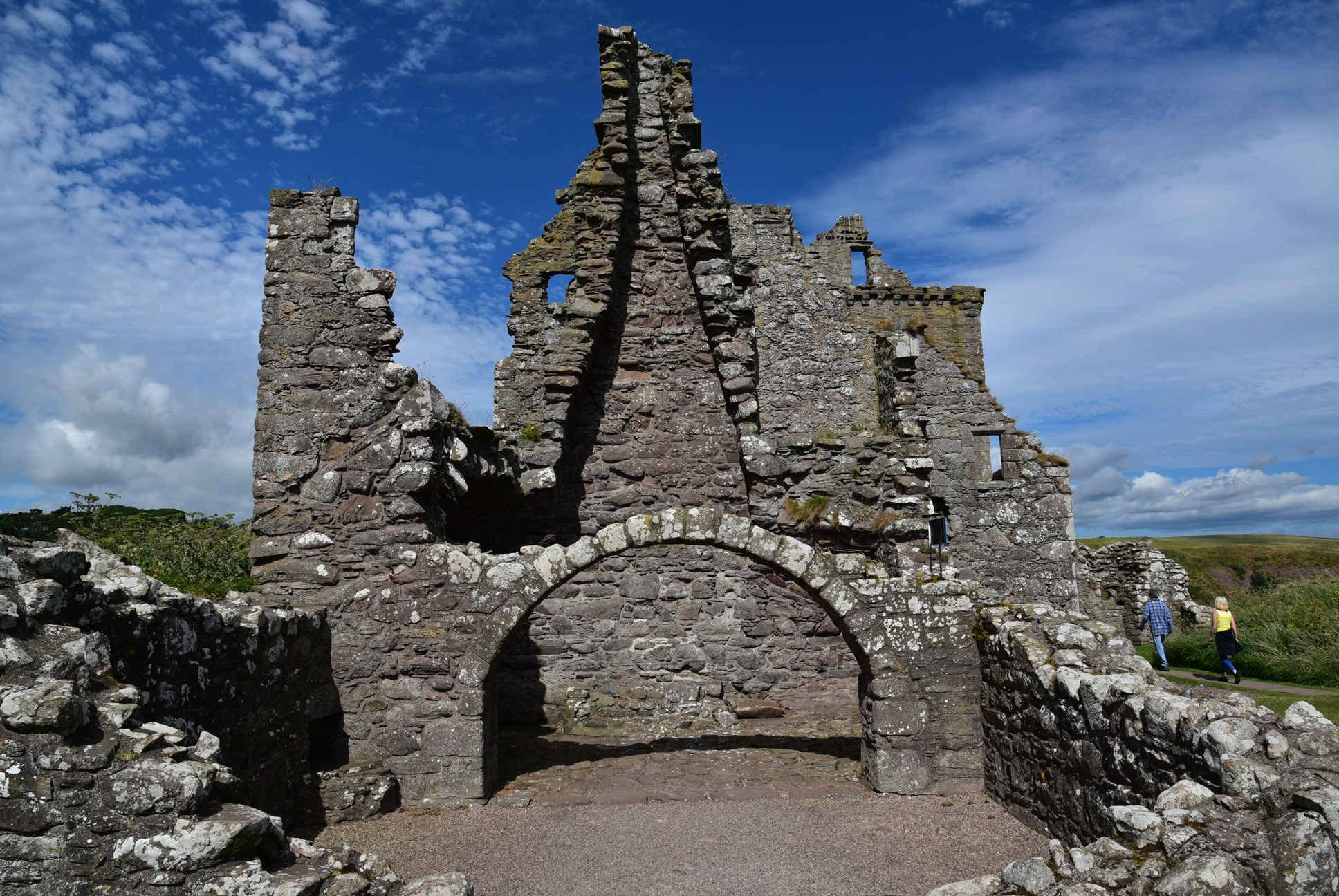
In 1581, George Keith succeeded as the 5th Earl Marischal and began large-scale reconstruction at the castle, transforming the medieval stronghold into a comfortable residence. Builders erected a series of ranges around a quadrangle on the north-eastern cliffs and restored the 13th century chapel. They also constructed a stone gatehouse with numerous gunports, now known as Benholm's Lodging.
James VI visited again on April 17th, 1589, watching for the Catholic rebel Earls of Huntly and Erroll.
In 1592, during the rebellion of Catholic nobles, Captain Carr captured Dunnottar Castle on behalf of the Earl of Huntly. Officials restored it to Lord Marischal a few weeks later.
In 1593, George Keith continued building at Dunnottar Castle. He brought a pet lion to the castle and kept it in what is now called the Lion's Den.
In 1639, William Keith, 7th Earl of Marischal, supported the Covenanters, a Presbyterian movement that opposed the Episcopal Church and the changes King Charles I was trying to impose. That year, William, along with James Graham, 1st Marquess of Montrose, marched against the Catholic James Gordon, 2nd Viscount Aboyne, defeating the Royalists' attempt to seize Stonehaven. The political landscape shifted when Graham later changed sides and joined the Royalists, yet William Keith remained loyal at Dunnottar, even as Graham went on to burn Stonehaven.
In 1648, William Keith led a horse troop to the Battle of Preston to support King Charles I. After Charles I's execution in 1649, William pledged allegiance to his son, King Charles II. Charles visited Dunnottar Castle in July 1650. Because Charles stayed in Scotland, Oliver Cromwell led a force there and defeated the Scots at the Battle of Dunbar in 1650.
On January 1st, 1651, King Charles II was crowned at Scone Palace. Officials used the Honours of Scotland (the Scottish Crown Jewels) during the ceremony. Because Cromwell's troops occupied Lothian, officials did not return the Honours to Edinburgh. The Privy Council ordered their move to Dunnottar Castle, and Katherine Drummond secretly delivered them in sacks of wool. Security at Dunnottar waivered when authorities arrested the Earl of Marischal and imprisoned him in the Tower of London.
George Ogilvie of Barras became the governor of the castle and took on its defense. In November of 1651, Cromwell's troops demanded that Ogilvie surrender the castle, but he refused. Ogilvie and his garrison resisted for eight months. During the blockade, conspirators planned to secretly remove the Honours of Scotland from Dunnottar Castle. They smuggled the King's papers out by sewing them into Anne Lindsay's clothes. She carried the papers in her dress and walked undetected through the besieging forces.
Two stories tell how the Honours were secretly removed from the castle. Christian Fletcher stated in 1644 that over three visits to Dunnottar in 1652, she carried away the crown, scepter, and sword, hidden in sacks of goods. An 18th century account says the Honours were lowered from the castle onto the beach, carried by Fletcher's servant, placed in a basket of seaweed, and buried under the Old Kirk at Kinneff.
By May 1652, Colonel Thomas Morgan, the commander of the castle blockade, had acquired enough artillery to demolish Dunnottar Castle. Ogilvie surrendered the castle on the agreement that the castle garrison could go free. When the English realized the Honours were gone, they imprisoned Ogilvie and his wife in the castle until the following year. A false story was spread that the Honours had gone overseas. Ogilvy survived, but his wife did not. Much castle property was removed, including twenty-one brass cannons. The Earl of Marischal had to sell further lands to pay fines levied by Cromwell's government.
In 1660, with the Restoration of Charles II, the Honours of Scotland were removed from the Old Kirk at Kinneff and returned to the King, marking the end of their concealment.
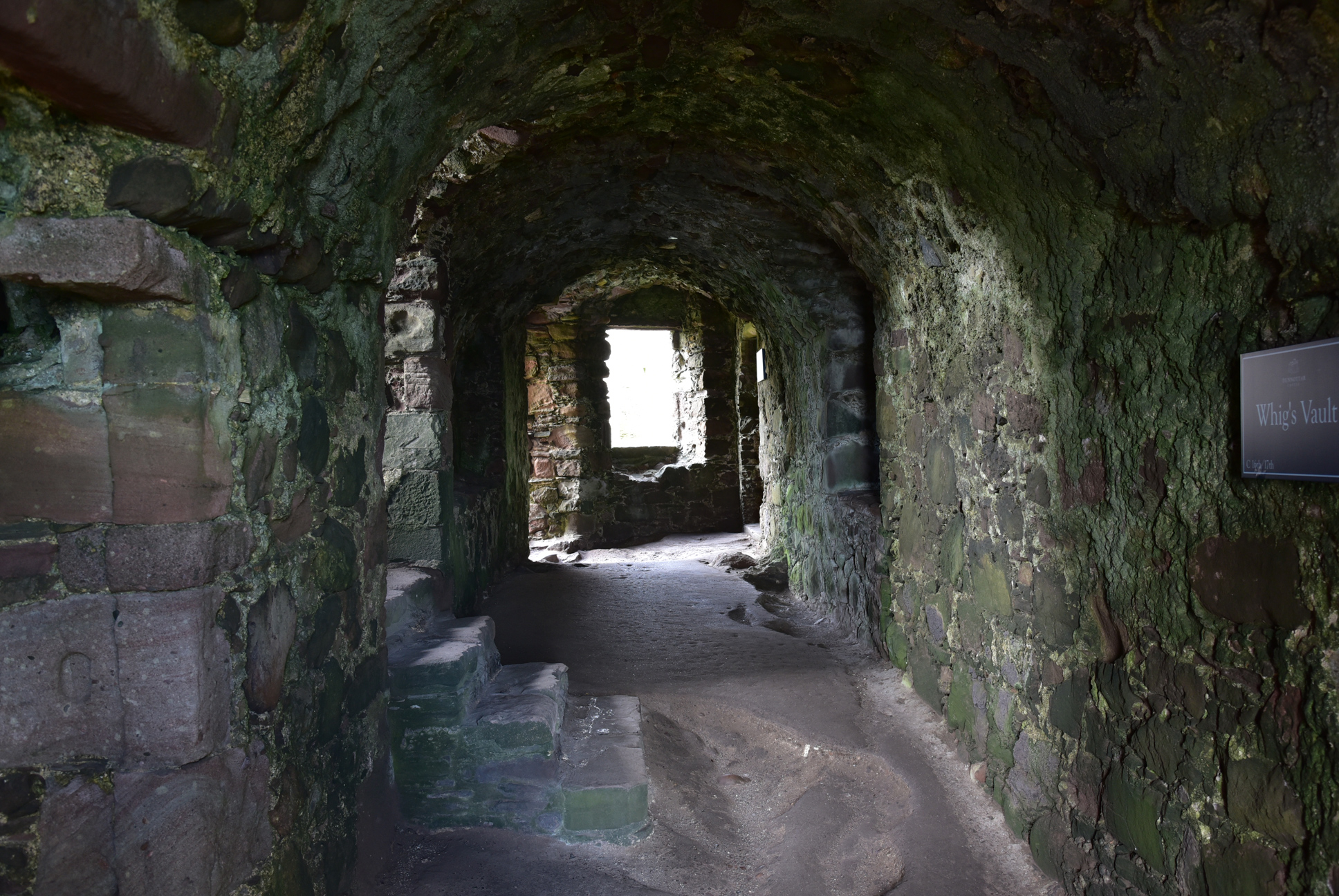
In 1685, during the Earl of Argyll's rebellion against King James VII, 167 Covenanters were held in a cellar at Dunnottar Castle. As Whigs, an anti-Royalist faction within the Covenanter movement, they refused to swear allegiance to James VII. Held from May 24 to late July, twenty-five escaped, two fatally fell from the cliffs, and fifteen were recaptured. The cellar beneath the King's bedroom in the 16th century buildings became known as the Whigs' Vault.
Both the Jacobites and the Hanoverians used Dunnottar Castle. In 1689, the castle was garrisoned for William III and Mary II, with Lord Marischal appointed captain. Seventeen suspected Jacobites from Aberdeen were captured and held at the castle for about three weeks, including George Liddell, a professor of mathematics at Marischal College.
In the 1715 Jacobite Rising, George Keith, 10th Earl Marischal, led cavalry at the Battle of Sheriffmuir for the Jacobites. When the rising failed, Keith fled and became a diplomat for Frederick the Great of Prussia. His lands and titles, including Dunnottar Castle, were forfeited to the crown.
In 1720, the York Buildings Company bought the castle and dismantled much of it. In 1761, the Earl Marischal briefly returned, bought back Dunnottar, then sold it to Alexander Keith five years later. It passed to Patrick Keith-Murray of Ochtertyre in 1852, then to Major Alexander Innes. In 1919, Weetman Pearson, 1st Viscount Cowdray, bought it, and his wife began repairs. Dunnottar Castle remains in the family today and is open to the public.
Castle Highlights
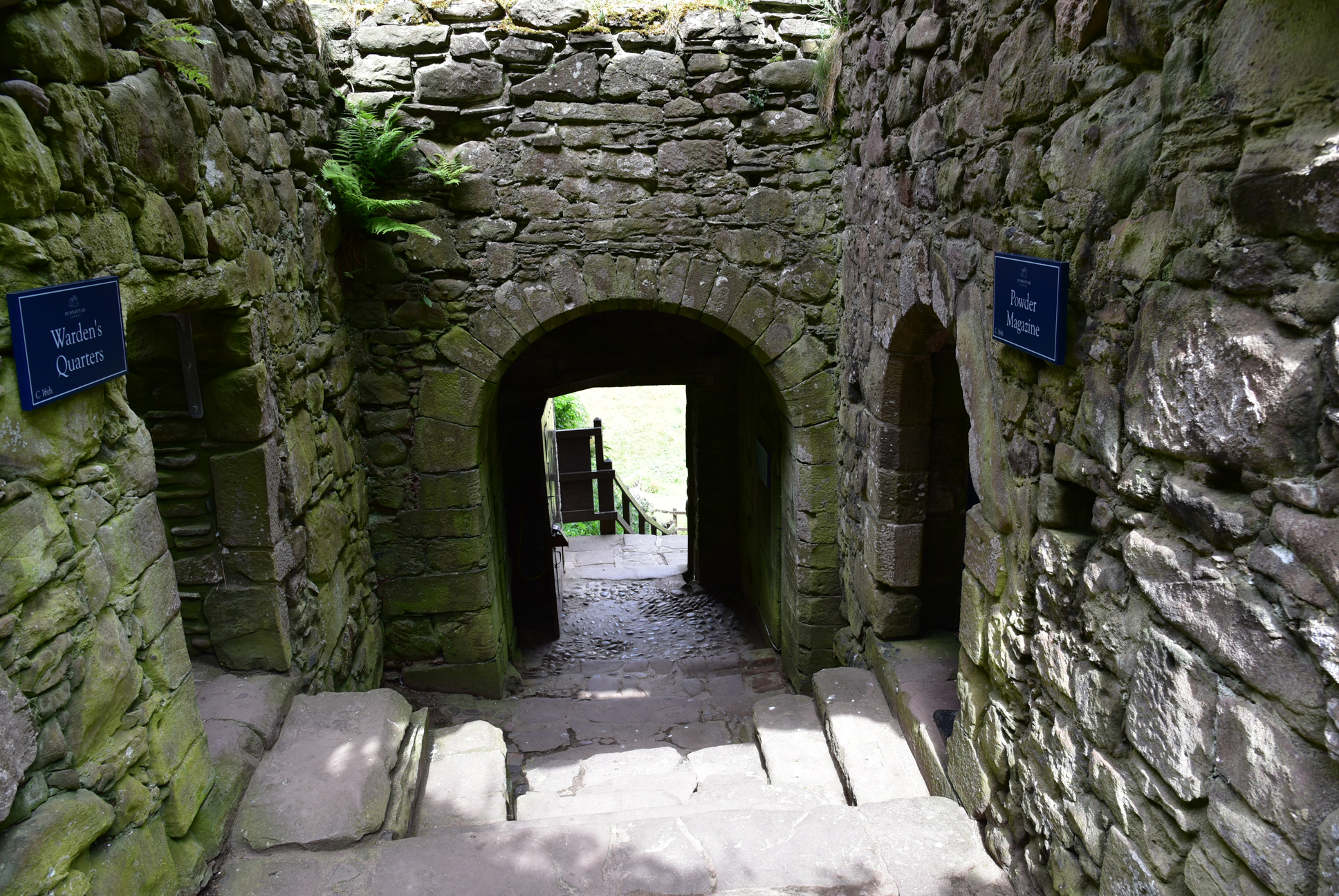
Dunnottar Castle sits proudly on a clifftop 160 feet above the North Sea and is one of the most photographed and visited castles in Scotland. Access is gained through a doorway defended by a gatehouse with a portcullis and several rows of gun loops. From there, a passage runs through two tunnels and a short climb up a flight of steps, and you will find yourself in the inner bailey of the castle courtyard near the Keep.
The 14th century L-plan Keep is the most impressive part of the castle, with a stone-vaulted basement, and, in earlier centuries, rose another three levels, including a roof-level garret. Rooms inside the Keep include the lesser hall on the first floor, the Great Hall on the second floor, and bedroom chambers on the upper floors. The Keep also has a straight staircase from the ground floor to the 1st floor, rather than a spiral staircase, which is unusual in castle design for this period. The cavity underneath the staircase was used as a prison cell.
In the castle courtyard behind the Keep is the Storehouse and the Smithy or Blacksmith's Forge. Beyond that are the Stable Blocks for housing a dozen or so horses along the southern edge of the headland.
The Palace along the north-east headland consists of three wings set around a quadrangle. It provided more comfortable accommodation than the medieval Keep. The gallery originally included an oak ceiling and a Roman tablet taken from the Antonine Wall. At the north end of the gallery was the drawing room. At the south-east corner of the quadrangle is the chapel.
Dunnottar Castle can easily take a half day to a full day to visit. If you only spend half a day, Crathes Castle or Drum Castle are close enough to visit the same day.
Dunnottar Castle is also haunted.