Sir Henry Percy - Hotspur
… and by his light did all the chivalry of England move to do brave acts.
Shakespeare, Henry IV, Part 2
The Percy family was a powerful family in Northern England for much of the Middle Ages, often at odds with the Neville family. Sir Henry Percy was an English knight and the eldest son of Henry Percy, 1st Earl of Northumberland.

Henry was born at Alnwick Castle, in Northumberland, England, on May 20th, 1364. At that time, Alnwick Castle was the grander castle and the seat of power for the Percy family, but they preferred to live at Warkworth Castle. Henry was born in a time of constant conflict and unrest on the English border with Scotland, and the Percy family kept control of the area.

Statue of Harry Hotspur in the courtyard at Alnwick Castle.
In April 1377, the 13-year-old Henry was knighted by King Edward III, along with Richard of Bordeaux, future King Richard II, and Henry Bolingbroke, future King Henry IV. Their three lives would be forever intertwined after that.
Henry got his first experience in battle when the Scots took control of Berwick Castle in 1378. Henry's father, the Earl of Northumberland, gathered an army to reclaim the castle. Young Henry raised his banner in front of the main gate as others led groups of men who covered the flanks. The siege lasted eight days, and after a couple of hours of bombarding the castle, the English broke through the castle's defenses from all fronts, and victory for the English was swift and decisive.

Hotspur and Lady Percy (Shakespeare's Henry IV, Part 1), painted by Robert Smirke, engraved by James Neagle, 1795. Wikimedia Commons, public domain.
The following year, young Henry would be married to the nine-year-old Elizabeth Mortimer, daughter of Edmund Mortimer, the English Earl of March, an advantageous union for the Percy Family.
In 1385, young Henry was entrusted with more responsibilities by his father, the earl, and garnered the position of sole East March Warden in May of 1385. Henry Percy accompanied the 19-year-old King Richard II on a campaign into Scotland later in 1385, where he was given the nickname "Hotspur" by the Scots due to his speed and readiness to attack.
In April 1386, Henry was sent to France to participate in the Anglo-French conflicts and led many attacks, including an attack against the French as the commander of a naval army sent to relieve an English garrison at Brest in September 1387. For his brave actions, he was made a Knight of the Garter in 1388 by Richard II.

Around the same time, skirmishes with the Scots continued in Northumberland and James Douglas, 2nd Earl of Douglas, led a Scottish army south and surrounded Newcastle.
Hotspur and his brother Ralph Percy held Newcastle. After a week of minor skirmishes and challenges to single combat, Douglas challenged Hotspur to a duel. Douglas felled Henry and captured his pennon (banner) during the melee. Douglas announced, "I will carry it to Scotland and hoist it on my tower, where it may be seen from afar," to which Hotspur replied, "By God! You will never leave Northumberland alive with that!"

A few days later at the Battle of Otterburn, having ridden up from Newcastle, Henry and his men were tired and disordered as they made their way onto the field to set camp. Henry was so confident that he attacked the Scots a few hours before sunset. The Scots launched a counterattack on Percy's right flank. Douglas was mortally wounded, but the Scots prevailed and captured Henry Percy, who surrendered to Sir John Montgomery, as the rest of Henry's forces retreated to Newcastle. Henry was later ransomed for 7000 marks. The battle was romanticized in the ballads The Battle of Otterburn and Chevy Chase.
Henry Hotspur's service gained him royal favor through lands and appointments; however, in 1399, the Percy family decided to support Henry Bolingbroke, who had returned from exile to depose Richard II. Hotspur and his father joined Bolingbroke's forces at Doncaster, where Bolingbroke swore that he only wanted his inherited Lancaster lands. Richard II surrendered at Flint Castle in Wales and was taken to the Tower of London. Soon after, he abdicated his Crown to Henry Bolingbroke. The Percy family received more lands and favor from the new King, Henry IV. Richard II ended up starving to death while being held prisoner at Pontefract Castle in South Yorkshire.
Henry IV lavishly granted Henry Hotspur favor and was one of England's most powerful noblemen. Other noble families were not so lucky in the change of power, especially those along the Welsh Border who had strongly supported Richard II. One in particular was Owain Glyndŵr (Owain ap Gruffydd), who had an unresolved dispute over land rights with Baron Reginald Grey of Ruthyn. He led a force against Grey, destroying his possessions by fire and putting to sword members of his household. He claimed himself Prince of Powys and attacked Denbigh, Rhuddlan, Flint, and other castles.
King Henry IV decided to attack Owain as a disturber of the peace upon listening to Marcher Lords such as Grey and Mortimer, who sought a fight and opportunity to regain favor and lands. This escalated what started as a Welsh issue into a full-scale national problem. But he couldn't put one of those Marcher lords in charge as it would just fan the fires of discontent, so he put Henry Hotspur, loyal to the crown and related to Mortimer through marriage, in charge. Henry IV had already named Hotspur Justiciar of Chester and North Wales and Constable of the royal castles at Chester, Flint, Conwy, and Caernarfon. Hotspur already mentored King Henry's eldest son, Henry or Prince Hal. Hotspur and Hal laid siege to Conwy Castle, which the opportunistic Tudor brothers seized in 1401.
In 1400, Lord Dunbar and Henry "Hotspur" Percy besieged Hailes Castle but had to flee when Douglas forces arrived from Edinburgh Castle. Then in 1402, at the 2nd Battle of Nisbet, Dunbar and Percy defeated a Scottish army of 400 horsemen led by Halyburton of Dirleton and Hepburn the younger of Hailes. Dunbar executed Hepburn without considering ransoming him, while the other Scots Lords were returned to their castles for a price.
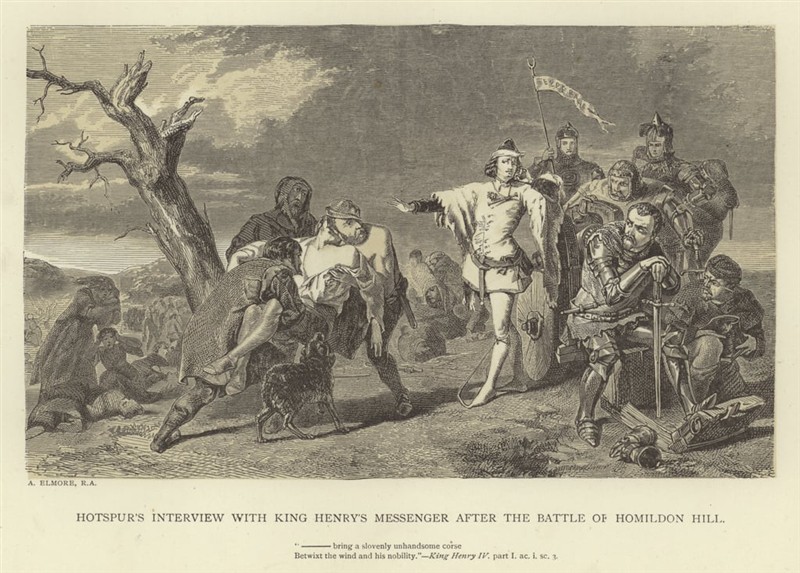
Hotspur's interview with the King's messenger after Homildon Hill, by Alfred Elmore, c. 1880. Wikimedia Commons, public domain.
In 1402, the Scots, led by another Douglas, invaded northeast England again, thinking the English Nobles were still fighting in Wales. As they returned to Scotland, their path was blocked by Lord Henry Percy, his son Hotspur, and the Earl of Dunbar, along with an armed band and force of archers. Dunbar had defected from Scotland and now was supporting England and Henry IV. The Scots had no choice but to engage in battle and chose a hill near the town of Wooler called Halweden, now Homildon Hill. The Scots formed their normal schlitron formation of tightly grouped men at arms, but the English did not charge into battle. Instead, the archers rained down heavy barrages of arrows on them until they were almost lost, and then Hotspur and his cavalry ran them down. Many Scottish lords and some French knights were taken prisoner in the rout, including Archibald Douglas, 4th Earl of Douglas.
Many disagreements arose between Henry Hotspur and King Henry IV. The king failed to pay wages due to them for defending the Scottish and Welsh borders. The king demanded that the Percys hand over their Scottish prisoners, but Hotspur kept the Earl of Douglas, whose ransom he was entitled to under the custom of war. The king also refused to pay the ransom of Edmund Mortimer, Henry Percy's brother-in-law, whom the Welsh were holding prisoner. All this, along with their charge that Henry IV had broken the oath he swore at Doncaster, caused the Percys to rebel against the king in 1403.
Having to control the border with Scotland still, Hotspur headed to Chester with his uncle, Thomas Percy, Earl of Worcester, and a few men to gain support from the Welsh and supporters of Richard II, leaving most of his northern forces in place along the Scottish border. He planned to take Shrewsbury, where Prince Hal and a garrison were stationed on behalf of the king, and, once secured, would open up the rest of England to take the crown from Henry IV before the king realized what was happening.
Unbeknownst to Hotspur, King Henry was heading north with an army to support the Percys in the north against Scotland. When the king learned of Hotspur's arrival in Chester and his intention, he headed west to help his son Hal defend Shrewsbury against Hotspur. Archibald Douglas, whom Hotspur had captured at Homildon Hill, joined the rebels with his Scots, but Hotspur's father, the Earl of Northumberland, did not arrive in time. Hotspur was now outnumbered and stuck with two choices: either fight or flee. He chose to fight!
Hotspur, in Shakespeare's Henry IV, Part 1:
I thank him, that he cuts me from my tale
For I profess not talking; only this - Let each man do his best; and here draw I
A sword, whose temper I intend to stain with the best blood that I can meet withal
In the adventure of this perilous day. Now, Esperance! Percy! and set on
Sound all the lofty instruments of war
And by that music let us all embrace;
For heaven to earth, some of us never shall
A second time do such a courtesy.

On July 21st, 1403, the Battle of Shrewsbury commenced with archers on both sides launching a barrage of arrows, causing heavy casualties on both sides. Hotspur then led a charge and attacked the formation where King Henry was, attempting to take out the king and bring a swift end to the battle. This failed, and a giant mass of soldiers in plate armor became entangled in hand-to-hand combat. Prince Hal then launched a counterattack by leading his division into the unprotected right flank of Hotspur's forces. Hal was struck in the face by an arrow but refused to leave the field. Hotspur and about 30 men made one final push to take out the king, and Hotspur was killed in that attempt. His death was a critical loss for his army, who fled the field, making King Henry IV the victor. Hotspur was about 39 years old, though Shakespeare made him the same age as Prince Hal, who was 16. Hotspur's uncle, Thomas Percy, Earl of Worcester, and Archibald Douglas were captured. Worcester was beheaded two days later at Shrewsbury, and Douglas was later ransomed.

Hotspur's banner at the Battle of Shrewsbury re-enactment, 2026.
King Henry IV is said to have wept upon being brought Percy's body after the battle. It was taken to Whitchurch in Shropshire for burial by Thomas Neville, 5th Baron Furnivall. When rumors soon circulated that Hotspur had survived the battle and was still alive, King Henry had the body exhumed and displayed, propped upright between two millstones, in the marketplace at Shrewsbury. Hotspur was then subjected to a posthumous execution, and he was beheaded and quartered. His head was sent to York, where it was impaled on Micklegate Bar. His four quarters were displayed in London, Bristol, Chester, and Newcastle upon Tyne. Eventually, his body was returned to his wife, who had him interred in York Minster in November 1403. In 1404, Sir Henry Hotspur Percy was posthumously attainted and declared guilty of high treason; his lands and titles were declared forfeit to the crown.
One of England's football clubs is named after him, Tottenham Hotspur F.C., because the Percy family held land in Tottenham, where the club's first grounds were on the Tottenham Marshes.
A bronze statue of Hotspur in full armor, sculpted by Northumberland artist Keith Maddison, stands about 14 feet tall on Pottergate in Alnwick, near the castle. It was unveiled in 2010 by the 12th Duke of Northumberland, Ralph George Algernon Percy, to mark 700 years of the Percy family's association with Alnwick Castle. Another statue of Hotspur on horseback stands in the courtyard at the castle.
