Corfe Castle
History
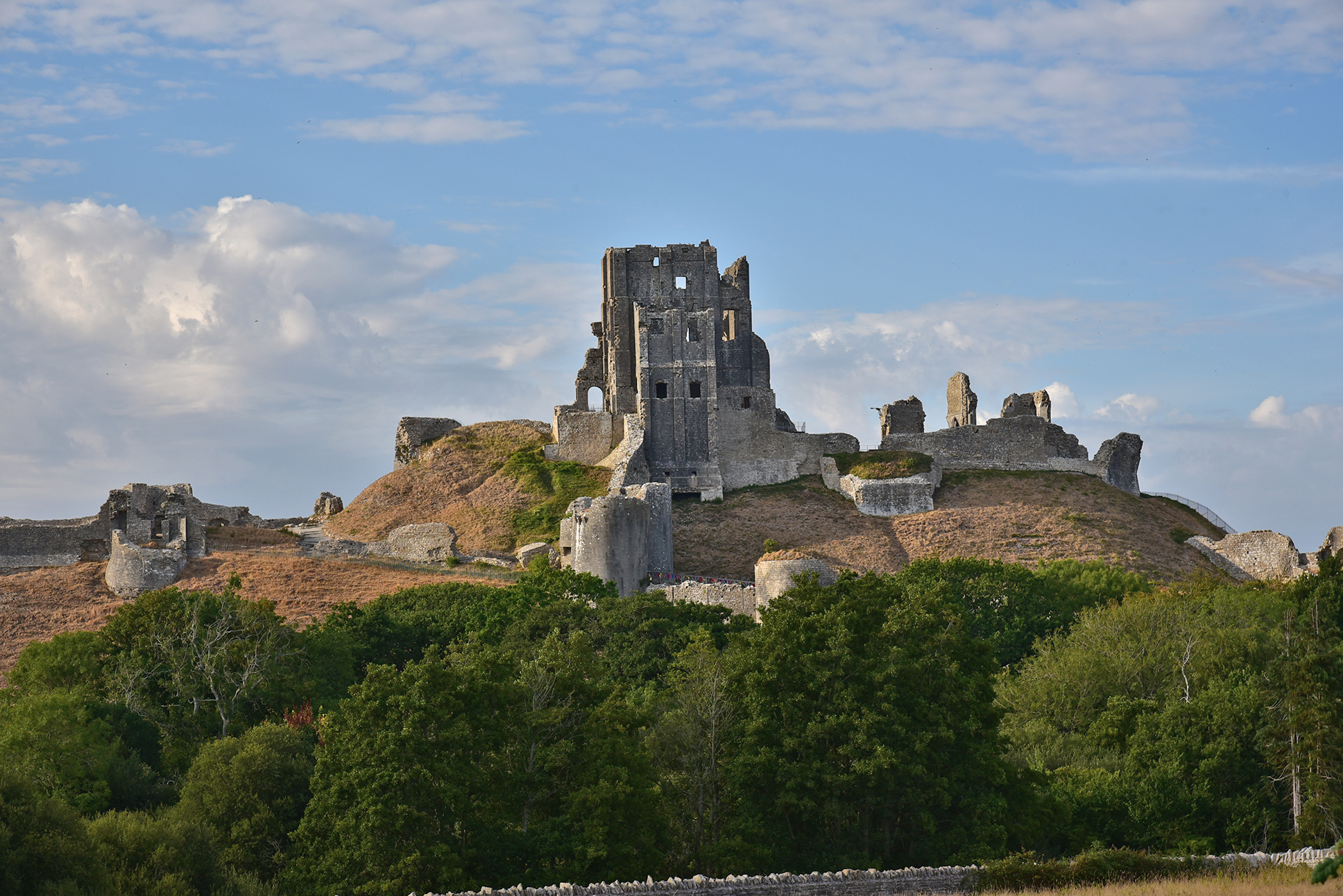
Corfe Castle stands on a steep chalk hill in a gap in the Purbeck Hills in Dorset, and its broken keep can be seen for miles around. The village takes its name from an Old English word for "a cutting," which describes the gap where two streams run through the hills.
Long before there was a castle here, there was a Saxon royal hall, which is thought to have stood on the hilltop, and archaeologists have found its postholes. In 978, the young King Edward came to Corfe to visit his stepmother, Queen Ælfthryth, and her son. He was ambushed when he arrived and cruelly murdered by her servants, and the widowed queen is thought to have ordered the killing. He was born about 962 and had become king in 975, so he was only a teenager when he died. His body was taken to Shaftesbury Abbey, where miracles were said to happen, and that is how he came to be known as Edward the Martyr.
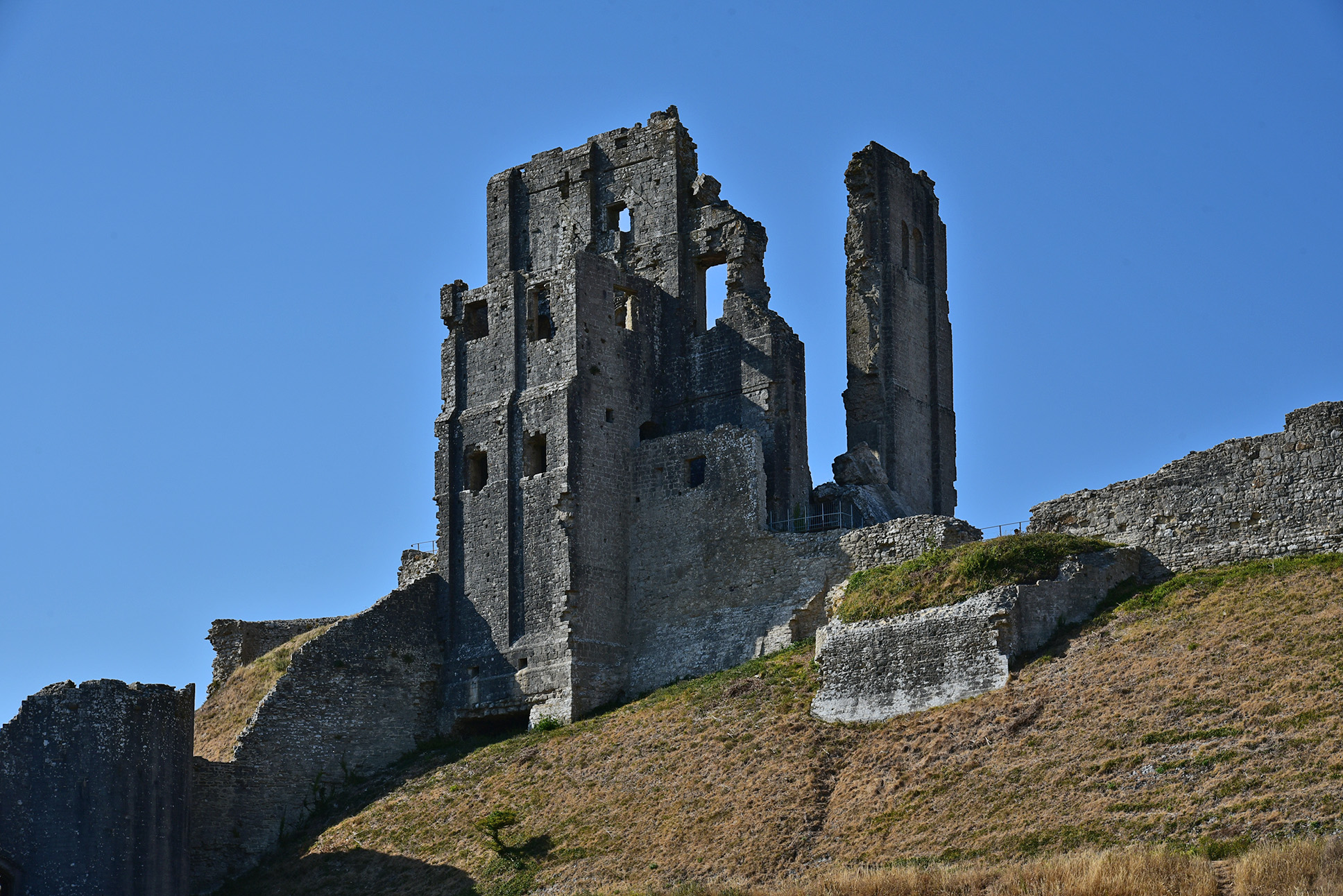
A Norman castle was founded here soon after 1066, probably by William the Conqueror, to guard the gap and control the royal forest of Purbeck. The Normans built the inner ward with a stone wall from the start, which was unusual for the 11th century, and protected the outer enclosures to the west and south with timber palisades. After the Conqueror's death in 1087, his three sons, Robert, William Rufus and Henry, feuded over his lands, and Corfe's story picks up when Henry became king in 1100. Most scholars accept that he ordered the massive stone keep at the beginning of his reign, and it is thought to have been built by 1105, although some think work began in the 1090s. The keep stands 80 feet (23 meters) high, and it was unusually slender for its width. It was built of the finest Purbeck limestone, in blocks dressed by the best craftsmen, and as a defensive structure it was considered impregnable. Henry is also said to have used the keep as a prison for his older brother, Robert of Normandy, whom he captured at the Battle of Tinchebray in 1106, before sending him off to Cardiff Castle to serve a life sentence.
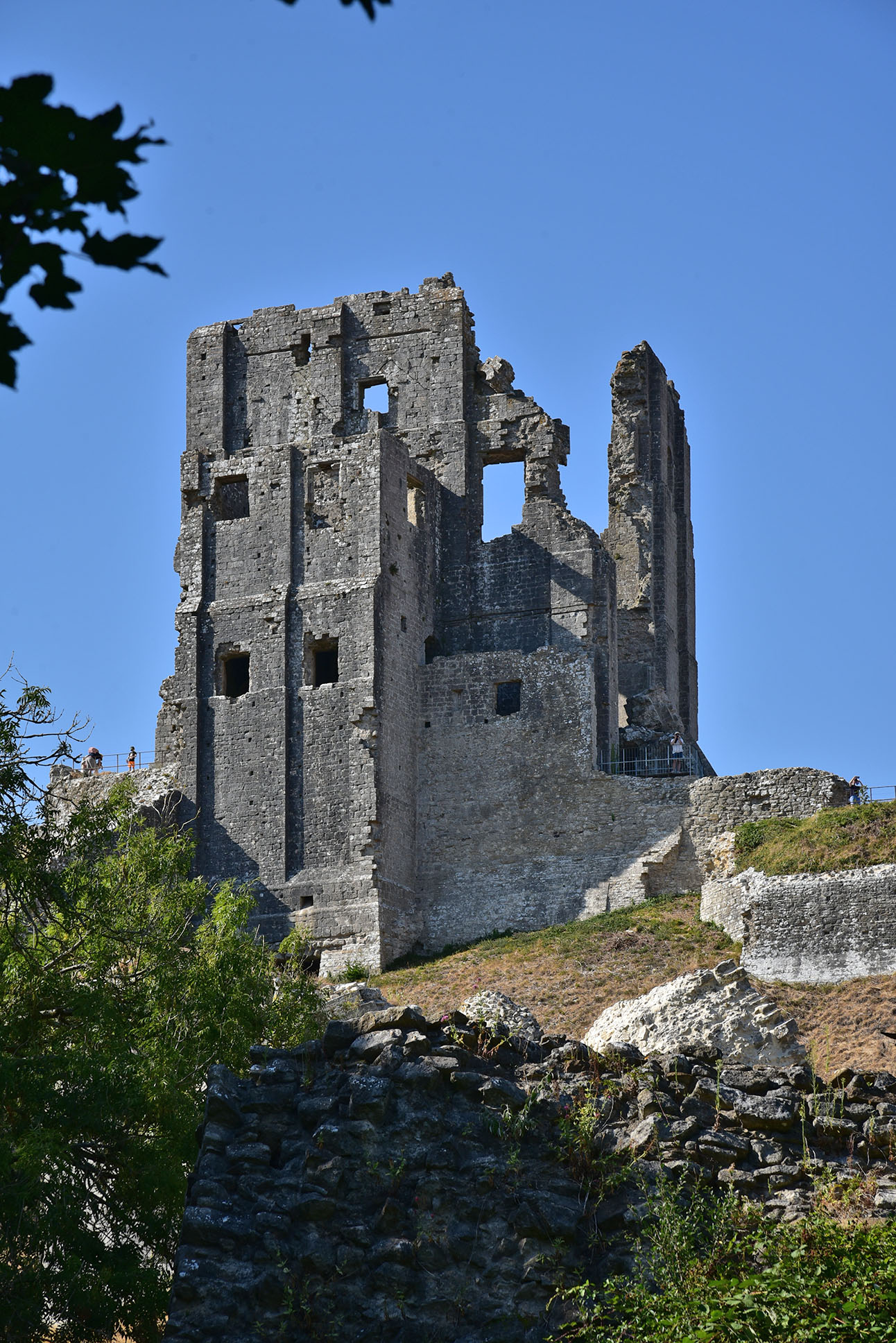
The ruined keep.
Stephen, who was hastily crowned in 1135, soon found himself fighting the supporters of the Empress Matilda. One of them, Baldwin de Redvers, Earl of Devon, had the nerve to gain admittance to Corfe, the king's own castle, and he held it with his garrison. Stephen was in Exeter at the time, and he rushed to Corfe to besiege the earl, but the stone fortress held out, and he had to give up when more dangerous enemies needed his attention. In 1139, as he prepared to attack the earl, Stephen's forces built an attacking base to the west of the castle, known as The Rings. It was used again in the Civil War of the 17th century, and The Rings can still be seen today. Under Henry II, little changed, and under Richard I the records show only maintenance. Corfe's great age as a royal fortress came under Henry II's youngest son, John.
King John spent heavily on Corfe, and he stayed here more often than at any castle other than Marlborough. He spent about £1,400 on building the luxurious palace that became known as the Gloriette, east of the keep, and on strengthening the castle's defenses. According to the royal accounts, more than £750 of that was spent between 1201 and 1204 alone, and about £275 went on the Gloriette. John also rebuilt the defenses of the west bailey, and its wall with three towers dates from 1202 to 1204. Historians have noticed how closely the west bailey resembles the bailey of Château Gaillard, which Richard I had built in Normandy a few years before. Corfe was also John's strongroom. He stored treasure here, including the coronation crown, bags of money from the treasury, and many of the jewels that he loved and collected. He also held hostages and prisoners here, including some Scottish hostages. In 1203, Savari de Mauléon, the same Savari who later commanded the French fleet at Damme, was imprisoned here, and he is said to have escaped by getting his jailers drunk.
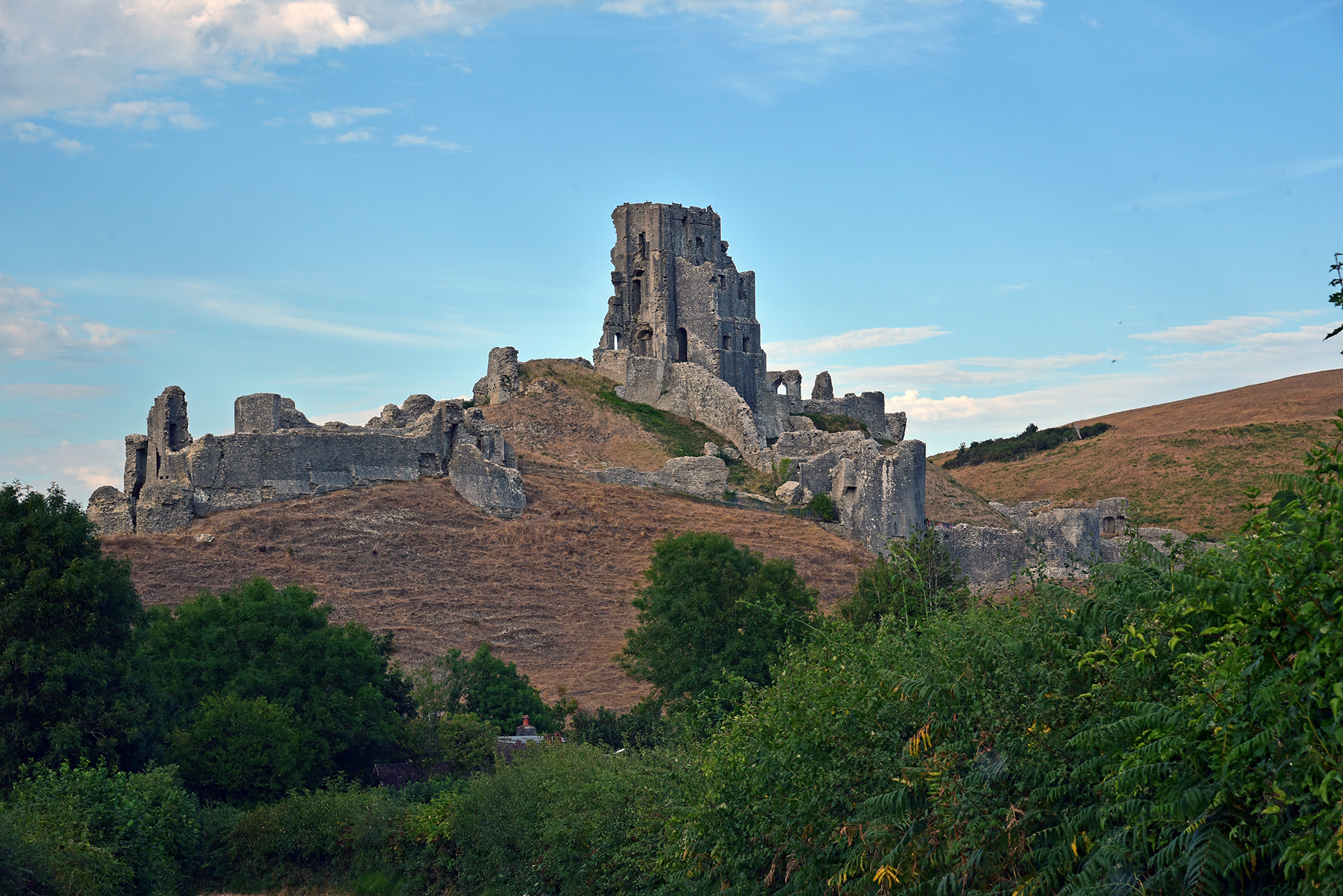
Corfe Castle from the road behind the castle.
Corfe also had a darker use. After John's victory at Mirebeau in August 1202, he took the knights he had captured back to Normandy in chains, and he sent dozens of them to castles in England. In January 1203, he sent some of the Mirebeau prisoners to Corfe, and a few days later he ordered keepers of eighteen castles to send a further twenty-two named prisoners to the same place. According to the chronicler at Margam Abbey in south Wales, "twenty-two of the noblest and strongest in arms were starved to death in Corfe Castle, so that not one of them escaped." The crime was shocking even then, because by the 13th century noblemen were not supposed to kill each other. Arthur of Brittany's sister, Eleanor, the rightful Duchess of Brittany, was among the captives held at Corfe. She was well treated, and although she was held at Corfe for years, probably until about 1222, she remained a prisoner for the rest of her life. Most of her knights were thrown into a deep dungeon and starved to death. The Battle of Mirebeau has the full story of how those prisoners came to Corfe.
The castle proved a convenient prison and place of execution for John's enemies. One of them was Peter de Pomfret, a "prophet" who had the temerity to foretell the end of John's reign. In 1213, the cruel king ordered that he be dragged along the ground by horses for several miles and then, barely alive, hanged, and to compound the cruelty, the prophet's son was hanged alongside him.
John used starvation again in 1210, against Matilda de Braose, the wife of William de Braose, the same man who had seized Arthur at Mirebeau and who had fallen out with the king, and her son, also named William. They are said to have been starved to death at Corfe, although some accounts say it was at Windsor. According to a grim tradition, when the dungeon was opened after they had died, the signs of how desperate their last days had been were too horrible to describe.
Under Henry III's long reign, the castle got even more royal money. More than £1,000 was spent on it. The last of the wooden palisades in the baileys were replaced by stone walls, and the inside of the keep was repaired, including new floors and joists, at a cost of £362 in 1235 and 1236. The keep's massive walls were also rendered and whitewashed, in the same way as the White Tower in London, which made the castle visible for miles. The whitewashing was ordered in 1244. The castle's armory was also useful. In 1224, 15,000 crossbow bolts were sent from Corfe for the siege of Bedford Castle. A camp for the castle's workmen grew into the village of Corfe, which was granted a market and a fair in 1247.
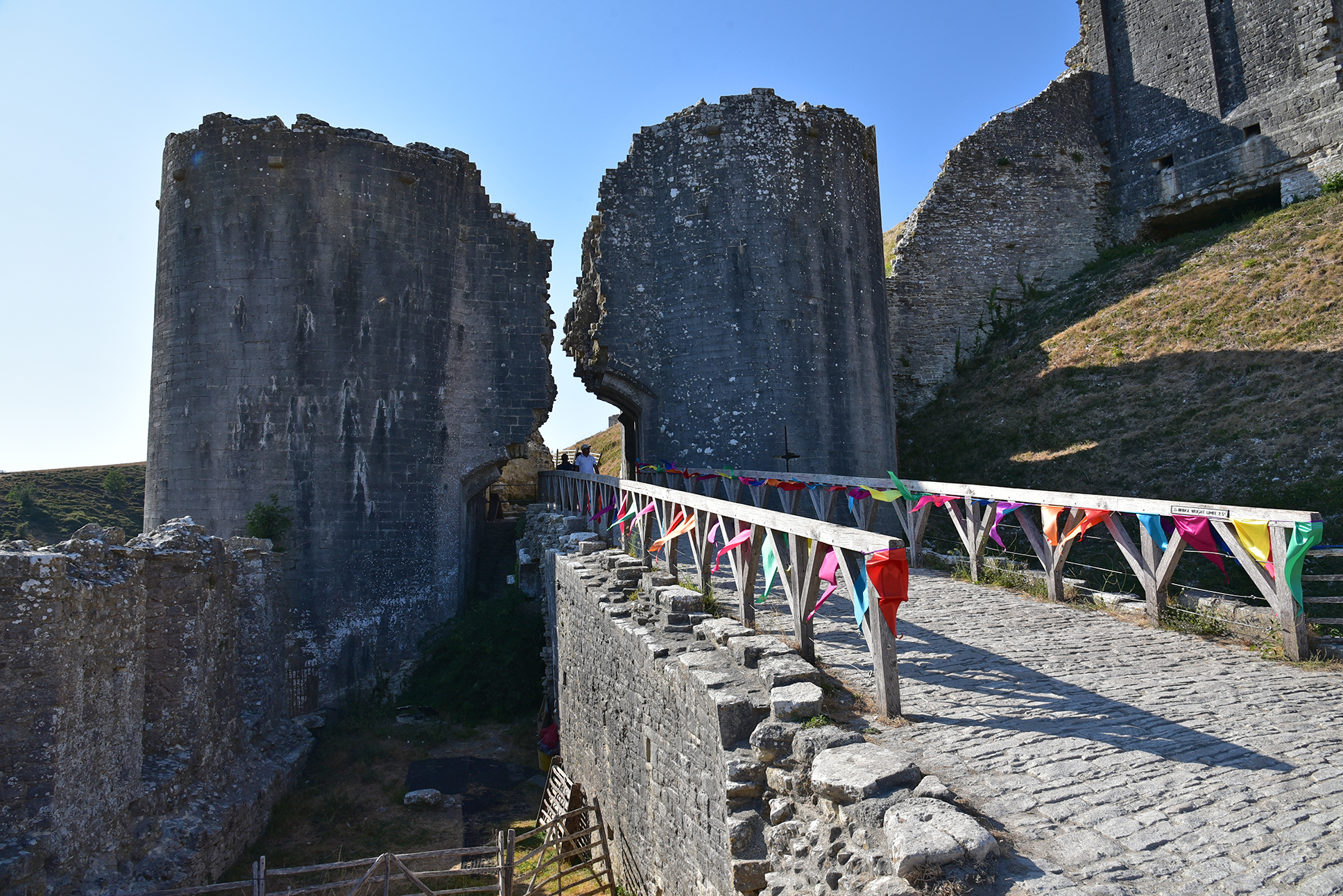
The South West Gatehouse, the way into the West Bailey and the keep.
The entrance to the West Bailey became the double-towered south-west gatehouse, which dates from the middle of the 13th century. It had an inner and an outer portcullis, and wooden fighting platforms that shielded the guards from enemy arrows while letting them throw missiles down on anyone below. Three new towers, the First, the Horseshoe and the Plukenet, were built into the walls of the outer bailey. The Plukenet Tower can be dated to 1269 to 1270, near the end of Henry's reign, and the arms of Alan de Plukenet, who was constable of Corfe Castle from 1264 to 1270, can still be seen on the outside of the tower.
Edward I completed the defenses of the Outer Bailey, including the Outer Gatehouse, and added four more towers: Butavent, which can still be identified in the West Bailey, and three others, Cockayne, Plenty and Sauveray. Edward's accounts show that three years of work on the Gloriette, by the Corfe Castle mason Philip Scroylle, cost him £125. In 1293, the master carpenter, Brother Henry of Bindon, supervised the stone masons Robert Brende and John le Mere as they worked on the roof of the keep, changing it from a pitched roof to a flat one. This turned the attic into a fourth floor.
The castle was often a prison. In 1326, Edward II was held at Corfe for a time before he was taken on to Berkeley Castle, where he was murdered the following year. In November 1386, Michael de la Pole, the 1st Earl of Suffolk, was held here for a few weeks after the Wonderful Parliament impeached him. Corfe was later the chief residence of Edmund Beaufort, 2nd Duke of Somerset, and in December 1450, during the troubles that led to the Wars of the Roses, it was ransacked by the tenants of his rival, Richard, Duke of York.
After Bosworth, Henry VII reined in the barons by banning private armies and making it extremely difficult to build new castles or fortify existing ones. The Beaufort family had provided constables for Corfe for much of the 15th century, before the castle reverted to the crown after 1461, and it became Henry's as he began his reign. He decided that the castle and the Manor of Corfe Castle would make a good present for his forceful mother, Lady Margaret Beaufort, Countess of Richmond, whose machinations had been largely responsible for his accession to the throne. There is no evidence that she ever lived at Corfe, but at least £2,000 was spent on repairs and improvements. When Lady Margaret died in 1509, Corfe reverted to the crown again.
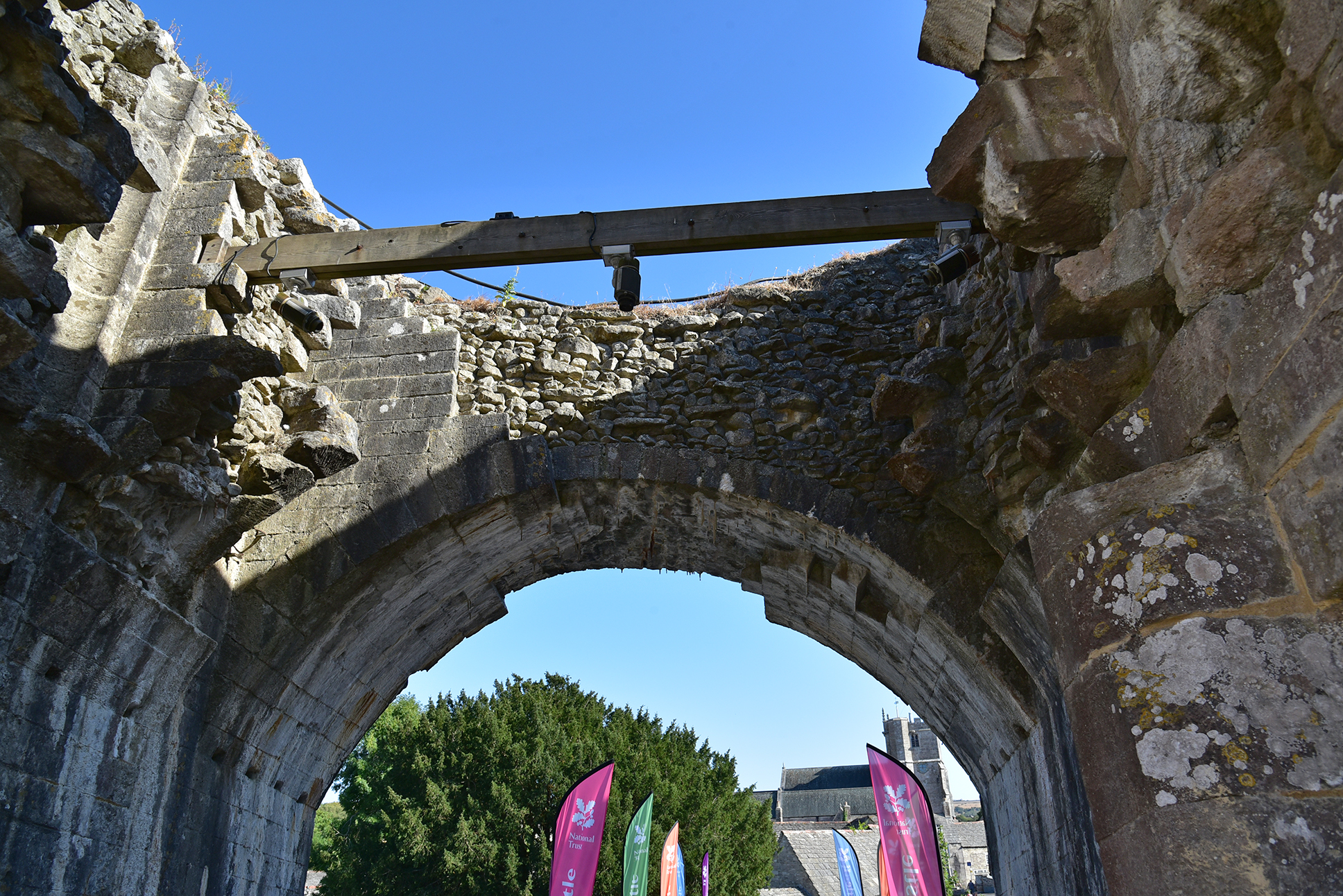
Looking out through the archway of the Outer Gatehouse to the bridge in front of the castle.
Corfe stayed in Tudor hands until 1572, when Elizabeth I sold it to the newly knighted Sir Christopher Hatton, a royal favorite who would become her Lord Chancellor 15 years later. He paid £4,761 18s 7½d for the castle and the estate. His steward, Ralph Treswell, drew up a plan of Corfe in 1586, the oldest surviving survey of the castle. In 1635, the castle was bought by Sir John Bankes, Charles I's Attorney General, who used it as a second home. His wife, Lady Mary Bankes, would become the castle's greatest defender.
The Civil War began in 1642. On May Day, 1643, when most of Dorset was occupied by Parliamentary forces under the command of Thomas Trenchard, the first attempt was made to capture the castle. Sir John was away with the king at Oxford. Lady Bankes had sent her oldest sons abroad for their safety and shut herself up behind the walls of Corfe with her younger children and a few servants. Parliament first tried to take the castle by a ruse, sending soldiers under the pretense of a May Day stag hunt, but she shut the gates against them. Over the next few weeks, she was ordered to give up the four small cannon mounted on the terrace of the Outer Bailey, and the Parliamentarians said they would burn the houses of her tenants if she refused. She handed over the guns and the troops left, which gave her time to stock up on food, drink and ammunition and to call for help from local Royalists. Captain Laurence arrived with 80 soldiers, which swelled the garrison from a handful of people to about eighty. On June 23, 1643, the Parliamentarians were back in position and the siege began.
The Parliamentary force numbered several hundred horse and foot soldiers. They brought two battering rams, known as "the sow" and "the boar," but these proved ineffective. When the troops stormed the castle walls, they were driven back not only by the garrison but also by Lady Bankes, her daughters and her servants, who threw burning coals and heavy stones down on their heads from the high walls. During the six-week siege, the attackers lost more than 100 men and the defenders lost two. The Parliamentarians finally retreated, having stripped the church of its lead and damaged property in the village. In September 1643, Sir John managed to visit his wife, and they had a loving reunion. Their youngest son, William, was born at Corfe Castle the following June.
Lady Bankes's accounts show that she stayed near London for most of 1645. She had returned to Corfe by December of that year, when the castle was besieged once more by Colonel John Bingham. In February 1646, during the second siege, a young Royalist officer turned up at the castle and offered her a chance to escape. She turned him down, determined to fight on. But the loyalty of her garrison was beginning to crumble. During the night of February 26, Lieutenant-Colonel Pitman opened a back door, or sally port, in the north curtain wall to what he called a "party of six score firelocks." They were 120 Parliamentarians disguised as Royalists. On February 27, the castle was occupied and Lady Bankes surrendered. Colonel Bingham formally handed her the castle keys and seals, as a mark of respect for her courage.
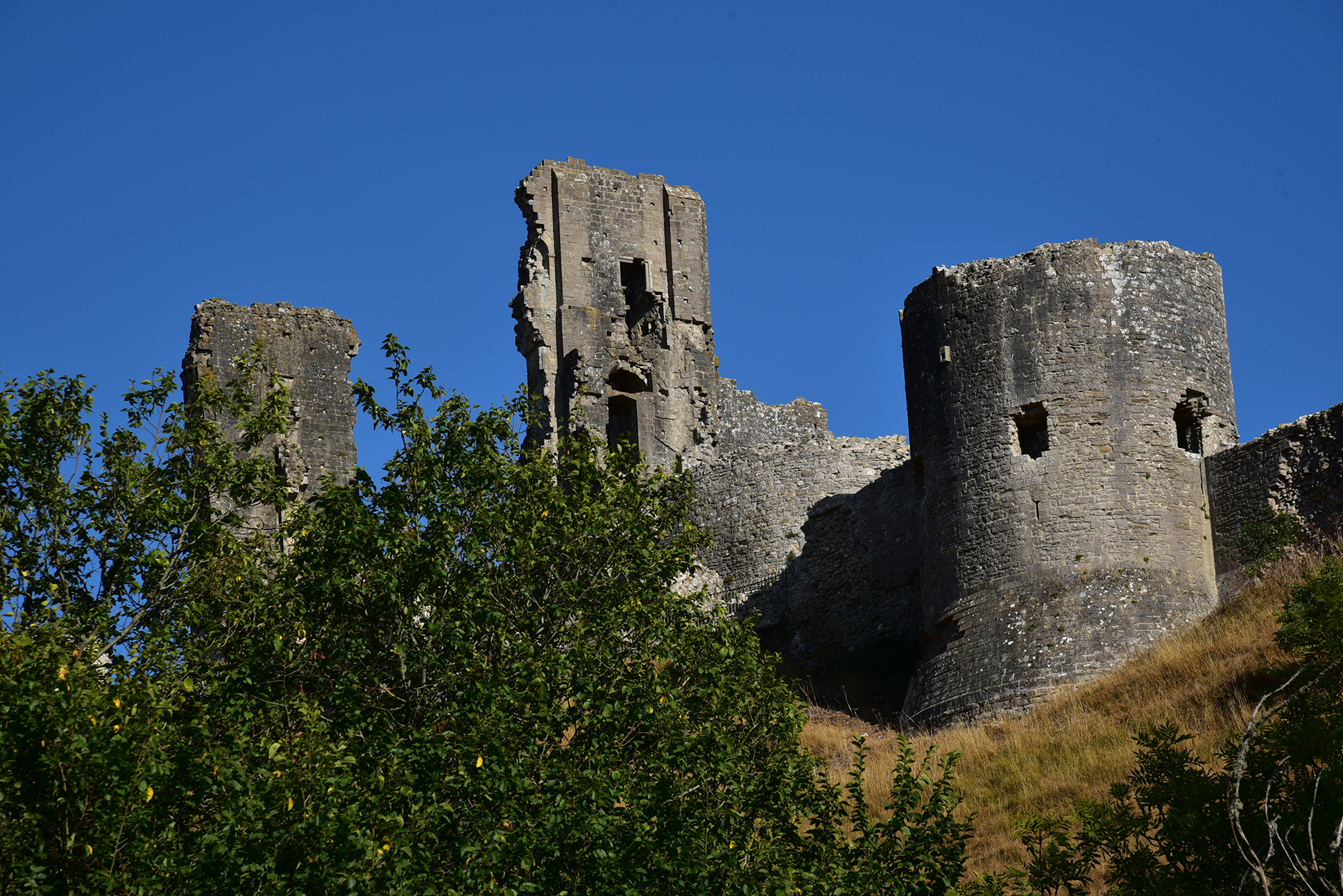
The semicircular North Tower, with the keep rising behind it.
In March 1646, an Act of Parliament was passed to slight, or demolish, the castle. Captain Hughes of Lulworth was appointed to the task, and within a few months he and his team had effectively destroyed the creation of centuries. After the demolition, the remains were pillaged, and the stone, lead and timber found new life in local houses. The North Tower above the West Bailey was taken over in the 18th century by the village rector, the Reverend Thomas Bankes l'Anson, as a place of retreat. The baileys became grassy, peaceful places, rented by farmers for their sheep or for growing hay. The ruins you see today are the result.
After the Restoration in 1660, the Bankes family recovered their property, but they did not rebuild Corfe. They built a new house at Kingston Lacy near Wimborne instead. Ralph Bankes died in 1981, and in 1982 the family bequeathed the ruined castle and their mansion at Kingston Lacy, with its miles of coastland, farms and nature reserves, to the National Trust in perpetuity. Corfe is thought to have been the inspiration for the castle on Kirrin Island in Enid Blyton's Famous Five books, and it appeared in the 1971 film Bedknobs and Broomsticks. The keep area was closed in 2006 because of unstable masonry, and after structural repairs it reopened in 2008 so that visitors could again explore the ruined keep and the inner parts of the castle. In December 2024, visitors were able to reach the high interior of the keep, the level of the upper royal quarters, by a viewing platform, something that had not been possible for ordinary visitors since the Civil War left the tower in ruins.
Castle Highlights
Visitors buy their tickets in the village and walk up to the castle entrance, which leads into the Outer Bailey, the largest of the castle's three enclosures. A path then climbs to the South West Gatehouse, built in the middle of the 13th century, and on through to the West Bailey, where John's wall and towers still stand. Most of what you see today is ruins, but the shapes of towers, gates and walls are easy to follow, and the descriptions on the signs help to fill in what is missing.
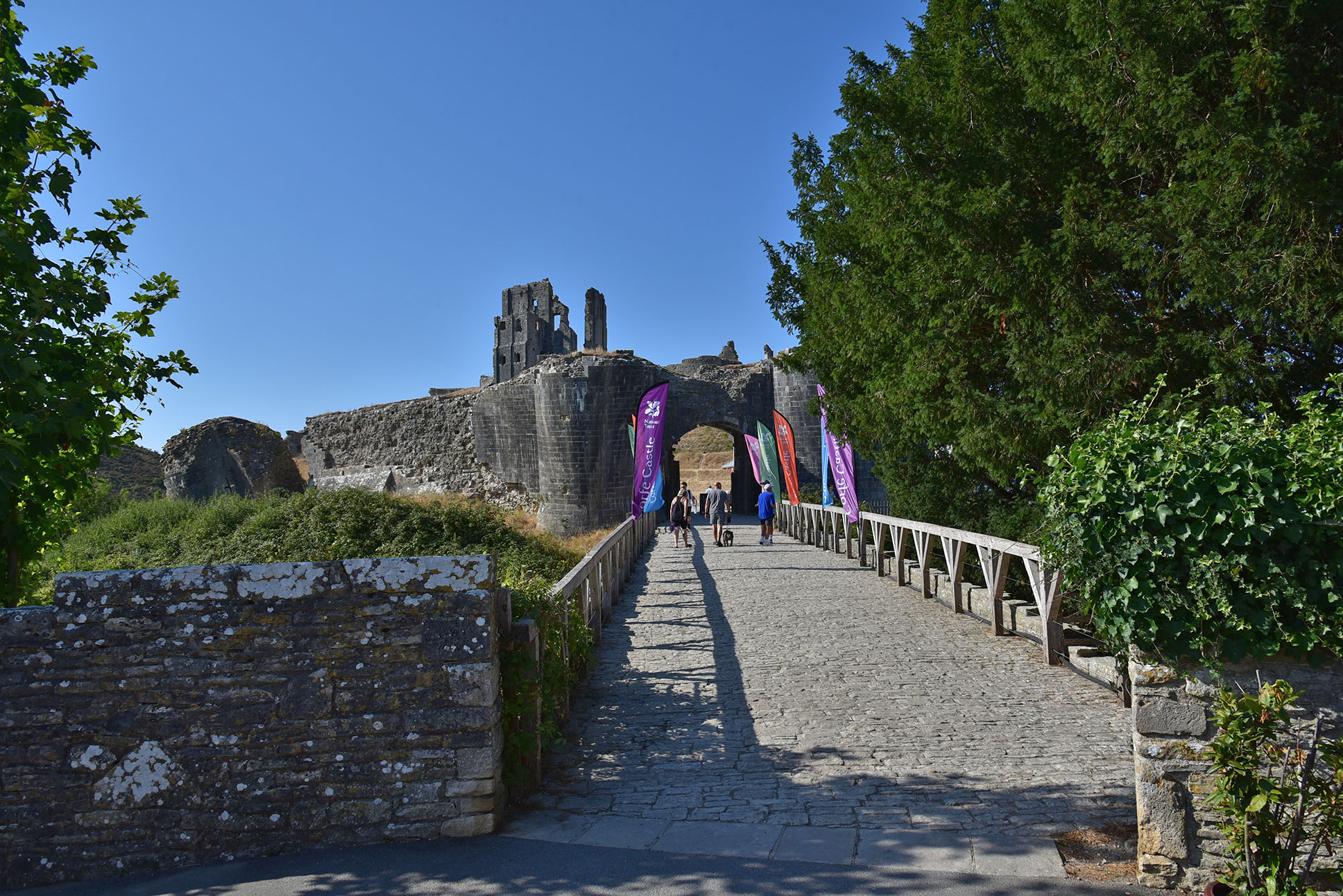
The bridge and Outer Gatehouse on the approach to the castle.
The great keep stands at the top of the hill, in the inner ward. Even in ruins, it has a forebuilding on its west face that once held the entrance stair, and the walls rise to 80 feet. In 2008, conservators found a door high in the keep that was designed for the king to make a formal appearance, and the National Trust says the discovery shows how important the castle was in the early 12th century. The Gloriette, John's luxurious palace, lies to the east of the keep, and it is a rare survivor from his time. The new viewing platform in the keep gives a view that has not been available since the Civil War.
Corfe is not an easy castle for visitors with limited mobility, because the hill is steep and the paths are uneven, with slopes and steps throughout. The castle is about a ten-minute walk from the main car park. The village below the castle has tea-rooms, shops and a station on the Swanage steam railway, and the Old Mill picnic area is a short walk from the main entrance.