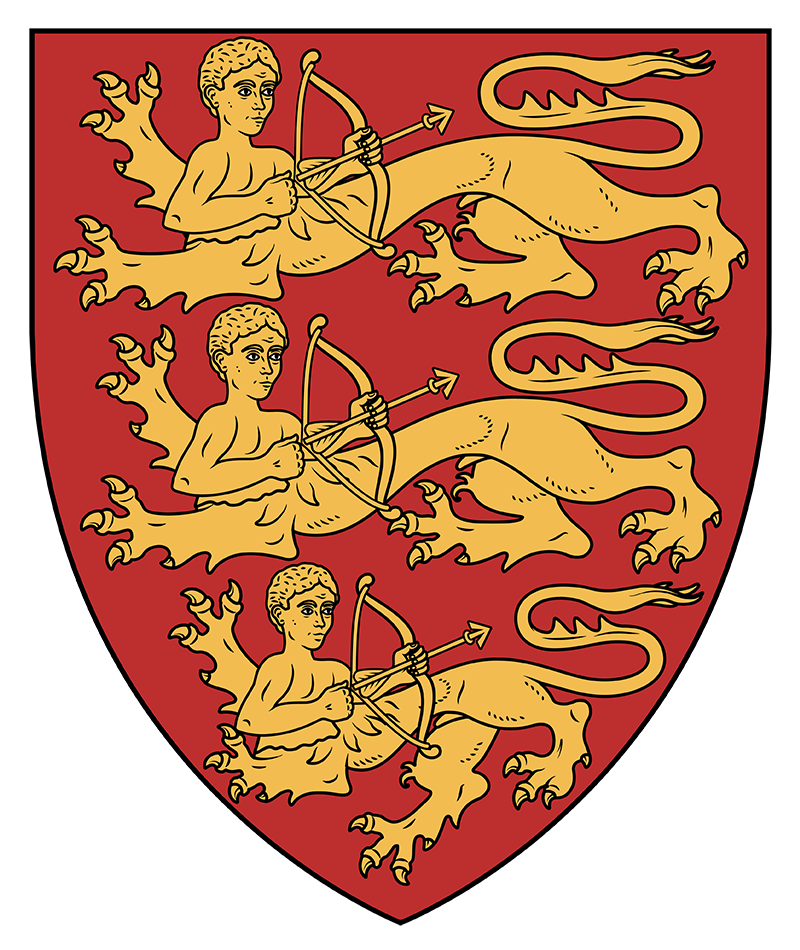
Stephen - King of England (1135-1154)
Stephen of Blois
Stephen ruled England from 1135 to 1154. A grandson of William the Conqueror, he seized the throne after the death of his uncle, Henry I, even though Henry had named his daughter, Matilda, as his heir. The struggle between Stephen and Empress Matilda, known as the Anarchy, dragged on for almost two decades and became a war of sieges and castles. Stephen was captured, freed, and nearly toppled, but he held the crown until his death.

Stephen was born in Blois, France, probably between 1092 and 1096. He was the fourth son of Stephen-Henry, Count of Blois, and Adela, a daughter of William the Conqueror. His father died on crusade in 1102, and his mother, a strong-minded woman, raised the family. Stephen was brought up at the court of his uncle, Henry I, who gave him lands in England and Normandy, including the county of Mortain, and made him one of the wealthiest men in the realm.
In 1120, Stephen was one of the nobles who were supposed to sail on the White Ship, which sank off Barfleur and drowned Henry's heir, William Adelin. Stephen is said to have left the ship before it sailed, claiming he was ill. In 1125, he married Matilda of Boulogne, the heiress to the county of Boulogne and to large estates in England. The marriage made them among the richest couples in the kingdom, and Matilda proved a capable and determined partner. They had at least five children, including two sons, Eustace and William.
In 1127, Stephen swore, along with the other barons, to accept Henry's daughter, the Empress Matilda, as heir to the throne. When Henry died in Normandy on December 1st, 1135, Stephen moved quickly. He crossed the Channel from Boulogne, was welcomed in London, and secured the support of his brother, Henry of Blois, Bishop of Winchester, who helped him take control of the royal treasury. Hugh Bigod, the royal steward, swore that Henry had named Stephen heir on his deathbed. Stephen was crowned at Westminster Abbey on December 22nd, 1135. Matilda was in Anjou and was in no position to act, and most of the barons accepted the new king.
Stephen was generous and brave, but he lacked the ruthlessness that had made Henry I feared. In 1136, he made peace with David I of Scotland in the Treaty of Durham, but the Scots invaded again in 1138, and his northern barons defeated them in August at the Battle of the Standard. That same year, Robert FitzRoy, Earl of Gloucester, Henry I's illegitimate son and Matilda's half-brother, renounced his allegiance to Stephen.
In June 1139, Stephen arrested Roger, Bishop of Salisbury, and his nephew Alexander, Bishop of Lincoln, and seized their castles. The move alienated the Church, including his own brother Henry. In late September, Matilda and Robert of Gloucester landed in England and went to Arundel Castle, where Matilda's stepmother, Adeliza, was living. Stephen besieged them there, but to the surprise of his followers, he allowed Matilda to leave under escort to Bristol, where Robert's supporters rallied to her. Historians still debate why he let her go, though it may have been chivalry or a truce arranged by his brother Henry.

The motte at Arundel Castle.
The war spread across the country, with each side relying on castles. In early 1141, the rebel Earl of Chester seized Lincoln Castle, and Stephen laid siege to it. On February 2nd, 1141, Robert of Gloucester and Chester's forces defeated him at the Battle of Lincoln. Stephen fought on foot until his weapons broke, and he was captured and taken to Bristol Castle. Matilda was acknowledged as "Lady of the English" by Henry of Blois, but she alienated the Londoners and was driven out of the city before she could be crowned.
Stephen's wife, Queen Matilda, rallied his supporters, and in September 1141, they besieged Matilda's forces at Winchester in what became known as the Rout of Winchester. Robert of Gloucester was captured during the retreat, and on November 1st, he was exchanged for Stephen, who was freed after nearly nine months in captivity. He was crowned again at Christmas.

Wolvesey Castle, the palace of Stephen's brother, Henry of Blois, in Winchester.
In 1142, Stephen almost ended the war when he besieged Matilda at Oxford Castle. After three months, she escaped over the frozen Thames in the snow, wearing white robes to blend in with the snow. Stephen's guards were said to be too busy carousing to notice her. She fled to Wallingford Castle, which Stephen failed to take despite building counter-castles around it. In July 1143, Robert of Gloucester surprised Stephen at Wilton and nearly captured him in the Battle of Wilton, though the king escaped. The war settled into a stalemate in which neither side could win.
Meanwhile, Matilda's husband, Geoffrey of Anjou, conquered Normandy by 1144, and Stephen lost the duchy. For ordinary people, the civil war was a time of misery, and many barons took advantage of the chaos to build their own power. Geoffrey de Mandeville, Earl of Essex, who held the Tower of London, changed sides twice before Stephen arrested him in 1143. The Peterborough Chronicle, describing the 1140s, complained that the land was filled with castles, and that men said "Christ and his saints slept." The war also cost Stephen much of his authority in the west and north, where local lords ruled their own areas.
Empress Matilda left England in 1148 and returned to Normandy, but her son, Henry Plantagenet, soon took up the fight. Stephen wanted his eldest son, Eustace, to be crowned during his lifetime to secure the succession, but the Church refused. Queen Matilda died in May 1152. In January 1153, Henry landed in England with a small army, and the two sides met at Wallingford, where they faced each other across the Thames but declined to fight. Eustace died suddenly in August 1153, which removed Stephen's most determined heir.
In November 1153, Stephen and Henry agreed to the Treaty of Winchester, also known as the Treaty of Wallingford. Stephen would remain king for life, and Henry would succeed him. Stephen's younger son, William, was given his father's lands as compensation. Stephen died at Dover on October 25th, 1154, after a short illness, and was buried at Faversham Abbey in Kent, which he and his wife had founded. Henry succeeded him as Henry II, the first of the Angevin kings. Stephen's reign has been remembered as a time of civil war, but his compromise ended the conflict and allowed a stronger monarchy to emerge afterward.