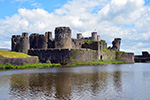
Chepstow Castle / Cas-gwent
History
Chepstow Castle stands on a limestone cliff above the River Wye, on the Welsh side of the border with England. It was founded by William FitzOsbern, the lord of Breteuil in Normandy and a close political colleague and companion in arms of William the Conqueror, whom the king made Earl of Hereford and charged with subduing the Welsh border. Work began in 1067, less than a year after the Norman Conquest, as a base for his conquest of the Welsh kingdom of Gwent, and the Domesday Book of 1086 records that "Earl William built the castle of Estriguil." It was one of the first Norman strongholds in Wales. FitzOsbern built the rectangular Great Tower in stone from the start, rather than in timber, and the builders reused Roman tile, probably taken from the ruins of nearby Caerwent. FitzOsbern was killed in battle at Cassel in Flanders in 1071, and four years later, in 1075, his son Roger of Breteuil rebelled against the king and fortified his lands, so the castle must have been completed by then, if not by the time of his father's death. Some historians think that the Great Tower was only finished around 1090.

Outside the castle, a small town grew up, and FitzOsbern founded a Benedictine priory there, which is now the parish church. The town was known as Cheap-stow, "the market town," and in time the castle took the English name Chepstow in place of the Welsh Ystraigyl, "the bend in the river."
The earliest halls had been barn-like buildings of timber, but by about the year 1000, rectangular stone halls were being built in several parts of western Europe. This was the birth of the stone castle of the Middle Ages, and the hall-keep at Chepstow, which is now called the Great Tower, is very likely one of the earliest of these defensive halls. It was not yet a tower like the later Norman keeps, but a fortified rectangular stone building of two stories, which evolved into the keep over time.
In 1115, Henry I granted the castle to the de Clare family, and it remained with them for most of the century. Richard de Clare, known as Strongbow, the conqueror of Leinster in Ireland, died in 1176, leaving his daughter Isabel as heiress to vast estates in Normandy, England, Wales, and Ireland. For 13 years, until her marriage, Chepstow was in the hands of the king. William Marshal, the future Earl of Pembroke, had stayed loyal to Henry II when almost all others deserted him, and Richard the Lionheart respected him for his loyalty and his skill as a soldier. When Richard became king, he married Marshal to Isabel, the "Maid of Chepstow," in 1189, and Marshal gained Chepstow with her. Chepstow had remained mostly unchanged for nearly a century and a half, but Marshal was a castle builder who remodeled several strongholds with the up-to-date military architecture he knew from his campaigns in France. His most impressive work is the great round keep at Pembroke, guarding the sea route between his British and Irish lands, and many historians consider him England's greatest knight. He worked at Chepstow from the 1190s until his death in 1219.

The Great Tower.
At Chepstow itself, Marshal rebuilt the east curtain wall with two round towers projecting from the wall face, and arrow slits to cover the ground in front of it, to protect the vulnerable side where an approach was possible on level ground. The entrance to Marshal's castle was a simple pointed arch through the curtain wall, without a portcullis, and it was protected by sitting beside one of the two towers, which covered it at close range. A generation later, the castle would be defended by a stronger gatehouse with a defended passage between two towers. Tree-ring dating of the castle's original wooden doors shows that they were made no later than the 1190s, which makes them the oldest castle doors in Europe, according to Cadw.
Marshal's sons succeeded him in turn. In 1228, the king gave 10 oaks from the Forest of Dean for roofing rooms, and in 1234, Gilbert Marshal received several more gifts of oak, and he began the building program at the castle. Before 1245, the sons added a lower bailey with a twin-towered gatehouse, a barbican at the upper end, and more work on the Great Tower. When the last of them died without an heir in 1245, Chepstow passed to the Bigod family through Marshal's eldest daughter, Maud, who had married Hugh Bigod, 3rd Earl of Norfolk. Roger Bigod, 5th Earl of Norfolk, inherited the castle in 1270 and built a new range of buildings in the lower bailey, including a hall block on the north side. Around 1272, he strengthened the upper gatehouse in the barbican with a gate tower and a portcullis, and the next six years were focused on building the town wall, the Port Wall, which was built around 1274 to 1278. After Edward I visited in 1284, he added Marten's Tower, which was built from about 1285 to 1293. It was a large tower at the southeast corner that included a private chapel, and it also provided private accommodation and a military command post for the earl.
Between 1293 and 1300, the Great Tower was enlarged to include an upper story. In 1298 and 1299, a military engineer named Reginald was brought in to advise on the building of four large springalds, or catapults, which were to be mounted on four of the towers, but they were later neglected. Three of them were put in store and later became useless, and it is not clear what became of the fourth.

Marten's Tower.
Because of his lavish building works, Roger Bigod was heavily in debt in his later years. In 1302, the childless earl made an agreement with Edward I that, in return for an annuity, his lands would pass to the crown on his death, and when he died in 1306, they did. With Edward I's conquest of independent Wales, Chepstow's military role declined. Edward II granted the castle to his half brother, Thomas of Brotherton, Earl of Norfolk, in 1312, but for some years it was in the hands of the king's favorite, Hugh Despenser the Younger, who built up a power base in south Wales. The castle later passed to Brotherton's descendant, Thomas Mowbray. In 1403, he was ordered to garrison it against Owain Glyndŵr with 20 men-at-arms and 60 archers, but Glyndŵr's advance was halted at Usk, and Chepstow was not attacked. In 1468, the castle passed to William Herbert, Earl of Pembroke. During the Wars of the Roses, Chepstow was again the refuge of fallen royal favorites, when Richard Woodville, Earl Rivers, and his son Sir John Woodville, the rivals of Warwick "the Kingmaker," fled there after their defeat at Edgecote in July 1469. Warwick pursued them, and the Chepstow garrison handed the unpopular Woodvilles over to him without a fight. They were later beheaded, as was Herbert, their ally, who had only recently acquired the castle and was also executed after Edgecote. In 1508, Sir Charles Somerset, who later became the Earl of Worcester, remodeled the buildings as private accommodation.
During the English Civil War, Chepstow was held for the king, and it was not until October 1645, with the king's cause rapidly becoming hopeless, that Parliamentary artillery finally forced the surrender of the garrison of 64 men and 17 cannon. In 1648, the castle was seized by a local Royalist, Sir Nicholas Kemeys. Cromwell, on his way to reduce Pembroke, demanded its surrender, and when this was refused, he left Colonel Ewer and his regiment to reduce it. Ewer's four cannon quickly breached the walls, probably on the south side near Marten's Tower, where there is higher ground across the castle dell. As Ewer's men prepared to storm the breach, many of the garrison surrendered, and the castle fell on May 25th, 1648. Kemeys and the man who had originally betrayed the castle to him were killed, and Kemeys is commemorated in the Great Tower. The 120 prisoners, including many local Royalist gentlemen, were imprisoned in Chepstow church, but they were later released. Afterward, the south face was reinforced with earth and stone, and the parapets were remodeled with musket loops.
After the war, Chepstow served as an artillery fort, a barracks, and a political prison. Henry Marten, one of the men who signed the death warrant of Charles I, was held at Chepstow, in the tower that now bears his name, for 12 years, and he died there in 1680. The Duke of Beaufort acquired the castle in 1682, but it remained a military garrison until 1690, when the remaining troops were withdrawn. The cannon were shipped to Chester, and then presumably on to Ireland for King William III. The buildings were partly dismantled and left to decay, and in 1899, the Duke tried to sell the castle but found no buyer.

The River Wye and its bridge, seen from the castle.
Chepstow had a colorful 20th century. In 1910 and 1911, Dr. Orville Ward Owen dug in the castle searching for evidence that Francis Bacon had written the plays of Shakespeare, and in 1913, the silent film of Ivanhoe was made in the grounds. In 1914, William Royse Lysaght bought the castle and began conservation work, and in 1953, his family placed it in the care of the Ministry of Works. Cadw has been responsible for the castle since 1984, and in 1977, Terry Gilliam shot scenes for his film Jabberwocky here.
Castle Highlights
Chepstow is one of the oldest and most interesting castles in Wales. Because it was built in stages along a narrow ridge above the Wye, it has a long, terraced layout of upper, middle, and lower baileys, rather than concentric rings of walls, and it shows how castle design changed over time in response to new weapons and the ambitions of its owners.
The Great Tower is described as the oldest surviving post-Roman stone fortification in Britain, and Cadw calls it the earliest datable secular stone building in the country. Marten's Tower dominates the landward approach to the castle, and visitors can go inside it. There is also a high, narrow wall walk at the rear.

The outer gatehouse.
The approach from the town is a steep slope, some of the historic steps are uneven, and the rooms inside the towers can be dark and slippery when wet. Nesting gulls and other birds may be present in the towers, so keep your distance. Dogs on short leads are welcome in the ground-floor areas.
Chepstow Castle can be explored in two to three hours. To see more castles on the same trip, Monmouth Castle and Raglan Castle are each about half an hour away, and the ruins of Tintern Abbey are a few miles up the Wye valley.
Chepstow Castle is also haunted.