Dinefwr Castle / Castell Dinefwr
History
Dinefwr Castle stands on a wooded hilltop at the edge of a cliff above the River Tywi, just outside Llandeilo in Carmarthenshire. For centuries it was the chief seat of Deheubarth, the kingdom of south-west Wales. A fort is said to have stood here since about 876, built by Rhodri the Great at a time when Wales was divided into three great kingdoms, Gwynedd, Powys and Deheubarth, and his grandson Hywel Dda later ruled from Dinefwr. In the 11th century, Rhys ap Tewdwr is said to have held the stronghold against the first Norman invasion of south Wales. No remains from those early periods have been found, however, and the earliest written references to a castle belong to the 12th century.
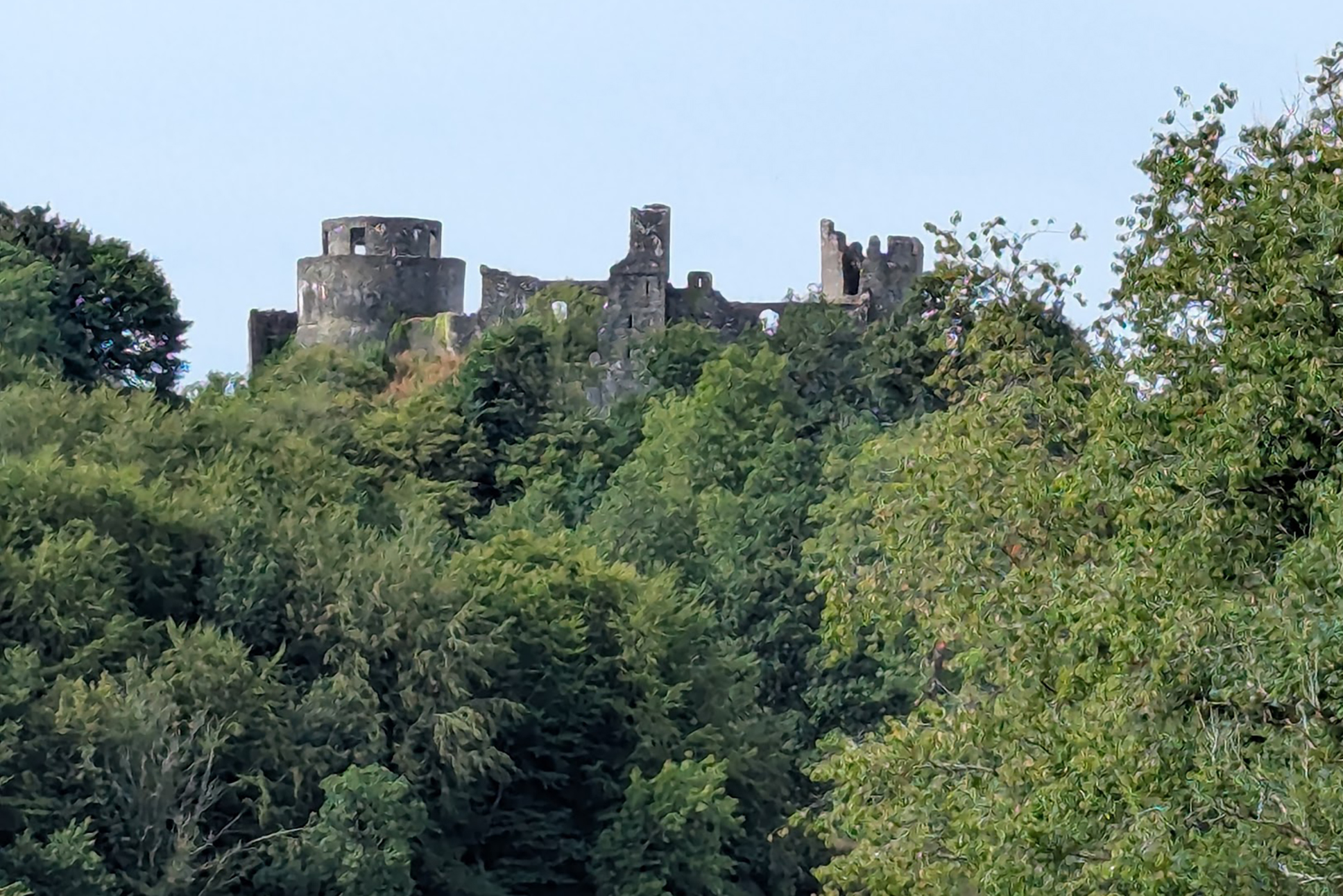
The first great figure in the castle's story is Rhys ap Gruffydd, known as the Lord Rhys and styled the "Prince of South Wales," one of the most influential Welsh rulers of the reign of Henry II. He ruled Deheubarth from 1155 until 1197. He is thought to have built or rebuilt the castle. Under his rule, Deheubarth became the most powerful Welsh kingdom, under English overlordship, and his reign brought a rare period of peace and stability, along with a flowering of Welsh poetry, music and culture. Nobody can be sure what his castle looked like, but it probably had an inner ringwork and an outer ward with two gates, and the inner ward is remarkably intact today.
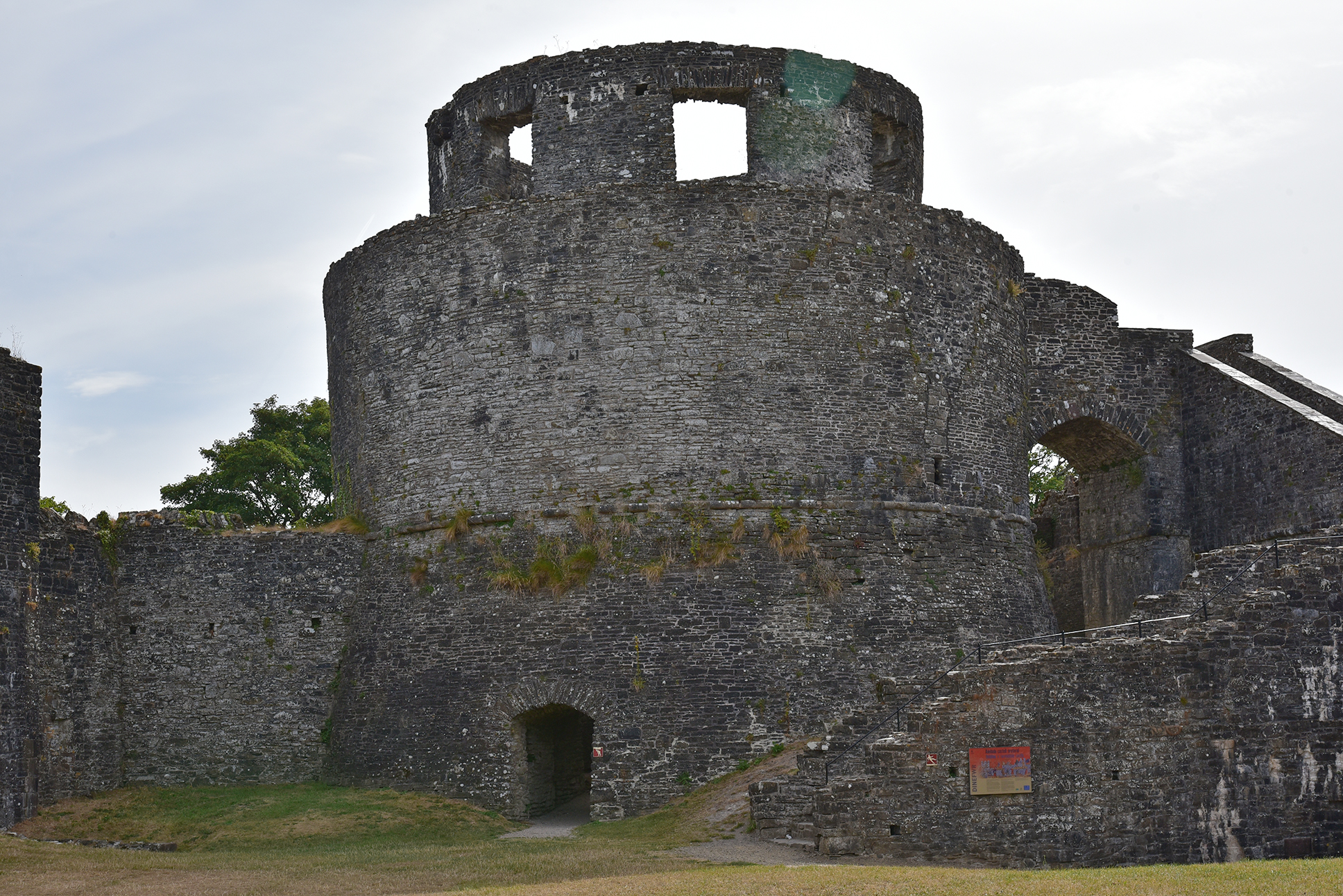
After the Lord Rhys died, his sons fought over his inheritance, and Dinefwr passed to his son Rhys Gryg. Llywelyn the Great imposed a division of Deheubarth in 1216, and Rhys Gryg may have pulled down part of the castle wall in 1220 to keep Llywelyn happy. The original castle was demolished and rebuilt around 1230, and the great round keep, the most impressive part of the castle, dates from this early 13th-century work. It may be the work of Rhys Gryg. Over the following decades, the Welsh princes quarreled among themselves and fought the English, and Dinefwr changed hands several times.
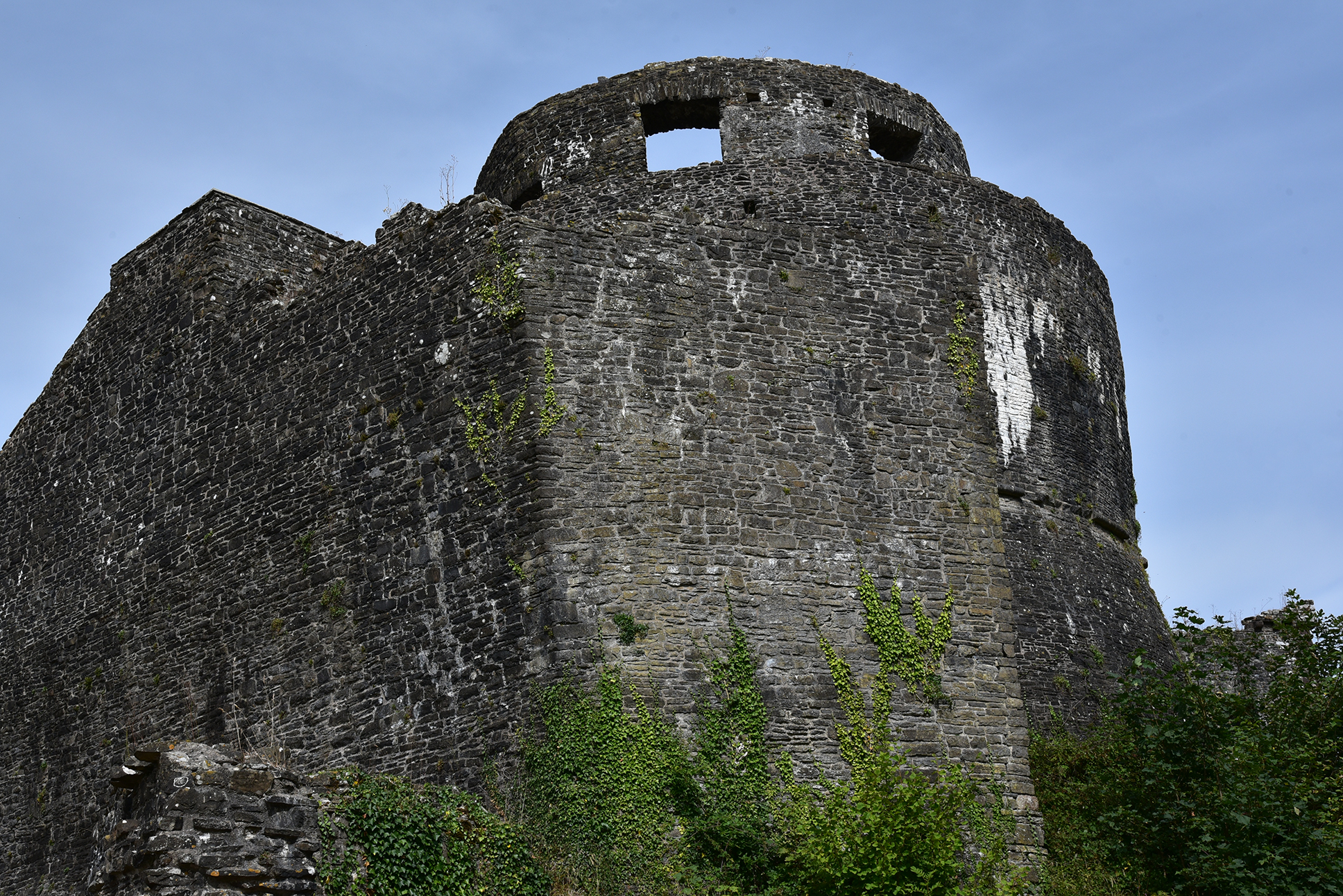
The round keep, seen from outside the inner ward.
The end of Welsh rule came in the reign of Edward I. Rhys ap Maredudd, the lord of Dinefwr, was one of the first Welsh nobles to submit to Edward during the war of 1276-77, but the king refused to give him the castle. In 1287, while Edward was away in Gascony, Rhys rebelled and captured most of the Tywi valley, including Dinefwr and Carreg Cennen. The revolt was put down, and Dinefwr passed into English hands, where it stayed for centuries. Rhys went into hiding, was captured in 1291, and was executed for treason at York in 1292. Records of the 1280s show repairs to the tower, the hall and the bridge, a new gate, and new buildings in the bailey, and some of the buildings along the north-east wall may date from this period.
The castle's later medieval story was a quiet one. The keep was reported to be close to collapse in 1343 and again in 1353. In 1403, forces of Owain Glyndŵr besieged Dinefwr but failed to take it, and some repairs seem to have followed. Records of building work for the rest of the Middle Ages are scarce, although the hall and solar are thought to date from the 15th century.
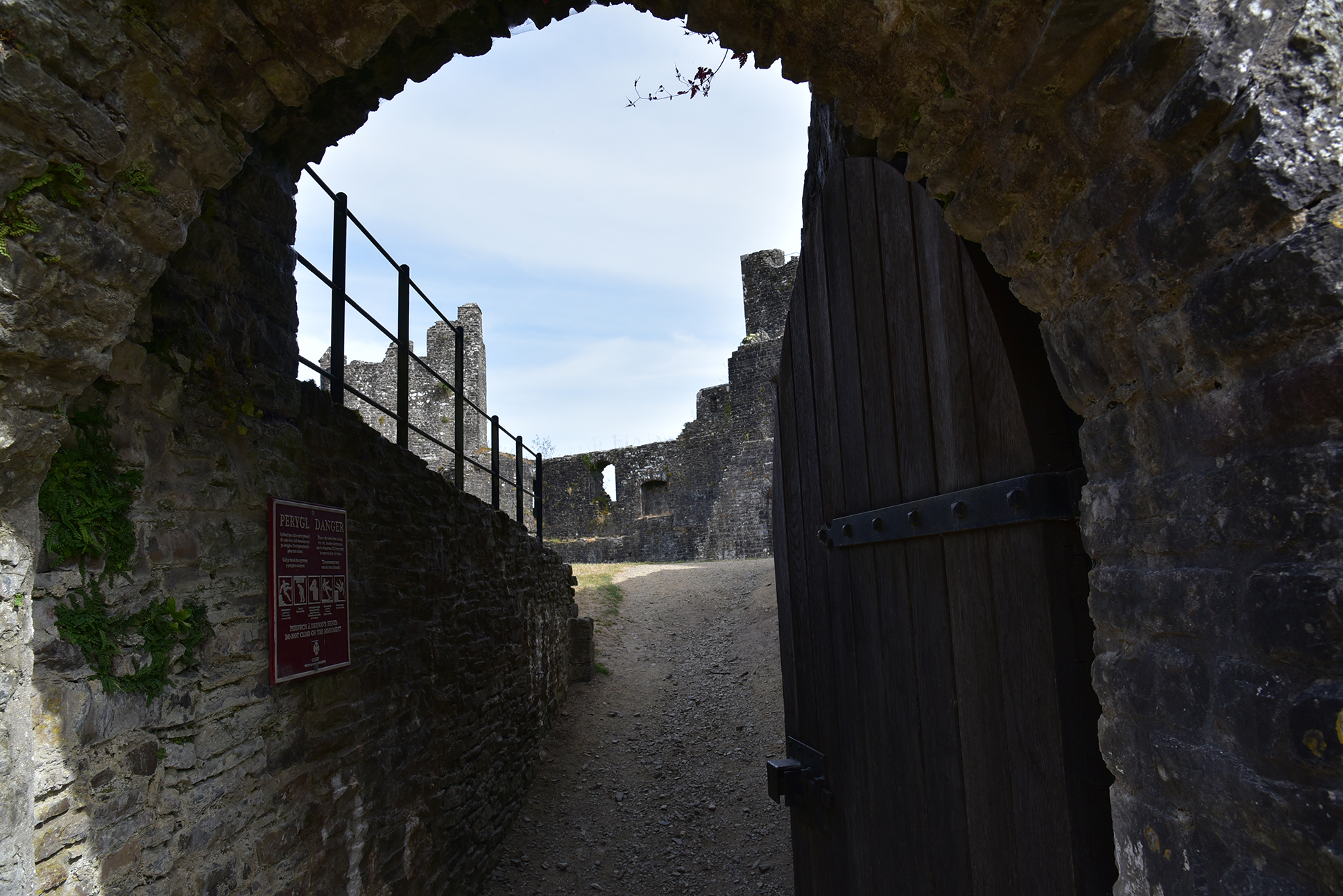
The entrance gate to the inner ward.
The Tywi valley's most successful Welsh family later came to hold Dinefwr. In 1440, Gruffydd ap Nicolas took the lordship of Dinefwr on lease, and his descendants made the area around Dinefwr and nearby Newton the base of their fortunes. His grandson, Rhys ap Thomas, became the most powerful man in south Wales under Henry VII. After the Battle of Bosworth in 1485, the king rewarded him with a gift of Dinefwr. Rhys ruled from Carew Castle, but Dinefwr remained the family's home in the Tywi valley. In 1531, his grandson Rhys ap Gruffydd was executed for treason, and the crown seized the castle, though the family later recovered it.
By then, the family had moved down the hill to a mansion at Newton, and the castle was left behind. Newton House was rebuilt in 1660, and in the later 17th century the top of the keep was rebuilt as a summerhouse, so that the family could enjoy the views over their park, and the southern turret was given a floor and a roof. The roofs burned in the 18th century, and the castle was largely abandoned. The Dynevor estate carried out repairs in the 20th century, and today the castle is cared for by Cadw and owned by the Wildlife Trust of South and West Wales, while the park around it belongs to the National Trust.
Castle Highlights
Dinefwr is a castle of two parts. The upper and lower outer wards on the hilltop were protected by ditches cut from the solid rock, and the entrance leads through a series of gates, an outer gate, a middle gate and an inner gate, before you reach the inner ward. The inner ward has a polygonal curtain wall with a turret at the southern end, and the 1280s work may have added a barbican and a ditch in front of the gate.
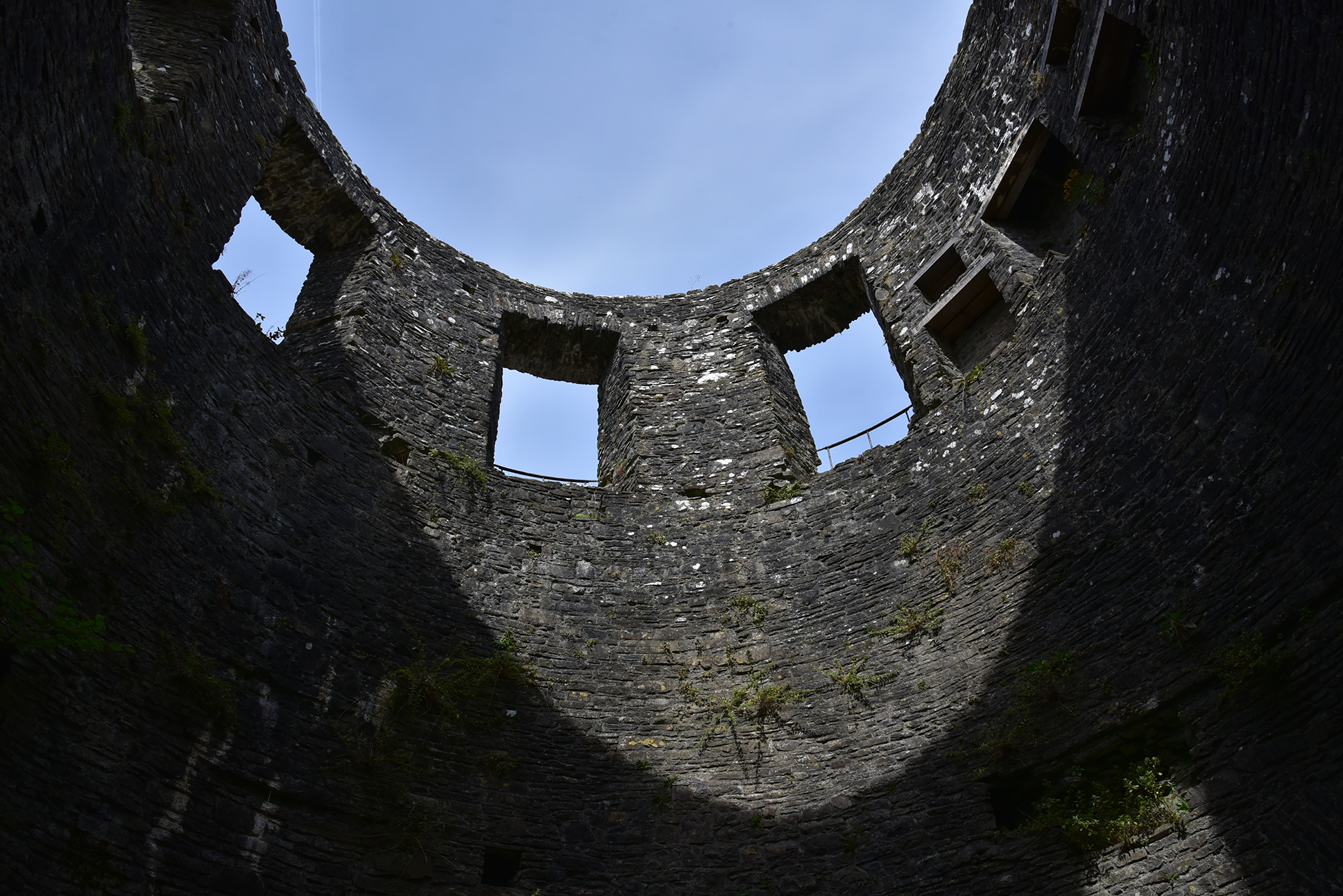
Looking up inside the round keep.
The round keep stands in the middle of the inner ward. It is a great cylinder of stone, and its ground-floor doorway was probably cut around 1326. A walkway circles the top of the keep, and it can only be reached by walking along the battlements. The keep belongs to a group of similar Welsh round towers, such as those at Bronllys, Skenfrith, Tretower and Dryslwyn, that all seem to date from the 13th century.
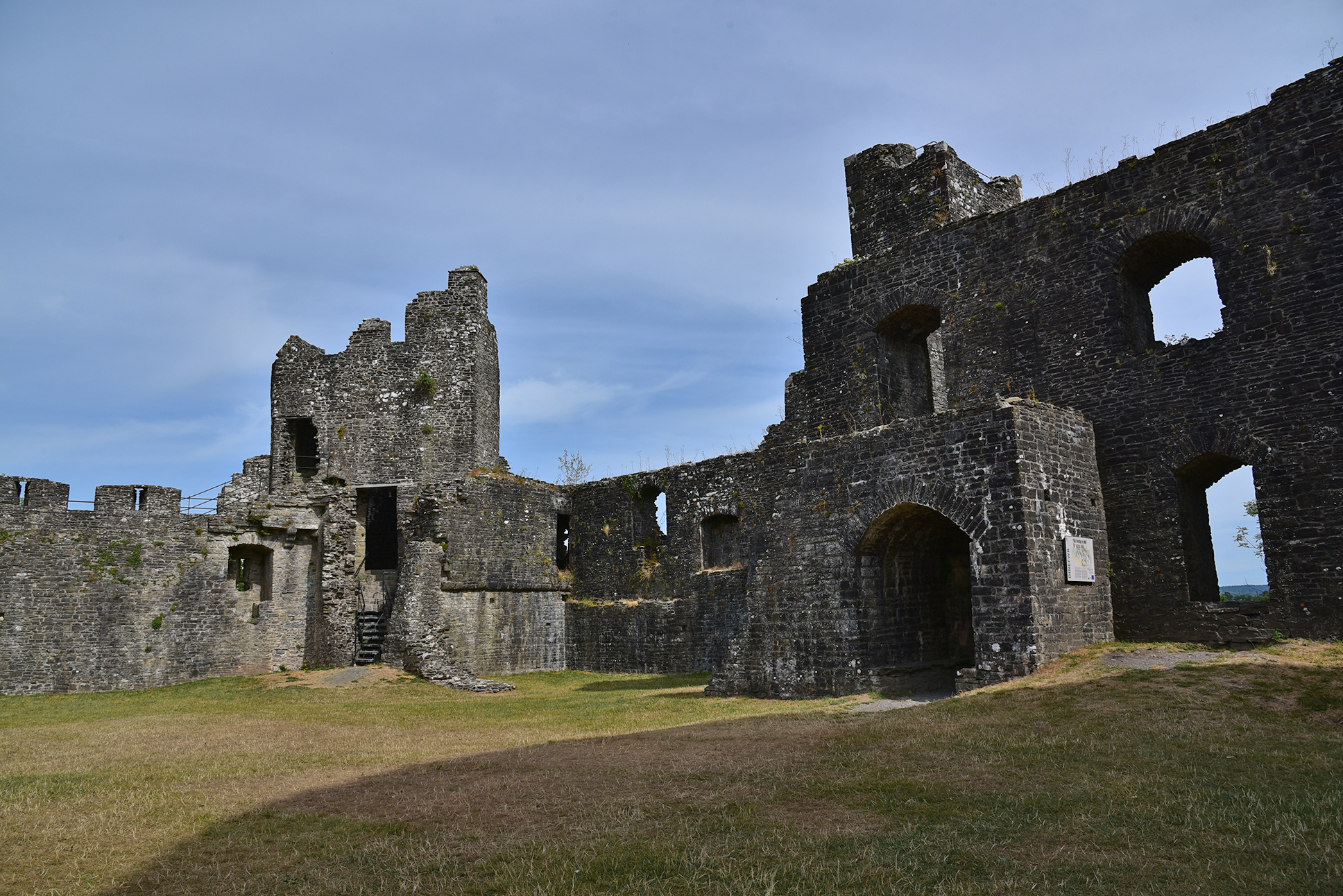
The range containing the Great Hall and Chamber Block, with the North-West Tower at left.
The rest of the buildings line the walls of the inner ward. In the north-west corner, a round tower, the North-West Tower, was built in the 13th century and rebuilt around the time of Edward I. A narrow spiral stair inside leads to the top, where you can look out over the deer park and the Tywi valley. Along the north-eastern wall, on the side away from the cliff, are the Chamber Block, with a basement entrance and a small watch turret, and the Great Hall. The hall and solar were built in the 15th century, although parts of the Chamber Block may be older, and the hall made the entrance to the North-West Tower rather cramped. Elsewhere in the ward you can find a well and several garderobes, the medieval toilets.
Dinefwr is free to enter, and the castle is usually open daily, but check the Cadw website for the current hours. The path up through the woods takes about 20 minutes from the car park near Newton House, and it is steep in places, so it is a real walk. The ground can be uneven and muddy, and there are hidden drops, so Cadw rates the terrain as strenuous. Rhys ap Thomas's story continues at Carew Castle, which is about an hour's drive to the west.