Middleham Castle
History
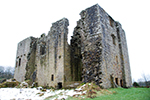
Middleham Castle stands in the market town of Middleham in Wensleydale, North Yorkshire. Its story begins around 1086, when a ringwork castle was built on a hill known as William's Hill, a short distance to the south-west, probably by Alan Rufus, a Breton follower of William the Conqueror, or one of his men.

The castle that survives today was built around an immense stone keep, one of the largest in the country. Architectural evidence dates it to about 1170 to 1180: a water-leaf carving in the small chapel inside the keep points to the second half of the 12th century, and the stepped plinth outside the keep resembles that of the keep at Newcastle upon Tyne, built between 1168 and 1178. That would place its construction under Robert FitzRandolph, grandson of Ribald.
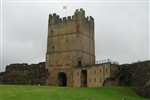
The Nevilles, one of the great northern families, acquired the castle through marriage. In 1270, Middleham passed to Robert de Neville through his wife Mary, daughter and heiress of Ralph fitz Ranulph. In 1271, Ranulph, 3rd Baron Neville, inherited it. By then, a tower with a chapel had been added to the east side of the keep, and the curtain wall was probably built in the early 14th century. In 1388, Ralph Neville, 1st Earl of Westmorland, inherited Middleham and won a market and fair for the town. Between about 1397 and 1410, he carried out major works, adding accommodation and converting the north-east tower into the gatehouse. Henry IV stayed at the castle in 1410.

The gatehouse, converted from a tower around 1400.
The Neville name reached its greatest fame in the Wars of the Roses with Richard Neville, Earl of Warwick, known as "the Kingmaker." In more settled times, from the later part of 1465 until probably 1468, the king's younger brother, Richard, Duke of Gloucester, the future Richard III, lived for some of that period at Middleham in the care of the Earl of Warwick. Warwick's fortunes changed when he turned against Edward IV. In 1469, he captured the king and briefly held him prisoner at Middleham. Warwick was killed at the Battle of Barnet in 1471.
Richard acquired the Neville lands in the north after Warwick's death, married Warwick's daughter, Anne Neville, and made Middleham his main home. Their only son, Edward of Middleham, was born at the castle around 1474. In 1483, Richard seized the throne as Richard III, though he spent little time at Middleham during his short reign. After a short illness, Edward died at the castle in April 1484, aged ten, and Richard is recorded as staying there for several days afterward. Anne died the following year, and in August 1485, Richard himself was killed at the Battle of Bosworth. Middleham passed to the Crown.

A statue of Richard III in the castle grounds.
The castle declined after the Nevilles. A Crown survey in 1538 found it in poor condition, and in Elizabethan times, a proposal to demolish it and build a manor house came to nothing, though the buildings fell into disuse. In 1604, James I sold the castle to Sir Henry Lindley. During the Civil War, Parliament ordered the castle destroyed in 1647, but no record shows the order was carried out. After the Restoration, the Wood family bought it in 1660.
In 1889, the Woods sold the castle to Samuel Cunliffe Lister, later Lord Masham, whose family had Walter Brierley conserve the ruins between 1897 and 1906. In 1925, the castle was placed in the guardianship of the Office of Works, which extensively repaired it, and it was given to the state in 1930. Since 1984, it has been in the care of English Heritage. In 1985, a metal detectorist found the Middleham Jewel, a gold pendant set with a sapphire, from the 15th century, near the castle. It may have belonged to a member of Richard III's family, and it is now on display at the Yorkshire Museum in York.
Castle Highlights
The keep is the heart of Middleham Castle. It is one of the biggest Norman keeps in England, about 32 meters long and 24 meters wide, with turrets at the corners and along the walls. Inside, the ground floor had two large chambers, and the upper level held two grand halls. A viewing platform on the keep gives views across Wensleydale. In the 15th century, the Nevilles added three ranges of luxurious rooms around the keep, which earned Middleham the nickname the "Windsor of the North."
Look for the multi-storey toilet tower and the horse-powered mill that once ground grain for the castle, as well as the kitchen, the cellars, and the well. The tower in the south-west corner is called the Prince's Tower, since tradition says Edward of Middleham was born there, though he was not necessarily born in that tower.
An exhibition about notable people from the castle's past includes a replica of the Middleham Jewel.
The statue of Richard III in the grounds is by the sculptor Linda Thompson and was put up in 1996. It is meant to show different views of the king, from a benevolent ruler to Shakespeare's villain. Look at the back, where a basilisk and a medieval demon wind up and around the figure, while the white boar, Richard's emblem, lies at his feet.
Middleham is best explored in an hour or two. Bolton Castle and Richmond Castle are both within a half-hour drive, which makes it easy to see a second castle the same day.
Middleham Castle is also haunted, and legend says treasure is hidden there.