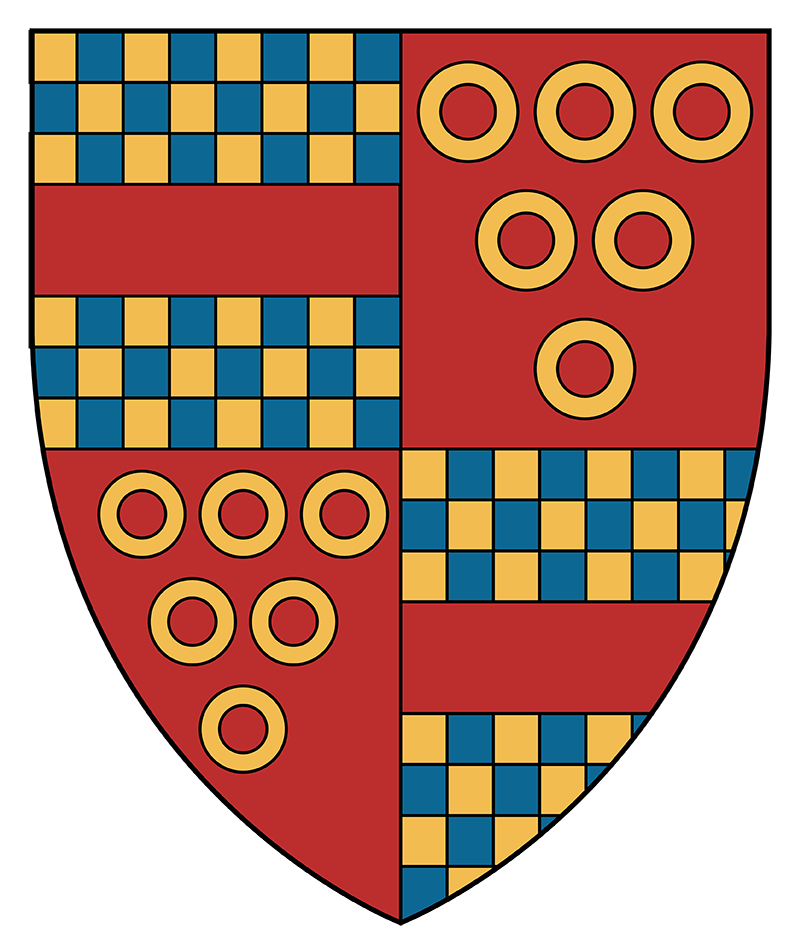
Lady Anne Clifford - 14th Baroness de Clifford
Lady Anne Clifford was a Yorkshire and Westmorland heiress who spent almost forty years fighting to win back the Clifford lands that her father had left to his brother. She finally took possession in 1649, when she was nearly sixty, and then spent the last twenty-seven years of her life restoring the castles and churches of her ancestors. By the time she died, she had rebuilt or repaired five Clifford castles and left behind some of the best personal records of any woman of her age.
Anne was born at Skipton Castle on January 30th, 1590, the only surviving child of George Clifford, 3rd Earl of Cumberland, and Lady Margaret Russell. Her father was Queen Elizabeth's champion at the joust and a privateer who made at least eleven voyages against the Spanish, including one in the Armada year of 1588, but he was rarely at home, and her two brothers, Francis and Robert, died as small children. Her mother saw that she was well educated, and the poet Samuel Daniel was her tutor. Elizabeth I was fond of her, and Anne remembered the queen's death in March 1603. John Donne later said that she could "discourse of all things from Predestination to Slea-silk".
The trouble began when her father died on October 30th, 1605. He left his estates to his younger brother, Francis, who became the 4th Earl of Cumberland, and gave Anne 15,000 pounds. She and her mother argued that an entail made in the reign of Edward II meant the Clifford lands, including Skipton, Appleby, Brougham, Brough, Pendragon, and Barden, belonged to the only surviving child. Her mother died in May 1616, a month after their last parting at Brougham, and Anne carried on alone. In 1616 and 1617, King James I tried to make her settle, and by her own diary, she refused to give up Westmorland on any terms. She wrote that she felt like an "owl in the desert", and in March 1617, the king gave the lands to the Cliffords.
Anne's marriages did little to help. On February 27th, 1609, she married Richard Sackville, 3rd Earl of Dorset, and they lived at Knole in Kent, where he gambled heavily and once sold Knole to a London merchant and rented it back. They had five children, but only two daughters, Margaret and Isabella, lived to grow up. After Dorset died in 1624, Anne married Philip Herbert, 4th Earl of Pembroke and Montgomery, on June 3rd, 1630. They became estranged, and when the Civil War began, Pembroke sided with Parliament while Anne stayed loyal to the king and lived at Baynard's Castle in London. She kept a diary through those years, partly as evidence for her case, and she never stopped making legal claims to her inheritance.
Her uncle Francis died in 1641, and her cousin Henry, the 5th Earl of Cumberland, died in 1643 without a son, so the barony of Clifford and the family lands finally passed to Anne. The war kept her away from them, and in 1646, she commissioned the Great Picture, a triptych that shows her parents and brothers in the center and Anne herself at fifteen and at fifty-six on the two wings. It now hangs in Abbot Hall Art Gallery in Kendal. She made her first journey north to Westmorland and Skipton in 1649, and Pembroke died the next year.
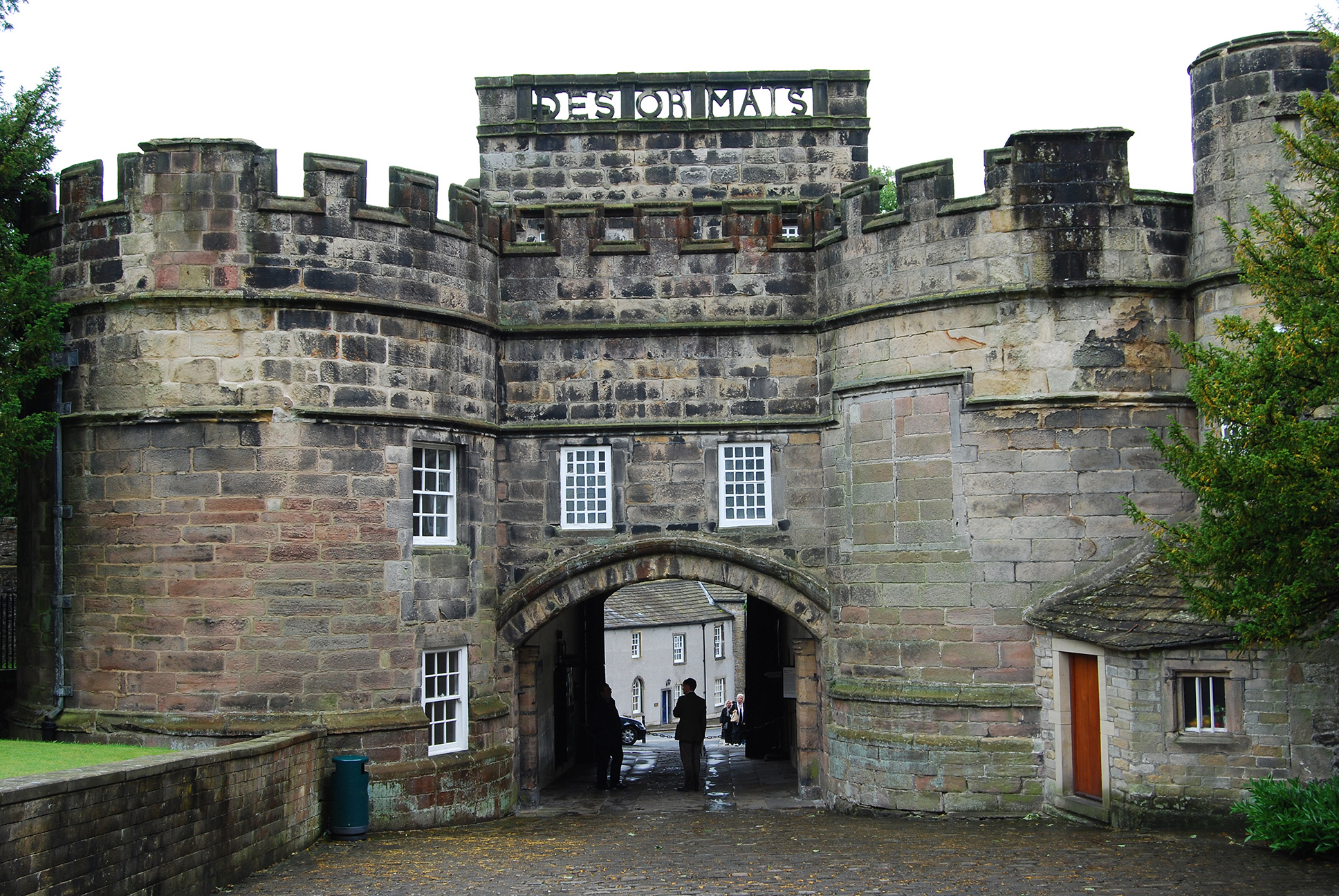
Skipton Castle held out for the king until its garrison surrendered in December 1645, the last Royalist garrison in the North. After Royalists reoccupied it in 1648, Cromwell slighted its defenses, and Anne repaired it. In 1659, she planted a yew tree in the central courtyard to mark the completion of her work, and the Clifford motto, Desormais, which means "henceforth," still runs across the gatehouse. When someone suggested that Oliver Cromwell stop her from building, he is said to have replied, "Let her build what she will, she shall not be hindered by me."
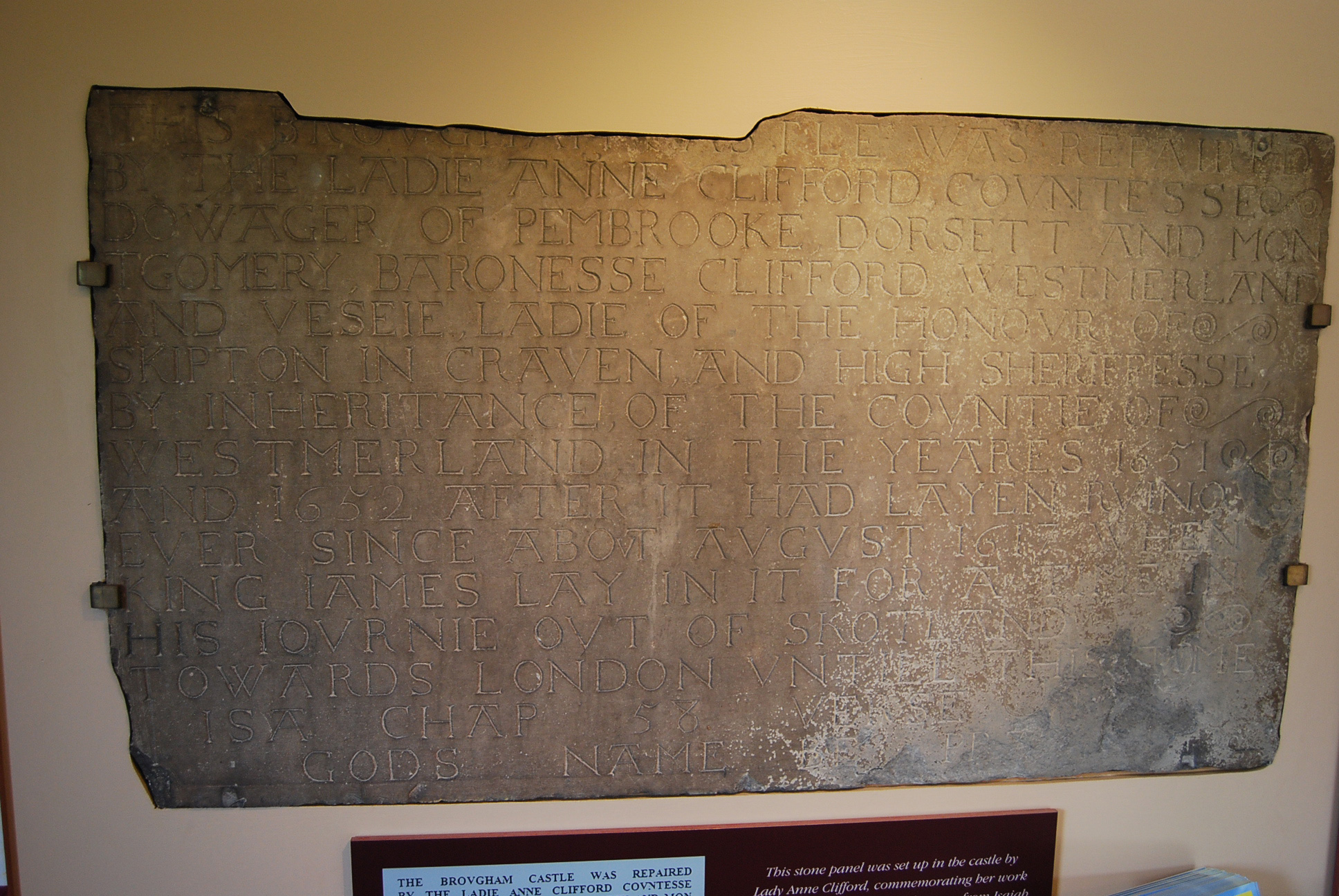
The stone panel in the exhibition at Brougham Castle that records her repairs.
Anne then turned to the castles that had been ruined or neglected. At Brougham Castle, a stone panel records that she repaired the castle in 1651 and 1652, and she later died in the room where her father had been born and her mother had died. In 1656, she put up the Countess Pillar beside the road near Brougham to mark where she and her mother had parted in 1616, and she gave 4 pounds a year to the poor of the parish, which is still handed out symbolically at the pillar on April 2nd. Brough Castle had stood empty since a fire in 1521, and she began work on it in 1659 and had it ready for a short visit the next year. At Barden Tower, she repaired the tower in 1658 and 1659 and left a stone inscription.
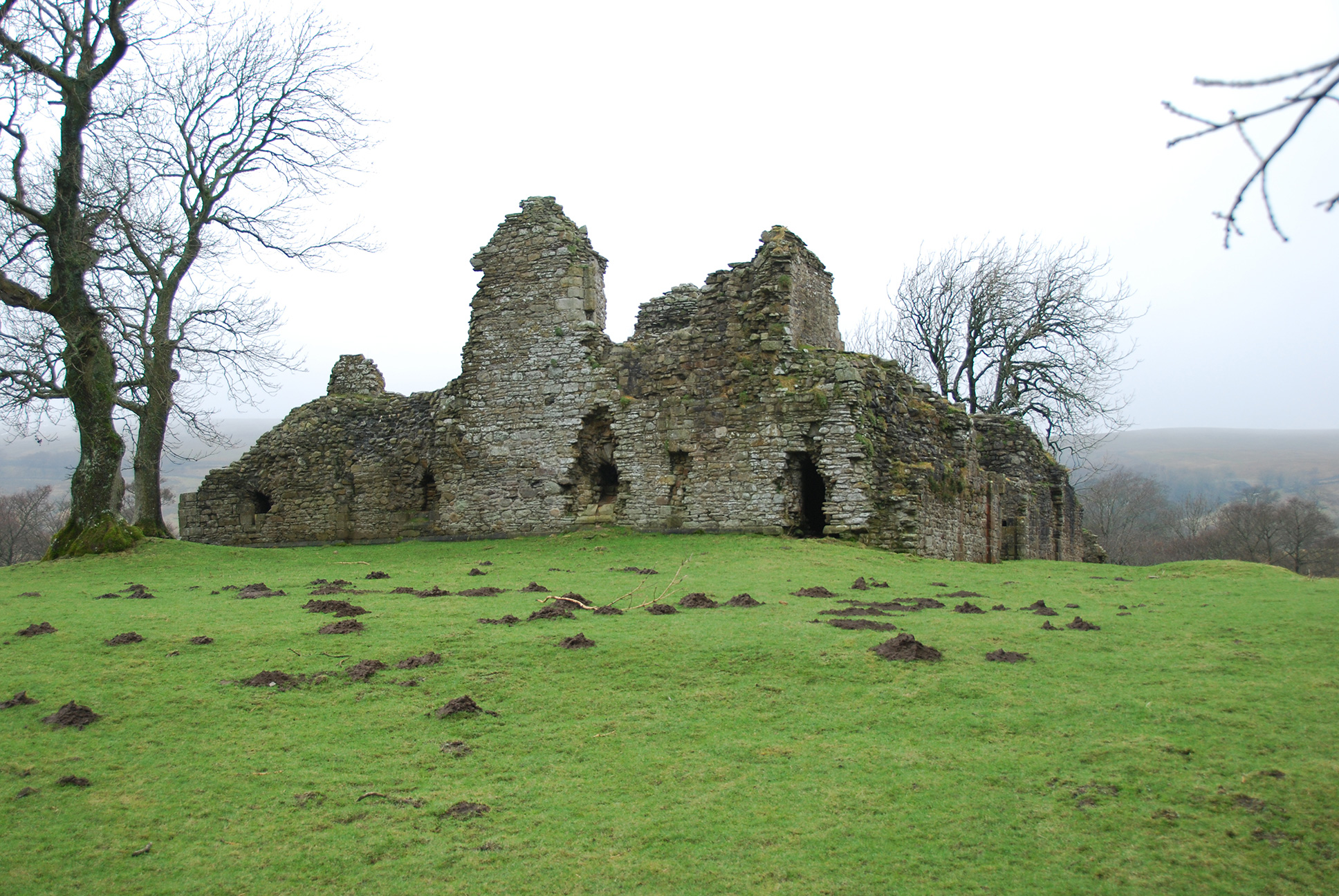
Pendragon Castle in the Mallerstang valley, which Anne rebuilt in 1660.
In 1660, Anne rebuilt Pendragon Castle in the remote Mallerstang valley and added an enclosing wall, a stable, a bakery, and a brewhouse. She restored her castles in a style that matched their original character, turning them into houses she could live in rather than fortresses, and she marked her work with inscriptions. She also restored seven churches, including those at Appleby, Brougham, Mallerstang, and Ninekirks. In the early 1650s, she founded St Anne's Hospital, an almshouse in Appleby for poor women, and at Beamsley in Yorkshire, she added the front range to the hospital her mother had founded in 1593.
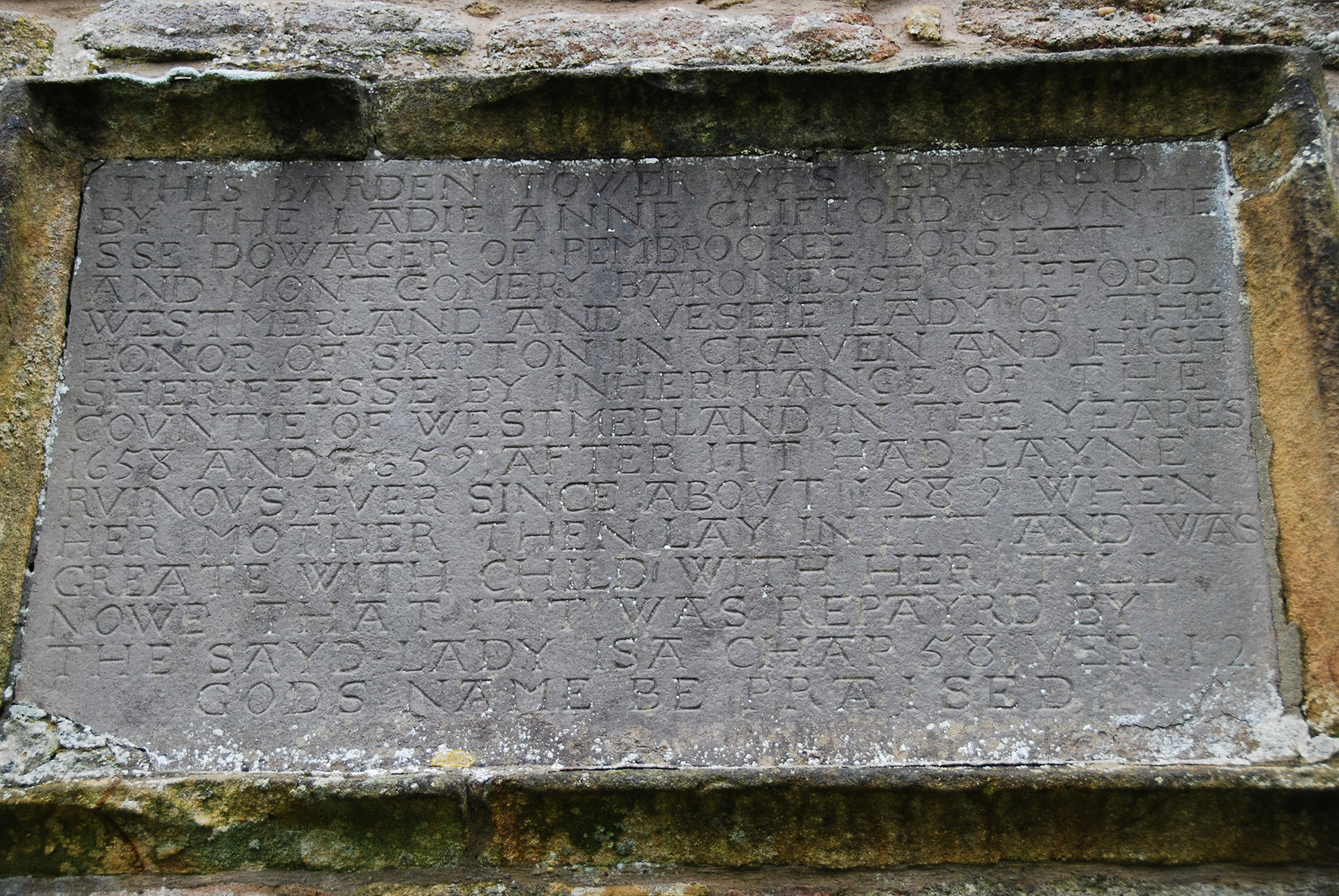
The stone inscription to Lady Anne at Barden Tower.
For the rest of her life, Anne moved between her castles with a large household, visiting tenants and friends and making sure the estates were run well. She wrote that she fell "more and more in love with the innocent pleasures of a country life." She also compiled the three volumes of her Great Books of Record, which trace the history of her family and the evidence for her claim, and her diary survives in copies. She served as High Sheriff of Westmorland from 1653, an unusual office for a woman, and she wrote her will at Pendragon Castle on May 1st, 1674.
Lady Anne died at Brougham Castle on March 22nd, 1676, at the age of 86. She was buried in the family vault in St Lawrence's Church in Appleby, and her tomb bears 24 heraldic shields of her ancestors. Her estates and the barony passed to her grandson, the Earl of Thanet, the son of her daughter Margaret. Skipton Castle's ghost stories claim that her carriage still drives up the High Street and through the castle gates to collect the spirit of the castle's owner when they die.