Skipton Castle
History
Skipton Castle stands on a rocky bluff at the head of the High Street in Skipton, North Yorkshire, above a sheer drop to the Eller Beck. Soon after 1090, Robert de Romille, a Norman baron, built a primitive fort here, but its timber ramparts did little to stop the Scots during their frequent raids on northern England.

Romille's fort was replaced by a formidable stone castle on top of the bluff, and Skipton was already recorded in the Domesday Book of 1086. After the Romille line died out, Edward II granted the castle in 1310 to Robert de Clifford, who was appointed Lord Clifford of Skipton and Guardian of Craven. The Cliffords took their name from Clifford Castle in Herefordshire, which they also owned. Robert began heavy fortification at Skipton, but he was killed at Bannockburn in 1314, when the castle was barely complete. The castle held out against the Great Raid of 1322, when the Scots swept through Yorkshire.

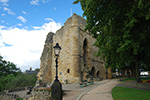
The Main Gate, with the Clifford motto, Desormais, above the arch.
Skipton remained the Cliffords' principal seat until 1676. In the Wars of the Roses, John, 9th Lord Clifford, was killed at Towton in 1461 fighting for Henry VI, and by tradition, his young son Henry was hidden away as a shepherd boy until Henry VII took the throne in 1485. The "Shepherd Lord" recovered the family estates and rebuilt Barden Tower between about 1485 and 1490. His son Henry, born at Skipton in 1493, was created Earl of Cumberland by Henry VIII on June 18th, 1525.
The 1st Earl turned the castle into a more comfortable home. He added the Long Gallery in 1536, and a new stair to the entrance replaced the old drawbridge. The building work is traditionally linked to the marriage of his son Henry to Eleanor Brandon, a niece of Henry VIII. When the Pilgrimage of Grace rose against the king in October 1536, the Earl stayed loyal and held Skipton against the rebels, who controlled much of Yorkshire. He became a Knight of the Garter in 1537.

The Main Entrance and its stair.
The 3rd Earl, George Clifford (1558-1605), was Queen Elizabeth's Champion and one of her admirals against the Spanish Armada, and his daughter, Lady Anne, was born at Skipton on January 30th, 1590. George left the estates to his brother Francis, the 4th Earl, who was born and died in the castle, and Lady Anne Clifford fought for decades to recover them. Her cousin Henry, the 5th Earl, died without a son in 1643, and the estates finally passed to her.
By then, the castle was holding out for Charles I. After the outbreak of the Civil War in 1642, Sir John Mallory held it as a Royalist stronghold. The Parliamentarians besieged it for a few weeks in early 1643, again for two weeks in August 1645, and finally in November and December 1645, when their guns battered the castle until Mallory surrendered on December 21st, 1645, and the garrison marched out with colors flying and the honors of war. The castle's own history calls it a three-year siege, and it was the last Royalist garrison in the North. Royalists returned to reoccupy the castle in 1648. The Siege of Skipton Castle has the full story.
When the Royalists were forced out again, Cromwell slighted the castle's defenses, leaving the walls and towers in ruins and stripping 44 tons of lead from the roof. About ten years after the first surrender, Lady Anne was allowed to restore it, on condition that the new roofs could not bear cannon. She worked on it through the 1650s, and in 1659, she planted a yew tree in the central courtyard to mark the castle's repair. The Cliffords held Skipton until 1676, when Lady Anne died at Brougham, the last Clifford to own it.
The Long Gallery was adapted as living quarters in the 1680s, and the rest of the castle was abandoned as a residence. The castle then passed through her daughter Margaret to the Tufton family, the Earls of Thanet, and it became the seat of Lord Hothfield in 1871. It was listed Grade I on April 28th, 1952, and in 1956, the Fattorini family bought it, and they still own it. The Clifford banner still flies over the castle with the approval of the present Lord Clifford of Chudleigh. Lady Anne's Way, a 100-mile walk to Penrith, begins here.
Castle Highlights
Skipton is one of the most complete and best preserved medieval castles in England, and it is still fully roofed. Visitors first pass through the twin-towered Main Gate, which stands in the curtain wall on the far side of the outer bailey from the castle itself. The Shell Room in the east tower of the gatehouse was made between 1626 and 1629 for Henry Clifford, the future 5th Earl of Cumberland, by a Frenchman, Isaac de Caus. It is a valuable feature, since only one other grotto like it survives in England from this period, at Woburn Abbey in Bedfordshire.

The Banqueting Hall.
The chapel also stands in the outer ward, outside the castle itself, and it dates back to the 12th century, when Alice de Romille, Lady of Skipton Castle, granted the chaplain an allowance for gowns and food, payable at Christmas. It is dedicated to St John the Evangelist and was reserved for the use of the lord and lady of the castle, their resident retainers, the castle garrison, and the farmer at Holme Farm.
Six round drum towers surround the castle itself, which visitors enter by the Main Entrance and the Norman Arch. Inside is Conduit Courtyard, a unique feature at the heart of the castle, formed by a range of domestic buildings that survive unaltered and intact from early Tudor times. The addition of the Long Gallery in 1536 is the chief reason for this, since the rest of the castle was abandoned as a residence when the gallery became living quarters. Lady Anne's yew still grows in the courtyard.

The middle floor of the Watch Tower.
The tour takes in the Fighting Chambers, the Dungeon Steps, the Wine Cellar and Beer Cellar, the Medieval Kitchen and the New Kitchen, the Muniment Tower, the Curing Room, the Banqueting Hall, the Withdrawing Room, and the Lord's Dayroom and Bedchamber. Visitors can climb from the depths of the dungeon to the top storey of the Watch Tower. The self-guided route takes up to about an hour and a half, and free illustrated tour sheets are available in ten languages.
Skipton Castle is also said to be haunted, and the ghost stories include a girl who has been photographed peering from a wall, spectral soldiers from the Civil War, and Lady Anne's phantom carriage.